
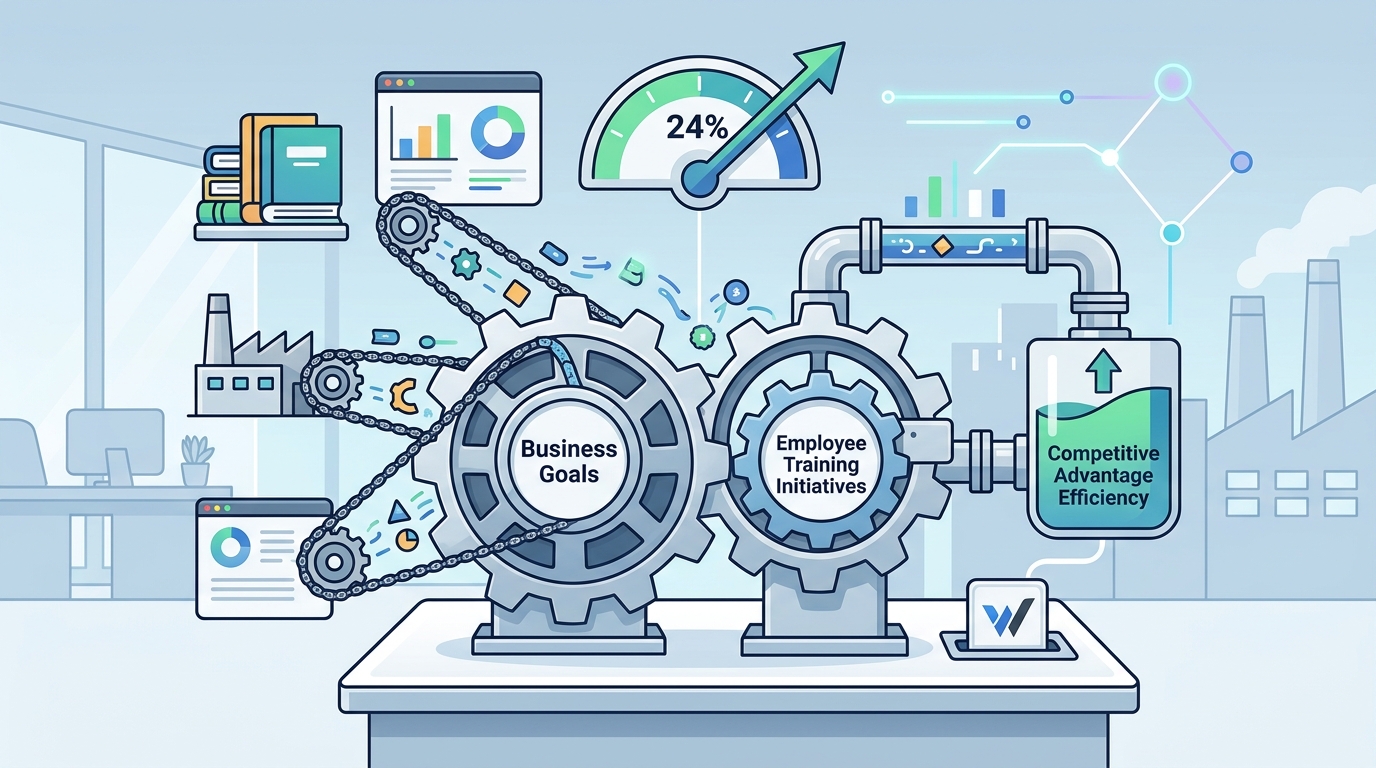
Organizations that tightly integrate learning initiatives with core operational targets see a 24% higher return on investment than those treating training as an isolated administrative task. This statistic highlights a critical shift in modern human resources. Companies can no longer afford to view employee development as a generic benefit. Instead, it must function as a direct lever for revenue growth, efficiency, and competitive advantage. When training aligns with business goals, every hour spent in a classroom or on a digital platform contributes directly to the bottom line. This guide details the precise methodology for achieving that alignment.
Step 1: Diagnose the Performance Gap
Alignment begins with a rigorous audit of current capabilities versus required outcomes. You cannot build a bridge between where your team is and where the business needs to be without a clear map. This process requires moving beyond surface-level complaints to identify root causes. Often, a performance issue is not a training deficit but a process or tool failure. However, when the gap is skill-based, targeted intervention is required.
The first phase involves stakeholder interviews with department heads. Sales leaders need different data than engineering managers. For sales, the goal might be reducing the sales cycle. For engineering, it might be reducing technical debt. Training is the systematic process of facilitating the acquisition of knowledge, skills, and competencies. By defining these specific needs, you prevent the common pitfall of "training for training's sake." This approach ensures that every module developed serves a distinct business purpose.
According to recent industry analyses, companies that conduct thorough needs assessments before launching programs reduce wasted budget by up to 30%. This data shows that precision in the diagnostic phase is the strongest predictor of subsequent success. Without this clarity, even the most expensive learning management systems will fail to deliver value.
Step 2: Design Goal-Driven Curriculum
Once the gaps are identified, the curriculum must be engineered to close them. This step requires translating business objectives into learning objectives. If the business goal is to increase customer retention, the learning objective might be "mastering advanced conflict resolution techniques." This direct translation ensures that the content is relevant and actionable.
Effective curriculum design also considers the adult learning principles. Adults need to know why they are learning something before they engage with the material. They need immediate applicability. Therefore, the content should be modular and just-in-time. Employees should be able to access the specific information they need at the moment of need, rather than sitting through a week-long seminar on a topic they may not use for months.
Furthermore, the design must account for different learning styles and roles. A one-size-fits-all approach rarely works in diverse organizations. By segmenting the audience, you can tailor the depth and breadth of the training. This segmentation allows for more efficient resource allocation. It also increases engagement because the content feels personally relevant to the learner's daily challenges.
Step 3: Implement Scalable Learning Methods
Implementation is where strategy meets execution. The method of delivery must support the learning objectives and the business context. Traditional classroom training is no longer the default for every scenario. Digital learning platforms offer scalability and consistency that physical classrooms cannot match.
Blended learning models often yield the best results. This approach combines self-paced online modules with live workshops for practice and feedback. The online component handles knowledge transfer, while the live sessions focus on application and problem-solving. This structure maximizes the value of expensive instructor time. It also allows employees to learn at their own pace, reducing disruption to daily workflows.
Scalability is another critical factor. As the organization grows, the training program must expand without losing quality. Automated onboarding sequences and standardized compliance modules are essential for this. They ensure that every new hire receives the same foundational knowledge, regardless of their location or start date. This consistency is vital for maintaining brand integrity and operational standards across a distributed workforce.
Research indicates that organizations using blended learning approaches see a 25% increase in knowledge retention compared to lecture-only methods. This ranking highlights the importance of active engagement in the learning process. Passive consumption of information is rarely sufficient for long-term behavior change.
Step 4: Measure Impact and ROI
The final and most critical step is measurement. If you cannot prove the value of training, it will be the first budget cut during lean times. Measurement must go beyond simple completion rates. Did the employee finish the course? That is a vanity metric. The real question is: Did their performance improve?
Use the Kirkpatrick Model as a framework for evaluation. Level 1 measures reaction. Level 2 measures learning. Level 3 measures behavior. Level 4 measures results. Focusing on Level 3 and 4 ensures that you are tracking actual business impact. For example, did the sales training lead to a measurable increase in closed deals? Did the safety training reduce incident rates?
Calculating ROI requires comparing the monetary benefits of the training to its costs. This includes direct costs like platform fees and instructor salaries, as well as indirect costs like employee time away from work. The formula is straightforward: (Benefits - Costs) / Costs. A positive ROI demonstrates that the training is an investment, not an expense.
According to data from the Association for Talent Development, companies that measure training effectiveness are 46% more likely to receive executive support for future initiatives. This statistic underscores the political and strategic importance of data-driven reporting. Leaders need proof of value to justify continued funding.
Training Model Comparison
Understanding the different approaches to alignment helps in selecting the right strategy for your specific context. The table below outlines the key characteristics of common training models.
| Training Model | Best For | Alignment Strength | Scalability |
|---|---|---|---|
| Traditional Classroom | High-touch soft skills, team building | Medium | Low |
| Self-Paced E-Learning | Compliance, technical knowledge transfer | High | High |
| Blended Learning | Complex skill acquisition, behavior change | Very High | Medium |
| Mentorship Programs | Leadership development, cultural integration | High | Low |
Key Takeaways
- Strategic Alignment: Training must directly address specific business gaps identified through rigorous needs assessment.
- ROI Measurement: Focus on Level 3 and 4 Kirkpatrick metrics to prove tangible business impact to stakeholders.
- Blended Approaches: Combining digital and live learning increases retention and accommodates diverse learning styles.
- Scalability: Automated and modular content ensures consistent delivery as the organization grows.
- Data-Driven Decisions: Using metrics to justify budget increases executive support and funding stability.
- Adult Learning Principles: Content must be relevant, immediate, and applicable to adult learners to be effective.
- Continuous Improvement: Training is not a one-time event but an ongoing cycle of assessment and refinement.
Frequently Asked Questions
How do I prove training ROI to executives?
Calculate the monetary value of the performance improvement and subtract the total cost of the training program. Present this data alongside industry benchmarks to contextualize your results.
What is the difference between training and development?
Training focuses on immediate job skills and current performance gaps. Development focuses on long-term career growth and future leadership capabilities. Both are essential for holistic alignment.
How often should training programs be updated?
Training content should be reviewed at least annually. However, if there are significant changes in technology, regulation, or business strategy, updates should be immediate.
Can small businesses afford formal training programs?
Yes. Small businesses can leverage low-cost digital platforms and mentorship programs to achieve alignment without the overhead of large-scale corporate training departments.
What role does leadership play in training alignment?
Leadership must champion the initiative, participate in the learning, and reinforce the new behaviors. Without active leadership support, training initiatives often fail to gain traction.
How do you handle resistance to new training?
Communicate the "why" clearly. Show employees how the training will make their jobs easier or more rewarding. Involve them in the design process to increase buy-in.
What metrics are most important for tracking success?
Focus on behavior change and business results. Completion rates are secondary. Look for increases in productivity, quality, sales, or customer satisfaction.
Start Your Strategic Training Journey
Aligning employee training with business goals is not just an HR function. It is a core business strategy that drives growth and efficiency. By following the steps outlined in this guide, you can transform your training program from a cost center into a profit center. The Wise Skill specializes in recruiting and training solutions that finally work. We help organizations build the precise capabilities they need to succeed. Visit our About page to learn more about our methodology. Schedule a demo today to see how our platform can streamline your training alignment. Explore our blog for more insights on workforce development. Review our Frequently Asked Questions for common concerns. Check our Legal and Privacy pages for compliance details. Take the first step toward a more aligned and effective workforce.