
Organizations that fail to map their internal capabilities against market demands face significant operational risks. According to recent industry analysis, nearly 60% of companies struggle to identify critical skill shortages before they impact productivity. This data shows that proactive skills intelligence is no longer optional but a strategic imperative for sustainable growth. Without a clear view of what your team knows versus what the business needs, you risk stagnation and increased turnover. This guide outlines the precise methodology for uncovering these hidden gaps and aligning your human capital with future objectives.
Defining Skills Intelligence
Before you can identify gaps, you must understand the tool used to measure them. Skills intelligence is the systematic collection and analysis of data regarding the abilities, competencies, and potential of your workforce. It moves beyond traditional job titles to focus on the actual tasks employees can perform. This approach allows organizations to see the fluid nature of work rather than static roles.
Traditional human resources models often rely on resumes and annual reviews. These methods are outdated and fail to capture real-time proficiency. Skills intelligence provides a dynamic map of your internal talent pool. It reveals who can lead a project, who needs training, and who is ready for promotion. By establishing this baseline, you create a factual foundation for all future hiring and development decisions.
Understanding this concept is the first step toward operational excellence. It transforms HR from an administrative function into a strategic partner. For more insights on building a resilient workforce, explore our blog resources on modern recruitment strategies.
Auditing Current Capabilities
The most effective way to find a gap is to measure the current state accurately. An internal audit requires you to look past job descriptions and assess actual performance. This process involves gathering data from multiple sources to create a holistic view of employee skills.
Self-Assessment and Peer Reviews
Start by asking employees to rate their own proficiency in key areas. While self-assessment can be biased, it provides valuable insight into employee confidence and perceived competence. Combine this with peer reviews to add objectivity. Colleagues often see technical nuances that managers might miss. This multi-source feedback loop creates a more accurate picture of daily operations.
Performance Data Analysis
Look at historical performance metrics. High performers in one area may struggle in another. Analyze project outcomes, code quality, sales figures, or customer satisfaction scores. These hard metrics serve as proof of skill application. They validate whether an employee can translate knowledge into results. This data is crucial for distinguishing between theoretical knowledge and practical ability.
For a deeper dive into effective training methodologies, visit our about page to learn how we approach workforce development.
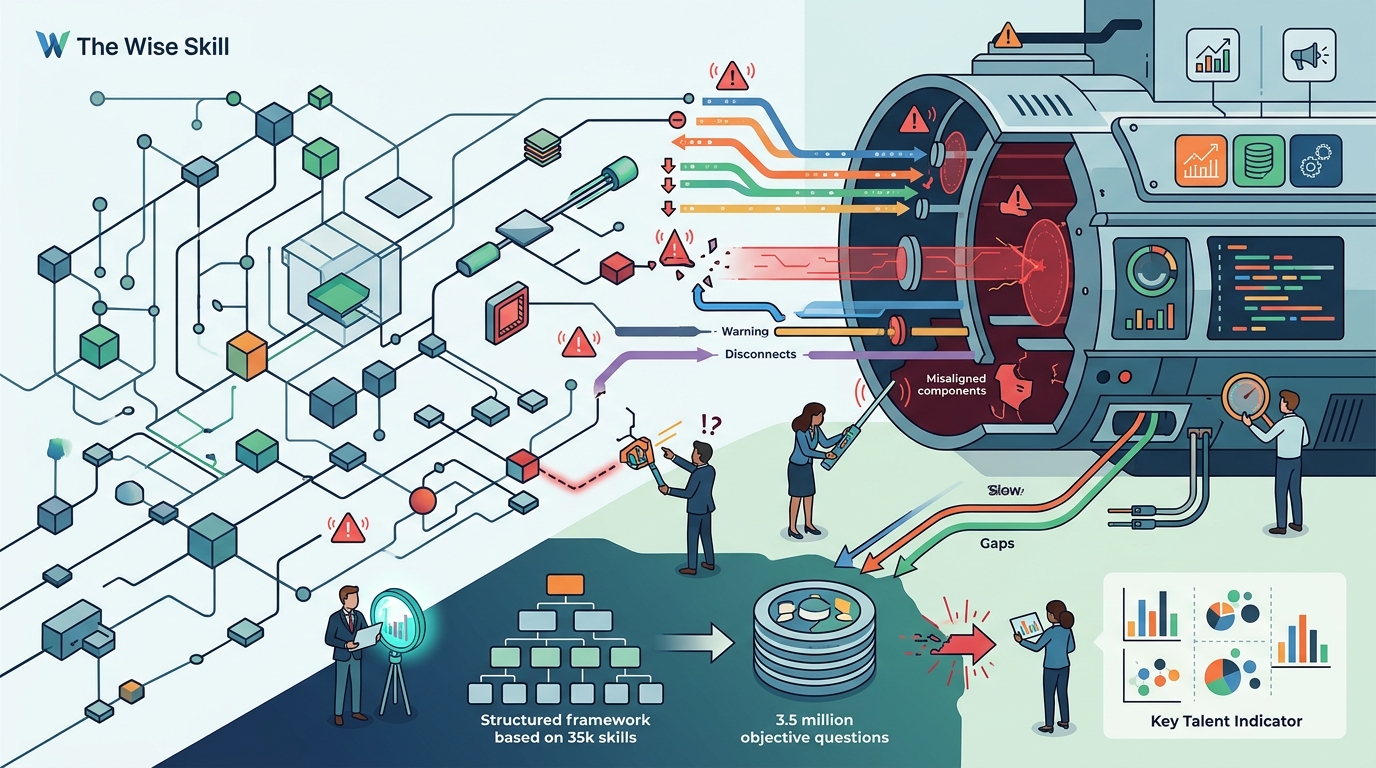
Benchmarking Against Market Needs
Once you know what you have, you must determine what you need. This requires external benchmarking against industry standards and future trends. A skills gap is not just a current deficiency; it is a future risk if left unaddressed.
Industry Trend Analysis
Research emerging technologies and methodologies in your sector. For example, the shift toward AI-driven analytics has changed the requirements for data roles significantly. According to recent workforce reports, demand for AI literacy has grown by over 300% in the last five years. You must compare your team's current AI proficiency against this rising standard. If your team lacks these skills, you are falling behind competitors who are adopting them.
Competitor Talent Mapping
Study the job postings of your top competitors. What skills are they prioritizing? If multiple competitors are hiring for specific certifications or software expertise, that skill is likely becoming a baseline requirement. Ignoring these signals means you will face a talent shortage when you finally need to hire. Proactive benchmarking allows you to upskill your current staff before the market tightens.
For authoritative data on workforce trends, refer to the SHRM workforce trends report.
Leveraging Technology for Data
Manual audits are time-consuming and prone to error. Modern skills intelligence relies on technology to scale the process. Software platforms can aggregate data from HR systems, project management tools, and learning management systems.
Automated Skill Mapping
Use AI-driven tools to scan resumes, LinkedIn profiles, and internal project histories. These tools can automatically tag employees with relevant skills based on their work history. This creates a living database of your talent. It updates in real-time as employees complete courses or finish new projects. This automation reduces the administrative burden on HR teams.
Predictive Analytics
Advanced platforms offer predictive capabilities. They can forecast future skill gaps based on your business strategy. If you plan to expand into a new market, the software can identify which current employees have the potential to lead that expansion. This predictive power turns skills intelligence into a strategic asset. It allows you to build pipelines for critical roles before vacancies occur.
To see how technology can streamline your recruitment and training, schedule a demo of our platform.
Strategic Alignment and Action
Identifying the gap is only half the battle. You must close it through targeted action. This involves creating a roadmap for upskilling, reskilling, or hiring.
Upskilling vs. Reskilling
Upskilling involves teaching current employees new skills related to their existing roles. Reskilling prepares employees for entirely different roles within the company. Use your skills data to decide which approach is best. If an employee has strong foundational skills, upskilling is often more cost-effective. If their current role is becoming obsolete, reskilling may be the only viable option.
Targeted Hiring Strategies
For gaps that cannot be filled internally, adjust your hiring strategy. Focus on hiring for potential and cultural add rather than just exact skill matches. You can teach specific software, but you cannot easily teach adaptability. Use your skills intelligence data to write more precise job descriptions. This attracts candidates who truly fit the future needs of the role.
For more information on our recruitment services, check our services page.
Key Takeaways
- Skills intelligence provides a dynamic map of employee capabilities beyond static job titles.
- Internal audits must combine self-assessment, peer reviews, and hard performance metrics.
- External benchmarking against industry trends reveals future skill requirements.
- Technology enables real-time skill mapping and predictive gap analysis.
- Closing gaps requires a mix of upskilling, reskilling, and targeted hiring.
- Proactive skills management reduces turnover and operational risk.
- Data-driven decisions outperform intuition in workforce planning.
Frequently Asked Questions
What is the difference between skills auditing and performance reviews?
Performance reviews evaluate past behavior and goal achievement. Skills auditing maps current capabilities and potential for future tasks. Auditing is forward-looking and data-driven, while reviews are often retrospective and subjective.
How often should a company conduct a skills gap analysis?
Companies should conduct a formal analysis annually. However, informal checks should happen quarterly or after major strategic shifts. The pace of technological change requires more frequent updates to stay relevant.
Can small businesses afford skills intelligence tools?
Yes, many scalable solutions exist for small businesses. Cloud-based platforms offer tiered pricing that fits smaller budgets. The cost of inaction, such as bad hires or missed opportunities, far exceeds the cost of the software.
What is the most common skills gap in modern workplaces?
Digital literacy and adaptability are the most common gaps. As automation increases, the ability to learn new tools quickly becomes the primary differentiator among employees.
How do you measure the ROI of closing a skills gap?
Measure ROI through increased productivity, reduced error rates, and faster project completion times. Compare these metrics before and after the training or hiring intervention.
Is self-assessment reliable for skills mapping?
Self-assessment alone is not reliable due to bias. It must be validated by peer reviews, manager assessments, and objective performance data to be accurate.
What role does leadership play in skills intelligence?
Leadership must define the future skills needed for the business strategy. They must also champion the culture of continuous learning required to close the identified gaps.
Ready to Optimize Your Workforce?
Identifying skills gaps is the first step toward building a resilient, future-ready organization. Don't let hidden deficiencies hold your team back. Partner with experts who understand the nuances of modern workforce development. Visit thewiseskill.com to start your journey toward strategic talent alignment. Book a demo today to see how our solutions can transform your HR strategy.