
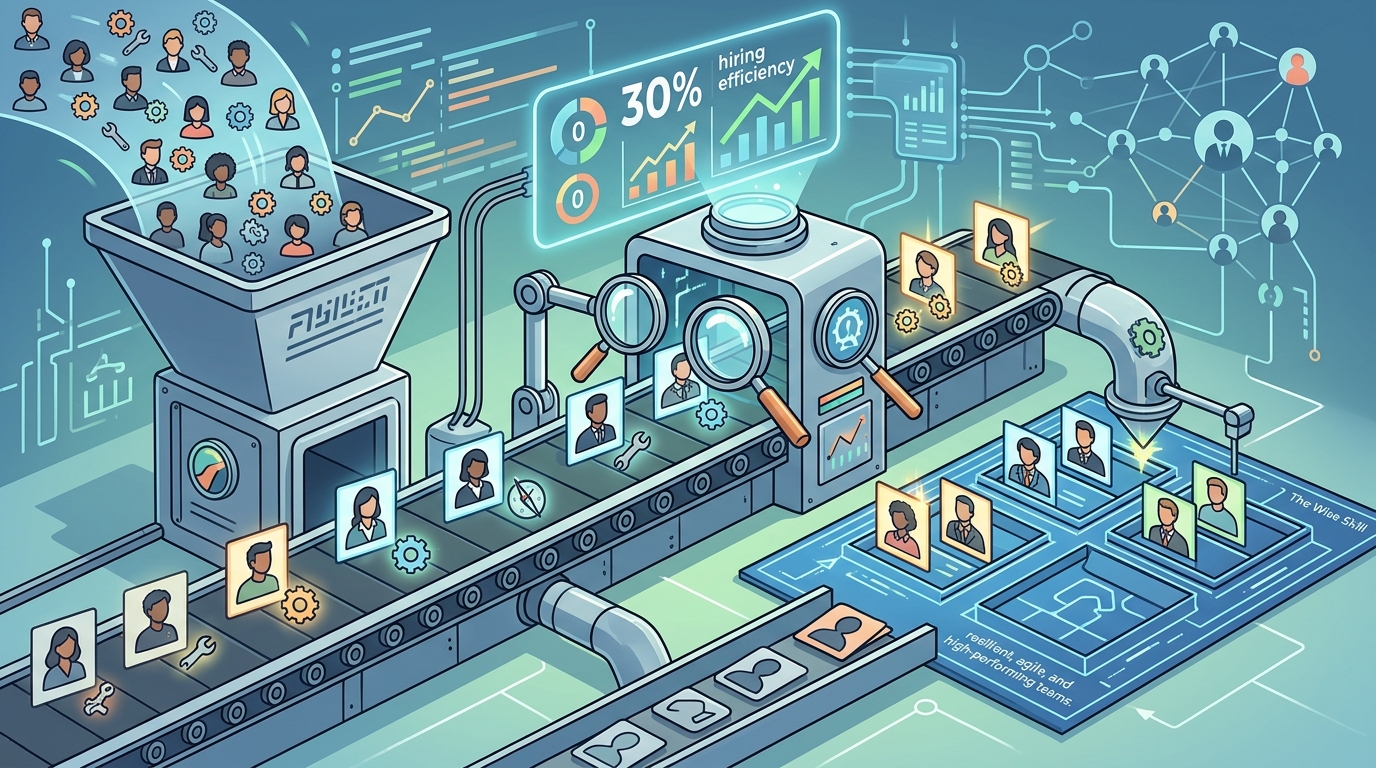
The global labor market is undergoing a fundamental structural shift. According to recent workforce analysis, organizations that adopt skills-based hiring practices report a 30% increase in hiring efficiency compared to traditional credential-focused methods. This transition is not merely a trend but a necessary evolution for companies seeking to build resilient, agile, and high-performing teams in an increasingly complex economic landscape. The core driver is the ability to match talent to tasks based on demonstrable capability rather than historical pedigree. (The Wise Skill Recruiting)
Defining the Skills-Based Framework
To understand the benefits, we must first establish a clear operational definition. Skills-based hiring is a recruitment methodology that prioritizes the specific abilities, knowledge, and competencies required to perform a job over traditional credentials such as degrees or years of experience. This approach fundamentally decouples talent acquisition from institutional gatekeepers. (The Wise Skill Recruiting)
Traditional hiring models often rely on degree filters and pedigree bias. These filters automatically exclude qualified candidates who may have acquired the necessary skills through alternative pathways, such as self-study, bootcamps, or non-linear career transitions. By removing these arbitrary barriers, organizations can access a wider array of high-potential individuals who possess the exact technical or soft skills needed for success.
The Wise Skill operates on the principle that recruiting and training must be aligned with actual job requirements. This alignment ensures that every hire contributes immediately to organizational goals. When the focus shifts to what a candidate can do, rather than where they studied, the hiring process becomes more objective and data-driven.
Expanding the Talent Pool
One of the most immediate benefits of adopting a skills-based framework is the dramatic expansion of the available talent pool. Traditional hiring criteria often restrict candidates to a narrow demographic that fits specific educational or geographic profiles. By focusing on skills, you open your organization to candidates from non-traditional backgrounds, including career changers, veterans, and self-taught professionals.
This expansion is critical in tight labor markets where the supply of traditional candidates is insufficient. According to industry data, skills-based hiring can increase the size of the eligible talent pool by up to 300% for certain technical roles. This increased volume allows recruiters to be more selective, choosing the best fit based on capability rather than settling for the first qualified candidate.
Furthermore, this approach supports remote work strategies by removing geographic constraints. When skills are the primary metric, location becomes secondary to capability. This allows organizations to tap into global talent markets, accessing specialized expertise that may not be available locally. The result is a more robust and flexible workforce capable of adapting to changing business needs.
Driving Diversity and Inclusion
Skills-based hiring is a powerful lever for advancing diversity, equity, and inclusion (DEI) initiatives. Traditional hiring processes are often rife with unconscious bias, where recruiters favor candidates who share their background or educational history. This homophily reinforces existing inequalities and limits the diversity of thought within an organization.
By standardizing the evaluation of skills, organizations can reduce the impact of unconscious bias. When candidates are assessed on their ability to perform specific tasks, the focus shifts to objective performance metrics rather than subjective impressions. This creates a more level playing field for underrepresented groups who may have been historically excluded from traditional career pathways.
Research indicates that diverse teams outperform homogeneous ones in innovation and problem-solving. By broadening the recruitment net, companies can build teams with varied perspectives and experiences. This diversity drives better decision-making and fosters a more inclusive culture. The Wise Skill emphasizes that recruiting and training that finally work must be rooted in fairness and objective assessment.
Boosting Retention and Engagement
Hiring for skills rather than credentials often leads to higher employee retention and engagement. When candidates are hired based on their actual capabilities, there is a better alignment between their skills and the job requirements. This reduces the likelihood of role mismatch, which is a common cause of early turnover.
Additionally, skills-based organizations often provide clearer pathways for internal mobility. Employees can demonstrate their skills for new roles without needing additional formal education. This transparency fosters a culture of continuous learning and professional growth. Employees feel valued for their contributions and see a clear future within the company.
Engagement is also boosted by the sense of autonomy and mastery that comes from working in a role that matches one's strengths. When individuals are placed in positions where they can excel, job satisfaction increases. This leads to lower absenteeism, higher productivity, and a more positive organizational culture. The long-term cost savings from reduced turnover are significant and contribute directly to the bottom line.
Cost Efficiency and ROI
The financial benefits of skills-based hiring are substantial. Traditional hiring processes are often lengthy and expensive, involving multiple rounds of interviews, background checks, and credential verification. By focusing on skills assessments, organizations can streamline the hiring process and reduce time-to-hire.
Reduced time-to-hire translates directly to lower recruitment costs. It also minimizes the opportunity cost of vacant positions, allowing teams to remain productive and meet business deadlines. Furthermore, hiring for skills can reduce the need for extensive onboarding and training, as candidates already possess the necessary competencies.
According to economic analyses, the return on investment for skills-based hiring is positive due to these efficiency gains. The initial investment in developing robust skills assessment frameworks is offset by the long-term savings in recruitment, training, and turnover. Companies that adopt this framework often see a measurable improvement in their overall operational efficiency.
Framework Comparison
To illustrate the differences between traditional and skills-based approaches, consider the following comparison of key operational metrics.
| Criteria | Traditional Hiring | Skills-Based Hiring |
|---|---|---|
| Primary Filter | Degree and Pedigree | Demonstrable Competency |
| Talent Pool Size | Restricted | Expanded (up to 300%) |
| Bias Mitigation | Low | High |
| Time-to-Hire | Longer | Shorter |
| Internal Mobility | Complex | Transparent |
Key Takeaways
- Expanded Talent Access: Skills-based hiring can increase the eligible talent pool by up to 300%, allowing for more selective and high-quality hires.
- Enhanced Diversity: Removing degree requirements reduces unconscious bias and promotes a more inclusive workforce.
- Improved Retention: Better alignment between candidate skills and job requirements leads to higher job satisfaction and lower turnover.
- Cost Reduction: Streamlined hiring processes and reduced training needs result in significant cost savings and higher ROI.
- Agility: Organizations can adapt more quickly to market changes by hiring for specific, in-demand skills rather than general credentials.
- Objective Assessment: Focus on demonstrable abilities creates a fairer and more transparent hiring process.
- Strategic Alignment: Hiring for skills ensures that every new hire contributes directly to organizational goals and capabilities.
Frequently Asked Questions
What is the primary difference between skills-based hiring and traditional hiring?
Traditional hiring relies heavily on degrees, certifications, and years of experience as primary filters. Skills-based hiring focuses on the specific abilities and competencies required to perform the job, regardless of how those skills were acquired.
How does skills-based hiring improve diversity?
It removes barriers related to educational background and pedigree, allowing candidates from non-traditional paths, such as bootcamps or self-study, to compete on equal footing. This reduces unconscious bias and broadens the demographic range of applicants.
Is skills-based hiring suitable for all job roles?
While it is highly effective for technical and operational roles, it can be adapted for any position by clearly defining the core competencies required. However, roles requiring specific licensed credentials, such as medicine or law, may still need formal qualification checks.
What are the costs associated with implementing a skills-based framework?
Initial costs include developing assessment tools and training recruiters. However, these are offset by long-term savings in recruitment time, reduced turnover, and lower training expenses. The net result is often a positive return on investment.
How do I measure the success of a skills-based hiring program?
Key metrics include time-to-hire, quality of hire, retention rates, and diversity statistics. Tracking these indicators over time will demonstrate the effectiveness of the new framework.
Can skills-based hiring replace all traditional hiring methods?
It does not necessarily replace all methods but rather augments them. For example, background checks and credential verification may still be necessary for compliance, but the primary decision-making factor shifts to skills assessment.
What role does technology play in skills-based hiring?
Technology enables the scalable assessment of skills through automated testing, AI-driven matching, and data analytics. It helps ensure consistency and objectivity in the evaluation process.
Next Steps
Transforming your organization's hiring strategy requires a deliberate and structured approach. The Wise Skill provides the expertise and tools necessary to implement a successful skills-based framework. We specialize in recruiting and training solutions that align talent with organizational needs. To learn more about how we can help your company thrive, visit our About page or schedule a demo today. Explore our blog for more insights on modern hiring practices.