
How to Integrate Skills Intelligence Into Your Existing HR Stack
Organizations that fail to map their internal talent capabilities are losing ground to competitors who do. According to recent workforce analytics, companies with mature skills-based operating models report a 30% faster time-to-fill for critical roles compared to traditional hierarchy-driven firms. This gap is not closing by accident. It is the result of deliberate data architecture and strategic tool deployment. Integrating skills intelligence into your current Human Resources Information System (HRIS) is no longer a luxury. It is a structural necessity for modern workforce planning.
Understanding Skills Intelligence
Before touching any code or configuration settings, you must define what skills intelligence actually means for your organization. Skills intelligence is the systematic collection, analysis, and application of data regarding the capabilities, competencies, and potential of your workforce. It moves beyond job titles and resumes to create a dynamic map of what your employees can actually do.
This approach relies on real-time data ingestion from multiple sources. It includes performance reviews, project histories, learning management system (LMS) completions, and even internal collaboration tools. The goal is to create a single source of truth that connects talent supply with business demand. Without this clarity, your HR systems remain static repositories of history rather than active engines for growth.
Traditional HR systems are built around roles. Skills intelligence is built around people. This shift requires a fundamental rethinking of how data flows between your applicant tracking system, your performance management tool, and your core HRIS. The integration process is technical, but the strategic implications are profound.
Audit Your Existing Data Foundation
You cannot integrate what you cannot see. The first step in any successful skills intelligence deployment is a rigorous audit of your current data landscape. Most organizations suffer from data silos. Your recruitment data lives in one platform. Your learning data in another. Your performance data in a third. None of these systems speak the same language natively.
Start by mapping your data sources. Identify which systems hold the most accurate and up-to-date information about employee capabilities. Look for gaps in your current taxonomy. Are you using standardized skill labels, or does every department use its own terminology? Standardization is critical for successful integration. If your engineering team calls a skill "Python" and your marketing team calls it "Scripting," your system will fail to recognize the overlap.
Create a unified skills taxonomy. This is a controlled vocabulary that defines every skill your organization values. It should include hard skills, soft skills, and emerging competencies. This taxonomy becomes the bridge between your existing HR systems and your new skills intelligence layer. Without it, you are building on sand. For a deeper look at how to structure this taxonomy, review our blog resources on workforce strategy.
Integration Methods and APIs
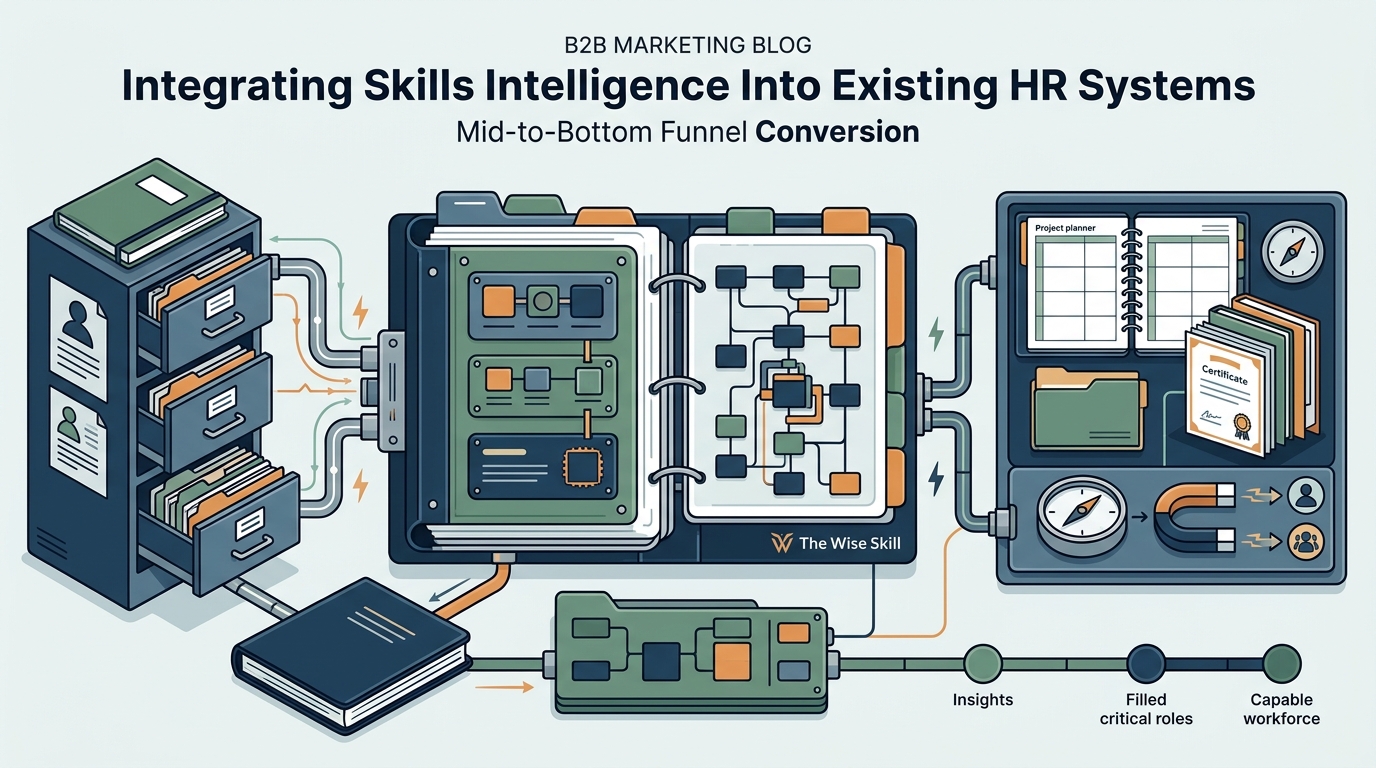
Once your data foundation is solid, you must choose your integration architecture. There are three primary methods for connecting skills intelligence to your HR stack. Each has distinct advantages depending on your technical maturity and budget.
1. Native API Integrations
Most modern HR platforms offer robust Application Programming Interfaces (APIs). These allow you to push and pull data in real-time. For example, you can configure your LMS to automatically update an employee's profile in your HRIS when they complete a certification. This method provides the highest level of accuracy and immediacy. However, it requires significant engineering resources to maintain and monitor.
2. Middleware and iPaaS Solutions
Integration Platform as a Service (iPaaS) tools act as translators between your disparate systems. They handle the heavy lifting of data mapping and error handling. This is often the most scalable solution for mid-to-large enterprises. It reduces the burden on your internal IT team while ensuring data consistency across all platforms. If you are struggling with complex data flows, consider exploring demo options for streamlined integration to see how middleware can simplify your workflow.
3. Manual Data Imports
For smaller organizations or those with limited technical resources, manual imports via CSV or Excel may be the starting point. While less ideal, it is a valid entry point. The key is to automate this process as soon as possible. Manual data entry is prone to error and quickly becomes outdated. It cannot support the real-time decision-making that skills intelligence promises.
Regardless of the method, ensure that your integration respects data privacy regulations. Skills data is sensitive personal information. You must have clear consent mechanisms and secure data transfer protocols in place. Consult your legal team and review the legal guidelines for data handling compliance.
Change Management and Adoption
Technology is only half the battle. The other half is people. Employees are often skeptical of skills mapping. They fear it will be used to monitor their every move or to justify layoffs. You must address these concerns head-on. Transparency is your best tool.
Communicate the benefits clearly. Skills intelligence is not about surveillance. It is about empowerment. It helps employees identify gaps in their own knowledge and find internal opportunities for growth. It makes career paths visible and achievable. When employees see how skills data benefits them, adoption rates skyrocket.
Train your HR business partners. They are the frontline advocates for this new system. They need to understand how to interpret the data and how to guide managers in using it for talent decisions. Provide them with clear playbooks and case studies. Show them how skills intelligence has helped other teams fill roles faster and reduce turnover.
Also, consider the manager's perspective. Managers are often overwhelmed by administrative tasks. Skills intelligence should make their lives easier, not harder. It should help them build balanced teams and identify high-potential employees quickly. If the system adds friction to their daily workflow, they will bypass it. Ensure the user experience is intuitive and actionable.
Measuring ROI and Success
To justify the investment in skills intelligence, you must track specific metrics. Vague claims of "better talent management" are not enough. You need hard data. Here are the key performance indicators (KPIs) that matter.
| Metric | Definition | Target Improvement |
|---|---|---|
| Time-to-Fill | Days from job opening to offer acceptance | 20% reduction |
| Internal Mobility Rate | Percentage of roles filled internally | 15% increase |
| Skill Gap Closure | Time to upskill employees for critical roles | 30% faster |
| Employee Retention | Year-over-year retention rate | 10% increase |
Track these metrics before and after integration. Establish a baseline. Then monitor progress quarterly. Use this data to refine your skills taxonomy and improve your integration processes. Continuous improvement is the hallmark of a successful skills strategy. For more insights on tracking these metrics, visit our FAQ section on performance tracking.
Key Takeaways
- Define Your Taxonomy First: A standardized skills vocabulary is the foundation of all successful integration efforts.
- Audit Your Data Silos: Identify where your capability data lives and how it flows between systems before connecting them.
- Choose the Right Architecture: Use APIs for real-time needs and middleware for complex, multi-system environments.
- Prioritize Employee Trust: Frame skills intelligence as a tool for career growth, not surveillance, to drive adoption.
- Measure Hard Metrics: Track time-to-fill, internal mobility, and skill gap closure to prove ROI.
- Ensure Compliance: Always align data collection with privacy laws and internal governance policies.
- Iterate Continuously: Skills are dynamic. Your system and taxonomy must evolve with the business.
Frequently Asked Questions
How long does it take to integrate skills intelligence?
Integration timelines vary based on complexity. Simple API connections can take weeks. Full-scale enterprise deployments with custom taxonomy development often take three to six months. Start with a pilot program to test the waters.
Do I need to replace my existing HRIS?
No. Skills intelligence is designed to layer on top of your existing stack. It enhances your current systems rather than replacing them. This reduces disruption and cost.
How do I handle outdated skills data?
Implement automated refresh cycles. Require employees to update their profiles quarterly. Link skill validation to project completions and learning achievements to keep data current.
Is skills intelligence suitable for small businesses?
Yes. While the technology is robust, the principles apply to organizations of all sizes. Start small with a core set of critical skills and expand as you grow.
What is the biggest risk in implementation?
The biggest risk is poor data quality. Garbage in, garbage out. If your initial data is inaccurate, the entire system will fail to provide value. Invest heavily in the audit phase.
How do I ensure data privacy?
Use role-based access controls. Only allow managers and HR partners to view specific data. Anonymize data for aggregate reporting. Follow GDPR and local privacy regulations strictly.
Can skills intelligence predict future hiring needs?
Yes. By analyzing current skill gaps and business strategy, you can forecast future talent requirements. This allows for proactive recruitment and upskilling rather than reactive hiring.
Ready to Transform Your Workforce?
Integrating skills intelligence is a journey, not a destination. It requires commitment, clarity, and the right partners. The Wise Skill is here to guide you through every step of this process. From defining your taxonomy to executing your integration, we provide the expertise you need to build a future-ready workforce.
Do not let your talent data remain hidden in silos. Unlock the full potential of your organization today. Schedule a demo to see how our solutions can streamline your HR operations and drive measurable growth.