
Creating an effective skills map requires translating business strategy into specific role requirements, measuring actual employee capabilities, and identifying gaps. The Wise Skill automates this process by reconstructing your organizational structure and mapping skills against a taxonomy of over 35,000 competencies. This approach replaces intuition with data-driven visibility into your talent pipeline.
Aligning Skills with Business Strategy
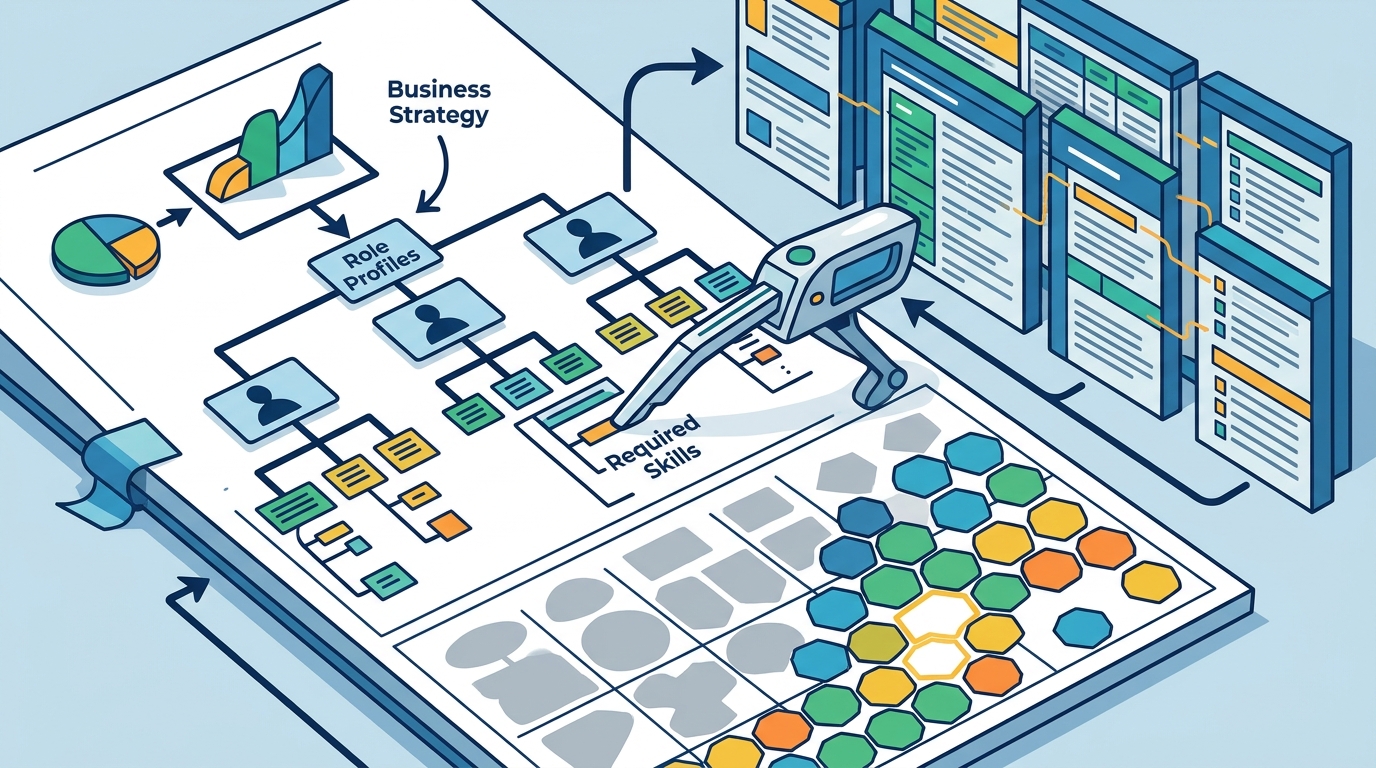
Organizations often fail because they map skills in isolation from their strategic roadmap. For example, a company planning to expand into AI-driven services must identify specific machine learning and data engineering skills before assessing its current workforce. The Wise Skill platform helps you translate high-level strategy into concrete role requirements, ensuring that every mapped skill has a clear business justification.
Building a Scalable Skills Taxonomy
A skills taxonomy is a standardized classification system that organizes competencies into a hierarchical structure. Using a consistent taxonomy is critical for comparing skills across different departments and roles. Without it, you risk creating silos where similar skills are named differently in different teams. For additional details, review the Aviso legal The Wise.
Building a taxonomy from scratch is time-consuming and often incomplete. The Wise Skill utilizes a macro taxonomy containing more than 35,000 skills, which allows for granular assessment without the overhead of manual curation. This scale ensures that you can capture both hard technical skills and soft behavioral competencies accurately.
When you use a pre-built, extensive taxonomy, you reduce the risk of bias in skill identification. It provides a common language for HR, managers, and employees, making it easier to discuss development needs and career paths.
Collecting Accurate Skill Data
Self-reported skills are often inflated or inaccurate, leading to a false sense of security in your workforce planning. To create an effective map, you need a method that verifies actual capability rather than just declared experience. This is where adaptive evaluation comes in. according to CAP Organization Benefits
The Wise Skill employs adaptive evaluations that adjust in real-time based on user responses. This method reduces the time required for assessment while increasing precision. For instance, if an employee demonstrates proficiency in a foundational skill, the system skips redundant questions and focuses on advanced competencies. This efficiency is crucial when mapping an entire workforce.
Accurate data collection also involves integrating with your existing HR systems. By syncing with your HRIS, you ensure that your skills map reflects current organizational structures and employee roles. This integration minimizes manual data entry and keeps your map up to date as your organization evolves.
Identifying and Prioritizing Skills Gaps
A skills gap is the difference between the skills required for a role and the skills currently possessed by the employee. Identifying these gaps is the core value of a skills map. However, not all gaps are equal. You must prioritize them based on business impact and urgency.
The Wise Skill generates a Key Talent Indicator (KTI) for every profile, providing a quantifiable measure of fit. This metric helps you distinguish between critical gaps that threaten business continuity and minor gaps that can be addressed over time. For example, a gap in a critical cybersecurity skill for a CISO role is far more urgent than a gap in a secondary soft skill for a junior analyst.
Prioritizing gaps allows you to allocate resources effectively. You can decide whether to close a gap through internal training, internal mobility, or external hiring. This decision-making process is supported by data, reducing the risk of costly missteps in talent acquisition.
Closing Gaps with Targeted Development
The Wise Skill matches identified gaps with more than 35,000 microlearning plans and over 1 million training courses. This extensive library ensures that employees have access to relevant, bite-sized learning content that fits their schedules. For example, an employee with a gap in Python programming can be assigned a specific microlearning module that addresses that exact skill level.
By linking gaps to actionable development plans, you transform your skills map from a diagnostic tool into a growth engine. This approach not only improves individual performance but also enhances overall organizational resilience and adaptability.
Key Takeaways
- Align your skills map with your business strategy to ensure relevance and impact.
- Use a standardized taxonomy to maintain consistency and comparability across roles.
- Verify skills through adaptive evaluations to avoid reliance on self-reported data.
- Prioritize skills gaps based on business criticality and urgency.
- Connect identified gaps to specific development actions like microlearning or mentorship.
- Integrate your skills map with your HRIS to keep data current and accurate.
Frequently Asked Questions
What is a skills map?
A skills map is a visual or data-driven representation of the skills required for each role in an organization and the current proficiency levels of employees in those skills.
How often should I update my skills map?
You should update your skills map regularly, ideally after significant organizational changes or at least quarterly, to ensure it reflects current capabilities and strategic needs.
Can I build a skills map without specialized software?
Yes, but it is often time-consuming and prone to errors. Specialized software like The Wise Skill automates data collection and analysis, making the process more efficient and accurate.
What is the difference between a skills map and a skills inventory?
A skills inventory is a list of skills, while a skills map shows the relationship between required skills and current employee proficiency, highlighting gaps and overlaps.
How does AI improve skills mapping?
AI improves skills mapping by automating data collection, providing adaptive evaluations, and generating insights that help prioritize gaps and recommend development actions.
Is a skills map useful for small businesses?
Yes, even small businesses benefit from skills mapping as it helps identify critical gaps and plan for growth more effectively. according to CAP Organization Benefits
Start Your Skills Mapping Journey
Creating an effective skills map is a strategic imperative for any organization looking to stay competitive in 2026. By aligning skills with business strategy, using a robust taxonomy, and leveraging AI-driven tools, you can gain the visibility needed to make informed talent decisions. The Wise Skill provides the infrastructure to build, maintain, and act on your skills map, ensuring that your workforce is ready for the challenges ahead. To begin your journey, request a demo and see how you can transform your talent strategy with data-driven insights.