
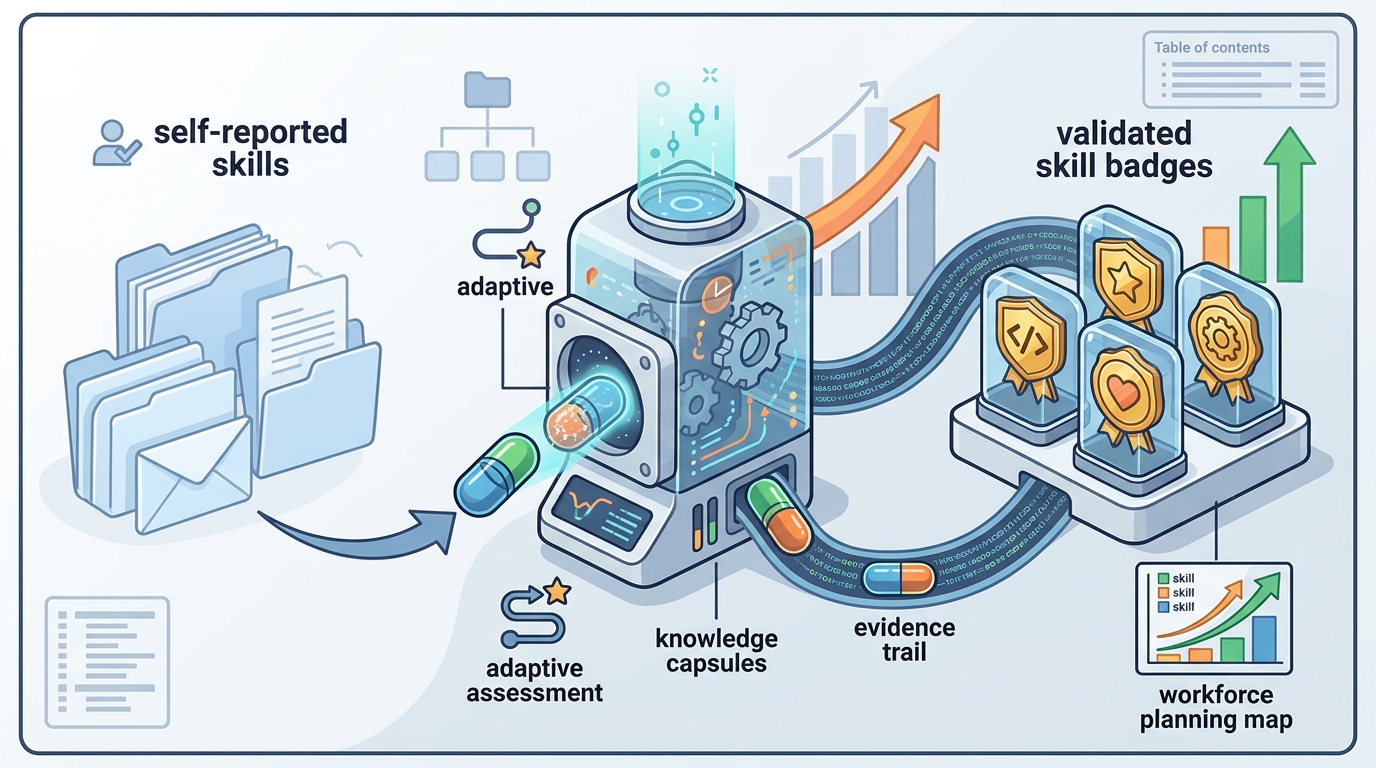
HR platforms distinguish verified from self-reported skills by using adaptive assessments that measure actual capability rather than relying on resumes or self-declarations. The Wise Skill implements this by pairing initial self-reports with real-time adaptive testing. This process creates a clear evidence trail that separates what employees claim from what they can demonstrate, ensuring objective workforce planning.
The Verification Gap in Traditional HR
Traditional talent management relies heavily on static data. Job descriptions and resumes often list skills without proof of proficiency. This creates a significant blind spot for HR leaders. When an employee claims expertise in a specific tool or methodology, the organization has no immediate way to confirm that claim. This lack of verification leads to misaligned hiring and ineffective training budgets.
The core issue is the divergence between perception and performance. An employee may rate themselves highly in a skill due to familiarity, not mastery. Conversely, a highly capable individual may understate their abilities due to imposter syndrome. Without an objective verification layer, HR decisions are based on noise rather than signal. This gap becomes critical when organizations attempt to map their workforce against strategic business goals.
Addressing this gap requires a shift from static records to dynamic measurement. The goal is to establish a baseline of verified capabilities. This baseline allows for accurate gap analysis. It ensures that training investments target actual deficiencies rather than perceived ones. This shift is fundamental to modern skills intelligence.
Adaptive Assessment Mechanics
Adaptive assessment is a psychometric method where test difficulty adjusts in real time based on the respondent's answers. This technique is the primary engine for skills verification in modern platforms. It allows for precise measurement with fewer questions than static tests. The system starts with a baseline question and moves up or down in difficulty based on performance.
The Wise Skill utilizes this approach to measure each person's real skill level. The assessment adjusts to the individual's demonstrated proficiency. This reduces the time required for evaluation while maximizing accuracy. The result is a verified skill score that reflects actual capability. This score is distinct from the initial self-reported data point.
This mechanism is crucial for maintaining a living taxonomy of skills. The platform uses a macro taxonomy of over 35,000 skills. Adaptive assessments allow the system to verify proficiency across this vast range efficiently. It ensures that the verification process scales with the organization's size and complexity. The output is a reliable metric that can be compared across roles and departments.
Side-by-Data Models for Transparency
Effective platforms do not replace self-reporting with verification. They integrate both data points into a unified view. This side-by-side model provides transparency for both HR and employees. It shows the declared skill level next to the verified skill level. This visual comparison highlights discrepancies that require attention.
When a discrepancy appears, it triggers a specific workflow. If the verified level is lower than the self-reported level, the system flags a potential gap. This flag informs training recommendations. If the verified level is higher, it may indicate hidden talent or underutilized skills. This dual-data model transforms raw scores into actionable insights. It moves the conversation from accusation to development.
The Wise Skill presents this data clearly to users. Each person sees their declared skills and their verified results. This transparency builds trust in the assessment process. It encourages employees to engage honestly with the platform. The data model supports the generation of a Key Talent Indicator (KTI) for every profile. This indicator synthesizes verified skills into a single, actionable metric for talent management.
Compliance and Audit-Ready Evidence
Verified skills data serves a critical compliance function. In regulated industries, organizations must prove that employees possess specific competencies. Self-reported data is rarely sufficient for audit purposes. Verified assessment records provide a defensible evidence trail. These records document when a skill was tested, the method used, and the resulting proficiency level.
Platforms that generate audit-ready reports are essential for compliance. The Wise Skill provides unified systems to track these records. This capability ensures that training and certification data are organized and accessible. It simplifies the process of demonstrating regulatory compliance. The evidence trail supports not just audits, but also internal performance reviews and promotion decisions.
This focus on evidence-based verification aligns with broader security and data standards. The platform adheres to ISO 27001 and ISO 42001 standards. It also complies with GDPR and the EU AI Act. These certifications ensure that the verification process is secure, ethical, and transparent. They provide the foundation for trust in the data generated by the system.
Closing the Loop with Targeted Development
Verification is only the first step in the talent lifecycle. The ultimate goal is to close the gaps identified through assessment. Once a verified skill gap is identified, the platform can recommend targeted development. This moves the process from measurement to action. It ensures that training resources are allocated to the most critical deficiencies.
The Wise Skill connects verified gaps to microlearning plans. The platform matches more than 35,000 skills with relevant training content. This integration allows for immediate remediation. Employees receive personalized learning paths based on their verified needs. This targeted approach improves training effectiveness and reduces time-to-productivity.
By linking verification to development, organizations create a continuous improvement cycle. Skills are measured, gaps are identified, training is delivered, and skills are re-verified. This loop ensures that the workforce remains aligned with business strategy. It transforms skills management from a static exercise into a dynamic capability. This is the core value of a skills intelligence platform.
Key Takeaways
- Self-reported skills are a starting point, not a final truth. They must be verified through objective assessment.
- Adaptive assessment adjusts test difficulty in real time to measure actual proficiency accurately and efficiently.
- Side-by-side data models show declared versus verified skills, highlighting discrepancies for targeted action.
- Verified skill data creates an audit-ready evidence trail for compliance and performance management.
- Platforms like The Wise Skill integrate verification with training recommendations to close skill gaps effectively.
- Security standards like ISO 27001 and GDPR ensure that skills verification data is handled ethically and securely.
Frequently Asked Questions
What is the difference between verified and self-reported skills?
Self-reported skills are what an employee claims to know. Verified skills are what an employee demonstrates through objective assessment. The difference lies in the evidence of actual capability.
How does adaptive assessment work in skills verification?
Adaptive assessment adjusts the difficulty of questions based on the respondent's answers. This allows the system to pinpoint the exact proficiency level with fewer questions than static tests.
Why is self-reported data insufficient for workforce planning?
Self-reported data is subject to bias and inaccuracy. It does not provide proof of capability. Workforce planning requires verified data to make reliable decisions about training and deployment.
Can HR platforms track the history of skill verification?
Yes, modern platforms track the history of assessments. This creates an audit trail that shows how skills have evolved over time. This history is crucial for compliance and performance reviews.
How does The Wise Skill handle the discrepancy between declared and verified skills?
The Wise Skill displays both data points side by side. When a discrepancy is found, it flags the gap and recommends targeted training to close it. This ensures that development is based on actual needs.
Conclusion
Distinguishing between verified and self-reported skills is essential for objective talent management. Adaptive assessment provides the mechanism for this verification. It transforms subjective claims into objective evidence. The Wise Skill offers a robust platform for this process. It combines adaptive testing with a living taxonomy of skills. This allows organizations to build a defensible evidence trail for their workforce. To start your diagnosis and see how your skills are verified, request a demo.