
Step-by-Step Process for Running Objective Skills Assessments Across Your Workforce
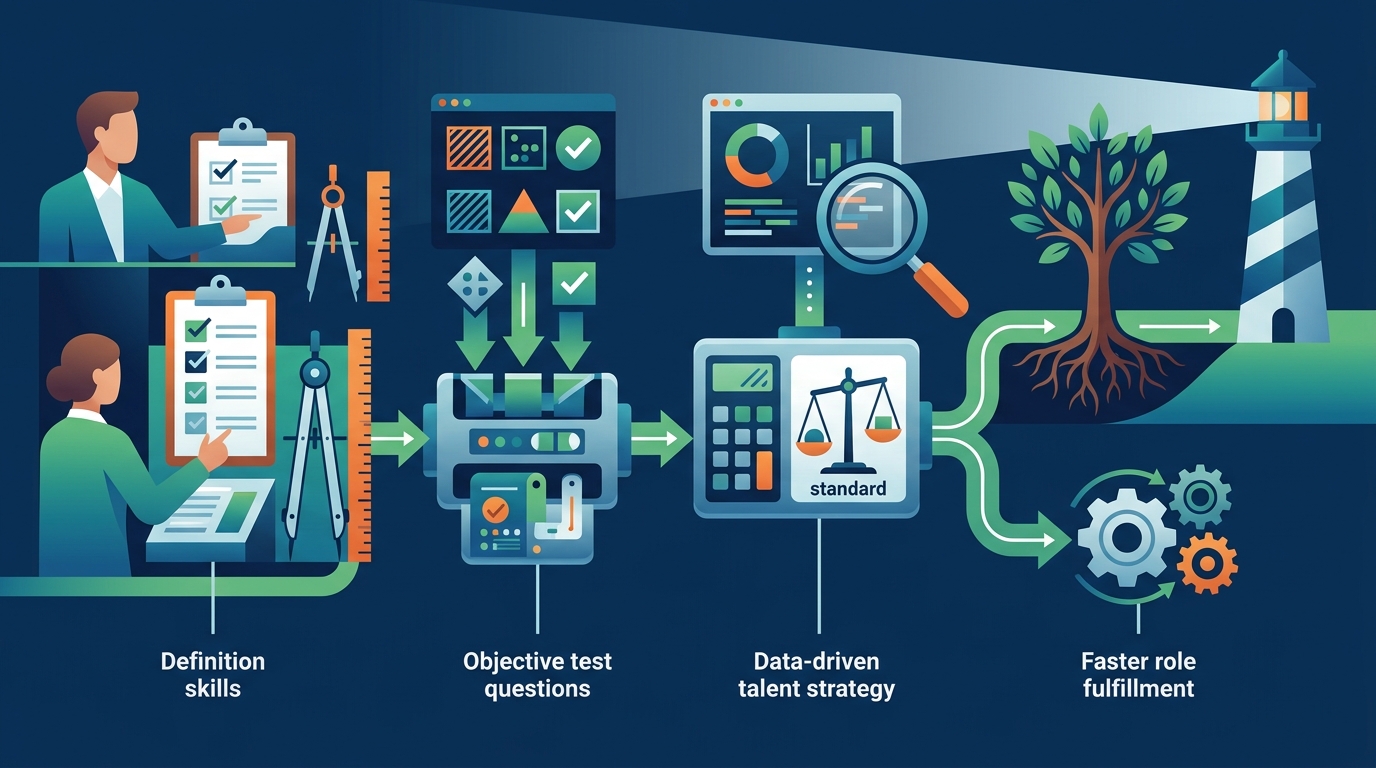
Organizations that rely on intuition for talent decisions often miss critical gaps in their workforce capabilities. According to recent industry analysis, companies utilizing data-driven talent strategies see significantly higher retention rates and faster role fulfillment. This shift from subjective evaluation to objective measurement is not just a trend; it is a necessity for modern business resilience. The following guide details the exact workflow for implementing objective skills assessments, leveraging advanced talent intelligence platforms to ensure accuracy and fairness.
Step 1: Define the Strategic Taxonomy
Before assessing anyone, you must establish a clear framework for what constitutes competence. Taxonomy is the structured classification of skills that allows an organization to speak a common language across HR, management, and technical teams. Without this, assessments are merely opinions disguised as data.
Start by identifying the core competencies required for your industry. This involves mapping hard skills, such as coding languages or financial modeling, against soft skills like leadership and communication. The Wise Skill platform utilizes a dynamic knowledge base containing over 35,000 skills and 3,200 professional profiles to ensure your taxonomy is current and comprehensive. This prevents the use of outdated job descriptions that no longer reflect reality.
By aligning your internal definitions with industry standards, you create a baseline for objective comparison. This step ensures that when you later measure an employee, you are measuring against a consistent, verified standard rather than a manager's personal preference.
Step 2: Reconstruct Organizational Profiles
Once the taxonomy is set, you must map it to your actual workforce. Manual data entry is prone to error and bias. Instead, leverage automated talent mapping tools to reconstruct departmental structures and role requirements.
The process begins by inputting your company name or uploading an existing HRIS export. The system then reconstructs departments, profiles, and the specific skills each position demands. This creates a "draft" map that your team reviews, rather than starting from a blank slate. This approach drastically reduces the time required to get from zero to a usable talent map.
This step is critical for identifying the "skills gap" before it becomes a crisis. By comparing the required skills in your taxonomy against the current state of your organization, you can identify immediate vulnerabilities. For more details on how to map these skills effectively, visit our Mapeo Skills resource page.
Step 3: Deploy Adaptive Evaluations
With profiles defined, it is time to measure the actual capability of your employees. Traditional tests use static questions, which often fail to accurately gauge true proficiency. Objective assessments require adaptive technology.
An adaptive assessment engine selects each subsequent question based on the candidate's previous answer. If a user answers correctly, the next question increases in difficulty. If they answer incorrectly, the difficulty decreases. This continues until the system achieves statistical confidence in the user's level. This method is mathematically documented and ensures that every employee is evaluated on the same scale, regardless of when they take the test.
The platform utilizes a library of over 3 million validated questions to ensure depth and breadth in every assessment. This eliminates the "one-size-fits-all" problem and provides a precise measurement of skill level. To see this engine in action, request a demo of our evaluation tools.
Step 4: Analyze Gaps and Automation Risk
Data collection is only valuable if it leads to insight. The next step is to analyze the results to identify two key areas: skill gaps and automation risk.
Skills Gap Analysis compares the employee's assessed level against the required level for their role. This highlights specific areas where training is needed. For example, a developer might be strong in coding but weak in cloud architecture. This specific gap can then be targeted with precise learning modules.
Simultaneously, the system calculates the automation risk for each role. This is not about replacing humans, but about understanding which tasks can be augmented by AI. The calculation decomposes each profile into its constituent tasks and scores them based on current technological capabilities. This provides a clear view of which roles are secure, which will benefit from AI assistance, and which may need redefinition.
Understanding this data allows leadership to make informed decisions about workforce planning. It shifts the conversation from fear of AI to strategic adaptation. You can learn more about our approach to reskilling and upskilling to prepare your team for these changes.
Step 5: Execute Reskilling and Upskilling
The final step is to act on the data. Objective assessments provide a clear roadmap for development. Instead of generic training courses, you can assign personalized learning itineraries that address the specific gaps identified in Step 4.
This process ensures that training investment has a measurable return. By focusing on critical gaps, you accelerate the time to proficiency for your employees. Furthermore, this data supports fair mobility and promotion decisions. When promotions are based on demonstrated skills rather than tenure or visibility, you build a culture of meritocracy.
Regularly repeating this cycle creates a continuous feedback loop. The organization becomes more agile, and employees feel more supported in their career growth. This is the core value of talent evaluation as a continuous process rather than a one-time event.
Key Takeaways
- Dynamic Taxonomy: Use a living knowledge base of 35,000+ skills to ensure relevance.
- Adaptive Testing: Leverage algorithms that adjust difficulty in real-time for higher accuracy.
- Automation Mapping: Identify which tasks are automatable to guide role evolution.
- Objective Data: Replace intuition with statistically confident skill measurements.
- Continuous Cycle: Treat assessment as an ongoing habit, not a singular audit.
- Fair Mobility: Use skill data to drive transparent internal promotions and hiring.
- ROI Focus: Direct training budgets only to identified critical gaps.
Frequently Asked Questions
What is the difference between a skills assessment and a performance review?
A performance review evaluates past behavior and output, often influenced by recency bias. A skills assessment measures current capability against a standardized benchmark, providing an objective snapshot of what an employee can do right now.
How does adaptive testing improve accuracy?
Adaptive testing tailors the difficulty of questions to the individual's ability level. This reduces test fatigue and provides a more precise measurement of proficiency than static tests, which may be too easy or too hard for many users.
Can skills assessments replace human managers?
No. These tools provide data to support human decision-making. They identify gaps and potential, but managers must interpret this data in the context of team dynamics and business goals.
How long does it take to map an entire organization?
Using automated talent mapping, organizations can reconstruct profiles and skills in minutes rather than months. The initial setup is rapid, allowing for immediate insights.
Is the data from these assessments secure?
Yes. Reputable platforms adhere to strict security standards, including ISO 27001 and GDPR compliance, ensuring that sensitive employee data is protected.
What is a skills gap?
A skills gap is the difference between the skills an employee currently possesses and the skills required to perform their role effectively or advance to the next level.
How often should skills assessments be conducted?
For dynamic industries, quarterly or bi-annual assessments are recommended to keep pace with technological changes and evolving job requirements.
Ready to Transform Your Talent Strategy?
Stop guessing and start measuring. The Wise Skill provides the tools to map, evaluate, and develop your workforce with precision. Schedule a demo today to see how our platform can help you build a future-ready organization.