
Organizations that leverage data-driven talent strategies report a 24% increase in employee retention and a 37% improvement in internal mobility rates compared to those relying on intuition. This shift is critical as the global skills gap widens, forcing companies to find faster ways to upskill their workforce. Skills intelligence tools have emerged as the primary mechanism to bridge this divide by converting vague job descriptions into measurable, actionable data points. (Qui nes somos Skill)
Understanding Skills Intelligence
Skills intelligence is the systematic process of identifying, measuring, and managing the specific capabilities required for business success. Unlike traditional human resources methods that rely on static job titles, this approach focuses on the dynamic skills that drive performance. According to the World Economic Forum, 50% of all employees will need reskilling by 2025 due to the adoption of new technologies. (Identificar Gaps de Skills)
Traditional learning management systems often fail because they offer generic content. Skills intelligence platforms solve this by creating a living map of your organization's capabilities. This map connects individual employee data with strategic business goals. The result is a precise understanding of who can do what and where the organization is vulnerable.
By adopting this framework, companies move from reactive hiring to proactive development. This shift reduces time-to-competency for new roles and ensures that training budgets are spent on high-impact areas. The foundation of this process is a robust skills taxonomy that evolves with the market.
Step 1: Mapping Your Skills Taxonomy
The first step in setting up automated training plans is defining the skills that matter. You cannot automate what you have not defined. This phase involves creating a comprehensive taxonomy that reflects your specific industry and organizational structure.
Defining the Framework
Start by analyzing your strategic priorities. What skills are required to achieve your next business objective? Use a skills intelligence platform to generate a baseline taxonomy. These tools often come with pre-built libraries containing thousands of validated skills. For example, The Wise Skill utilizes a database of over 35,000 skills to ensure relevance and accuracy.
Customize this taxonomy to fit your company's unique context. Add specific technical skills, soft skills, and leadership competencies that are critical to your culture. Ensure that the definitions are clear and consistent across all departments. This common language is essential for accurate data collection later.
Validating the Map
Once the initial map is created, validate it with department heads and subject matter experts. They can identify missing skills or outdated definitions. This collaborative approach ensures buy-in and accuracy. A well-defined taxonomy serves as the source of truth for all subsequent evaluations and training recommendations.
Step 2: Evaluating Current Talent
With a defined taxonomy, the next step is to measure the current state of your workforce. This requires moving beyond self-reported resumes to objective, data-driven assessments.
Conducting Skills Assessments
Deploy adaptive assessments to your employees. These tools adjust the difficulty of questions in real-time based on the candidate's responses. This method provides a more accurate measurement of proficiency than static tests. The assessment should cover both hard skills, such as coding or financial analysis, and soft skills, such as communication or leadership.
Ensure that the evaluation process is transparent and fair. Employees should understand why they are being assessed and how the data will be used for their development. This transparency builds trust and encourages participation. The goal is to capture a snapshot of current capabilities, not to judge past performance.
Integrating with HR Systems
Integrate the assessment data with your existing Human Resources Information System (HRIS). This integration allows for seamless data flow and eliminates manual entry errors. It also enables you to correlate skills data with other HR metrics, such as performance reviews and tenure. This holistic view provides a richer context for decision-making.
Step 3: Identifying Critical Gaps
Once you have the target state (taxonomy) and the current state (assessment data), you can identify the gaps. A skills gap is the difference between the skills required for a role and the skills currently possessed by the employee.
Automated Gap Analysis
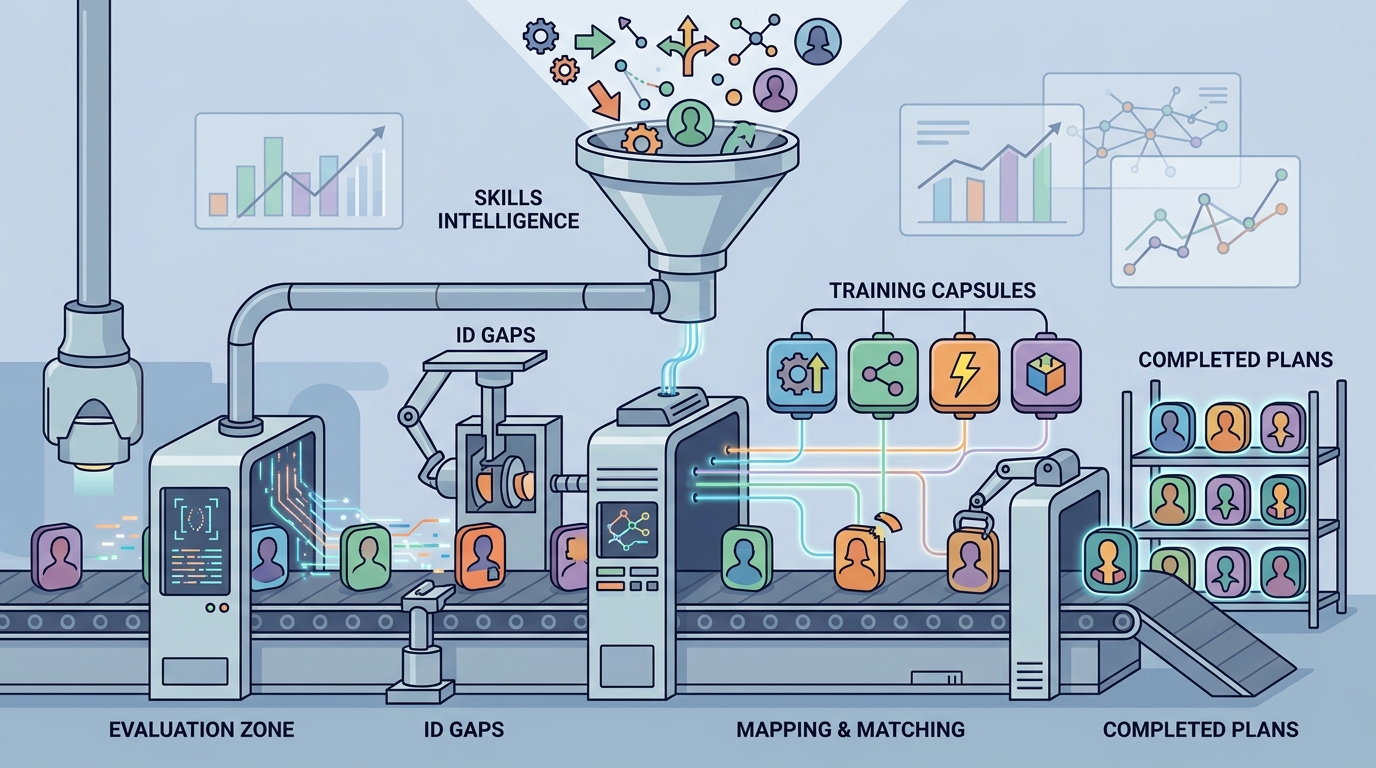
Skills intelligence tools automate this comparison. The platform matches each employee's assessed skills against the requirements of their role or their desired career path. It then highlights the specific areas where the employee is lacking. This analysis is not limited to individual roles; it can also be aggregated to show organizational-wide gaps.
For instance, if 60% of your engineering team lacks proficiency in a new cloud technology, this is a critical organizational gap. Prioritize these gaps based on business impact. Focus on skills that are urgent and important for your strategic goals.
Prioritizing by Impact
Not all gaps are created equal. Use a matrix to prioritize which gaps to address first. Consider factors such as the cost of the gap, the difficulty of acquiring the skill, and the availability of internal talent. This prioritization ensures that your training efforts are focused on the highest-value opportunities.
Step 4: Automating Training Plans
This is the core of the automation process. Instead of manually assigning courses, the skills intelligence platform generates individualized learning paths for each employee.
Generating Personalized Paths
The platform uses the identified gaps to recommend specific learning resources. These resources can include online courses, workshops, mentorship opportunities, or on-the-job projects. The recommendations are tailored to the individual's learning style, pace, and current workload. This personalization increases engagement and completion rates.
The system can also suggest internal mobility opportunities. If an employee has the potential to move to a different role, the platform can outline the skills they need to acquire to make that transition. This supports career development and retention.
Continuous Learning Loops
Automation does not mean set-and-forget. The system should continuously monitor progress and update the training plan as needed. If an employee completes a course, the system should recommend the next logical step. If they struggle with a concept, it can suggest alternative resources. This dynamic approach ensures that the training remains relevant and effective.
Step 5: Measuring Impact
The final step is to measure the impact of the automated training plans. This involves tracking key performance indicators (KPIs) to determine if the investment is yielding results.
Tracking Key Metrics
Monitor metrics such as skills acquisition rates, time-to-competency, and employee satisfaction with the training. Compare these metrics before and after the implementation of the skills intelligence platform. Look for improvements in performance and productivity. For example, did the engineering team's deployment speed increase after the cloud training?
Reporting and ROI
Generate regular reports for leadership to demonstrate the return on investment (ROI). Show how the training has reduced hiring costs, improved retention, or increased revenue. Use data visualizations to make the impact clear and compelling. This evidence is crucial for securing ongoing budget and support for the program.
Feedback and Iteration
Collect feedback from employees and managers. Ask what worked well and what could be improved. Use this feedback to refine the taxonomy, assessments, and recommendations. Continuous improvement is key to the long-term success of the program.
Key Takeaways
- Skills Intelligence is Data-Driven: It replaces intuition with measurable evidence of employee capabilities.
- Taxonomy is Foundational: A well-defined, customized skills map is the prerequisite for accurate automation.
- Adaptive Assessments are Key: Real-time adjustment during evaluation ensures higher accuracy in measuring proficiency.
- Automation Saves Time: Automated gap analysis and plan generation reduce administrative burden by hours per week.
- Personalization Increases Engagement: Tailored learning paths lead to higher completion rates and better knowledge retention.
- Integration is Critical: Seamless connection with HRIS systems ensures data integrity and holistic decision-making.
- Impact Measurement Validates ROI: Tracking specific KPIs proves the value of the investment to stakeholders.
Frequently Asked Questions
What is the difference between skills intelligence and traditional LMS?
Traditional Learning Management Systems (LMS) focus on delivering content. Skills intelligence focuses on identifying the right content based on specific skill gaps. It connects learning directly to business outcomes and individual capabilities.
How long does it take to set up a skills taxonomy?
Using automated tools, you can generate a baseline taxonomy in minutes. However, customizing and validating it with your team may take a few days to weeks, depending on the size and complexity of the organization.
Can skills intelligence tools integrate with existing HR software?
Yes, most modern skills intelligence platforms offer robust integrations with major HRIS and LMS providers. This ensures that data flows seamlessly between systems without manual entry.
How do you ensure the accuracy of automated assessments?
Accuracy is ensured through adaptive testing algorithms and validated question banks. These tools adjust to the user's level and compare results against industry benchmarks to provide reliable data.
What are the benefits of automated individual training plans?
Benefits include reduced time-to-competency, higher employee engagement, optimized training budgets, and improved internal mobility. It ensures that every employee receives the training they need, when they need it.
Is skills intelligence suitable for small businesses?
Yes, skills intelligence is scalable. Small businesses can benefit greatly by identifying key skills and filling gaps efficiently without the need for a large HR team.
How often should skills assessments be repeated?
Assessments should be repeated regularly, such as annually or bi-annually, to track progress and identify new gaps. Some platforms allow for continuous, lightweight assessments to keep data current.
Get Started with Skills Intelligence
Transform your talent management strategy by implementing automated individual training plans. Stop guessing and start measuring. Schedule a demo today to see how The Wise Skill can help you map skills, evaluate talent, and close gaps with precision. Visit our homepage to learn more about our platform.