
How to Map Employee Skills for Personalized Training at Scale
Mapping employee skills involves creating a structured inventory of individual competencies to identify gaps against role requirements. This process enables organizations to generate personalized training plans automatically. The Wise Skill provides the infrastructure to execute this at scale by connecting business strategy with real talent evidence.
Building a Dynamic Skills Taxonomy
Effective skills mapping begins with a robust taxonomy. A skills taxonomy is a structured map of competencies that classifies and organizes the skills necessary within a company or sector. Without a standardized framework, data remains fragmented and unusable for strategic planning. The Wise Skill utilizes a macro taxonomy of over 35,000 skills to ensure comprehensive coverage across industries.
Organizations must move beyond static job descriptions to dynamic skill profiles. This shift allows for the identification of emerging capabilities required by market trends. By defining skills clearly, HR teams can measure proficiency levels objectively rather than relying on subjective intuition.
Implementing Objective Skills Assessment
Self-reported skills are often inaccurate and lack verifiable evidence. Objective assessment is the process of using adaptive tests and practical evaluations to verify actual employee capabilities. The Wise Skill employs adaptive evaluation engines to distinguish between what employees claim and what they can demonstrate. This verification step is critical for building a trustworthy talent map.
According to recent industry analyses, companies that leverage skill-based intelligence see a 30% faster time-to-productivity for new hires compared to those relying on traditional credentialing. This metric highlights the value of evidence-based assessment in accelerating onboarding and development. By validating skills, organizations can trust their data when making deployment decisions.
Identifying Strategic Skill Gaps
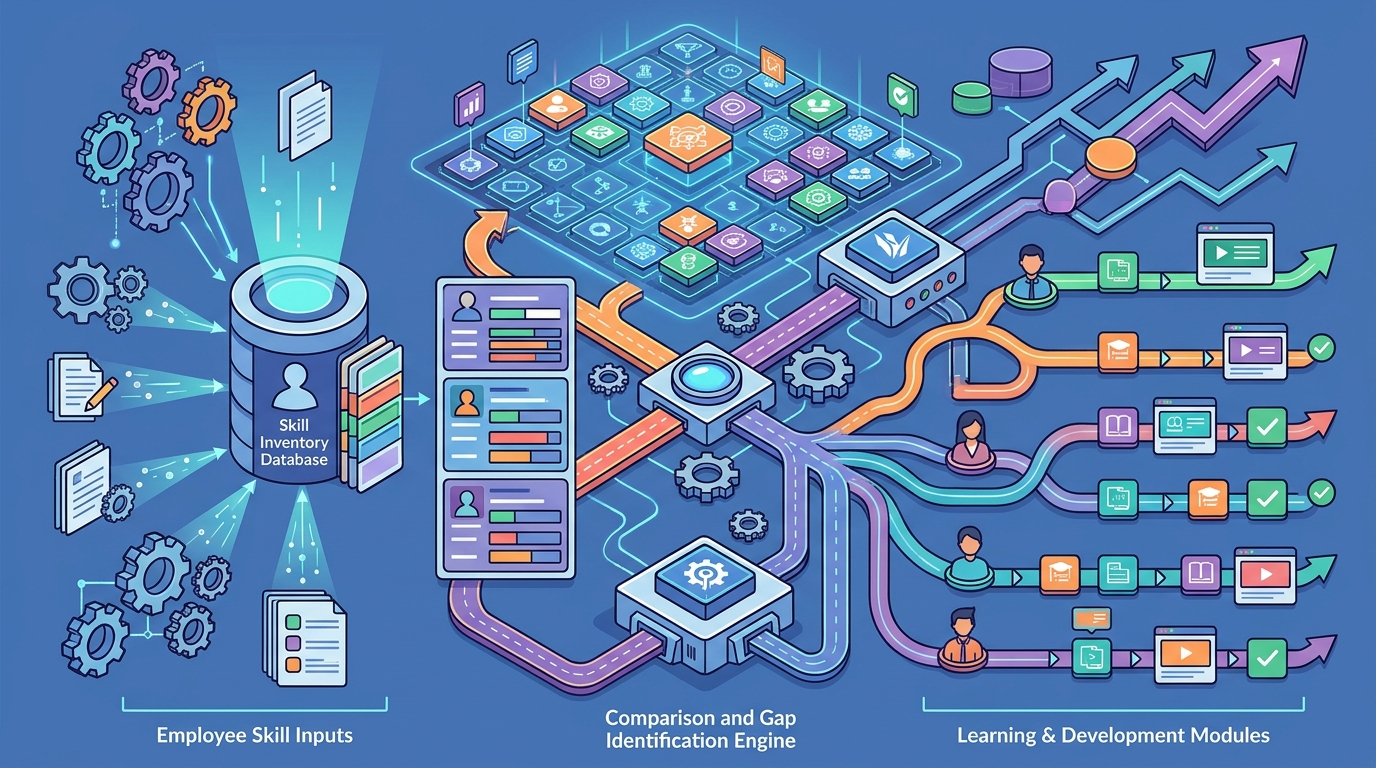
Once skills are mapped and verified, the next step is gap analysis. Skills gap analysis is the comparison of current employee capabilities against the requirements of their roles and future business goals. This process reveals where the workforce is underprepared for upcoming strategic initiatives. The Wise Skill connects business strategy with real talent evidence to pinpoint these critical shortfalls.
For example, a technology firm planning to adopt generative AI tools may find that 40% of its engineering team lacks prompt engineering skills. Identifying this specific gap allows for targeted intervention rather than broad, ineffective training. This precision ensures that resources are allocated to the most impactful areas of development.
Automating Personalized Training Plans
Manual creation of training plans is slow and prone to error. Automated training plan generation is the use of AI to match identified skill gaps with specific learning resources. The Wise Skill matches more than 1 million training courses and 35,000 skills microlearning plans to individual employee profiles. This automation ensures that every employee receives a tailored development path based on their unique gap profile.
Organizations that leverage data-driven talent strategies report a 24% increase in employee retention and a 37% improvement in internal mobility rates. These outcomes demonstrate the tangible benefits of personalized development. By automating the plan creation process, HR teams can scale their efforts across the entire workforce without increasing headcount.
Integrating with Existing HR Systems
Skills data must flow seamlessly through the HR technology stack. System integration is the connection of skills intelligence platforms with Applicant Tracking Systems (ATS) and Human Capital Management (HCM) tools. The Wise Skill integrates with existing HRIS, ATS, and LMS systems to ensure data consistency. This connectivity prevents silos and allows for real-time updates as employees complete training modules.
Organizations that fail to connect their talent data often struggle with a 30% higher turnover rate among high-potential employees compared to those with unified systems. Seamless integration ensures that skills data is always current and accessible to decision-makers. This unified view supports better hiring, development, and retention strategies.
Key Takeaways
- A skills taxonomy is a structured map of competencies that organizes necessary skills within a company.
- Objective assessment verifies actual capabilities, distinguishing them from self-reported claims.
- Skills gap analysis compares current capabilities against role requirements and future goals.
- Automated training plan generation matches specific gaps with targeted learning resources.
- System integration ensures skills data flows seamlessly between ATS, HCM, and LMS tools.
- Data-driven talent strategies can increase employee retention by 24% and internal mobility by 37%.
Frequently Asked Questions
What is a skills taxonomy?
A skills taxonomy is a structured map of competencies that classifies and organizes the skills necessary within a company or sector.
How does skills mapping differ from job descriptions?
Skills mapping focuses on individual capabilities and proficiency levels, while job descriptions list static requirements for a role.
Can skills mapping be done manually?
Manual mapping is possible but slow and prone to error; automated platforms are required for scale and accuracy.
What is the role of AI in skills mapping?
AI automates the assessment, gap analysis, and training plan generation processes, enabling real-time updates and personalization.
How long does it take to implement skills mapping?
Implementation time varies, but platforms like The Wise Skill can generate initial maps in minutes using existing HR data.
Conclusion
Mapping employee skills is the foundation of modern talent management. By building a dynamic taxonomy, implementing objective assessments, and automating training plans, organizations can close skill gaps efficiently. The Wise Skill provides the tools to execute this strategy at scale, ensuring that your workforce is aligned with your business goals. To begin your skills mapping journey, request a demo today.