
Building an Effective Internal Talent Marketplace for Mid-Size Companies
Mid-size companies build effective internal talent marketplaces by mapping employee skills against role requirements and creating a structured workflow for internal mobility. This approach reduces reliance on external hiring and accelerates time-to-fill. The Wise Skill provides the infrastructure to connect business needs with verified employee capabilities, ensuring that internal candidates are identified before external job postings go live. according to Internal Marketplaces Are
The Strategic Value of Internal Marketplaces
Internal talent marketplaces are digital platforms that allow employees to discover and apply for internal opportunities, projects, and development paths. For mid-size organizations, this tool is critical because it transforms talent management from a reactive process into a proactive strategy. According to SHRM's 2025 benchmarking report, 35% of organizations reported using an internal talent marketplace, up from 25% in 2024, signaling a rapid industry shift toward internal mobility. This growth reflects a broader recognition that retaining and redeploying existing talent is more cost-effective and culturally beneficial than constant external recruiting.
The primary benefit is agility. When a role opens, managers can immediately see which internal employees possess the required skills. This visibility eliminates the guesswork that often leads to missed internal candidates. By focusing on skills rather than job titles, companies can identify hidden talent in unexpected departments. This approach not only fills roles faster but also boosts employee engagement by providing clear career pathways.
Mapping Skills to Role Requirements
The foundation of any successful marketplace is a robust skills taxonomy. A skills taxonomy is a structured framework that categorizes the specific abilities, knowledge, and competencies required for various roles. Without this framework, a marketplace is just a job board, lacking the intelligence to match people to opportunities effectively. The Wise Skill utilizes a macro taxonomy of over 35,000 skills to ensure comprehensive coverage across industries and functions.
Building this map requires objective data, not self-reported assumptions. Employees often overestimate or underestimate their capabilities. To address this, organizations should use adaptive assessments to verify skill levels. The Wise Skill employs more than 3.5 million objective questions to generate a Key Talent Indicator (KTI) for every profile. This metric provides a standardized way to compare employee capabilities against role requirements. By relying on verified data, HR leaders can make confident decisions about who is ready for a new role and who needs targeted development first.
Creating a Structured Mobility Workflow
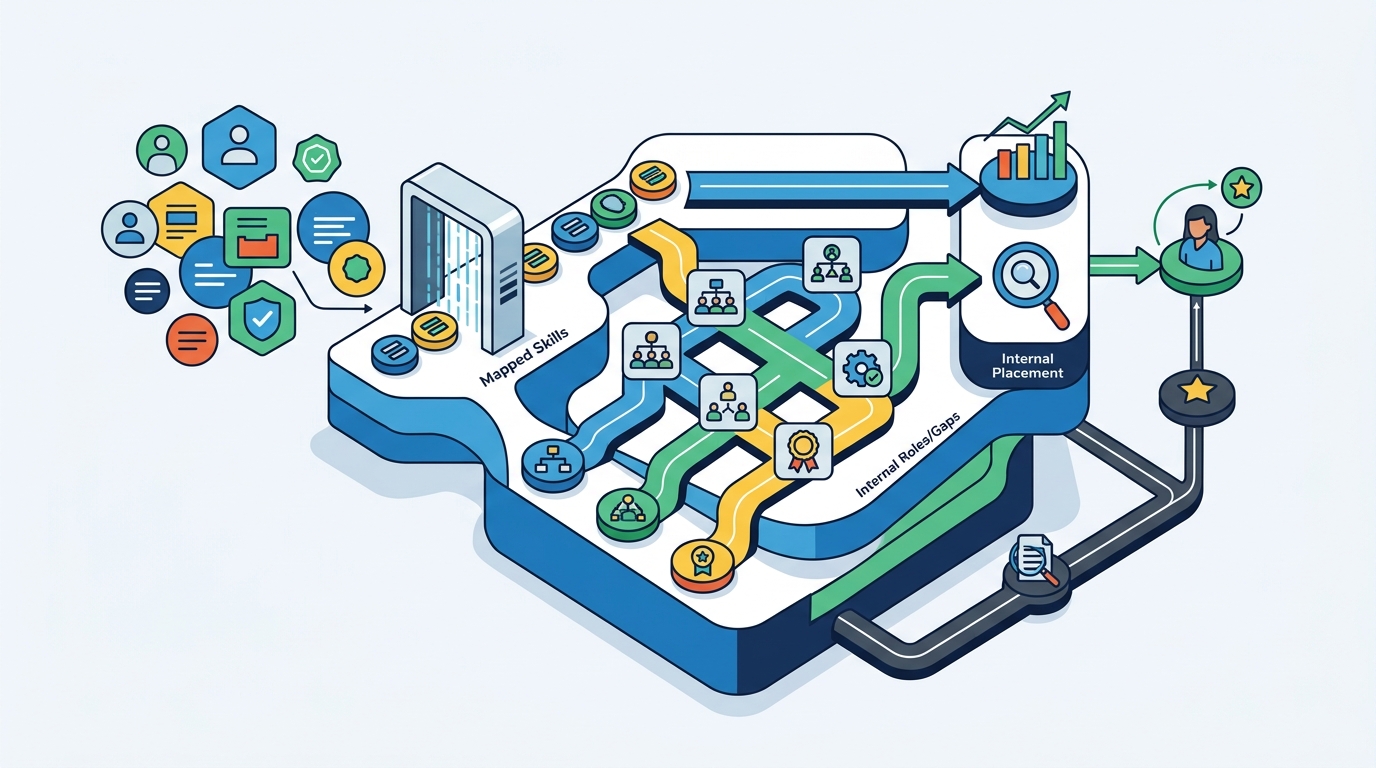
Once skills are mapped, the next step is designing a workflow that facilitates movement. A structured mobility workflow is a defined process that guides employees from discovery to application to onboarding for internal roles. This process should be transparent and accessible, reducing the friction that often discourages internal applications. For example, a mid-size tech company might create a portal where employees can filter opportunities by skill match, location, and career level.
Key components of this workflow include:
- Discovery: Employees see opportunities that match their verified skills.
- Application: A simplified process that highlights relevant experience and skills.
- Assessment: Managers review skill matches and performance data before interviews.
- Onboarding: AI-guided onboarding plans to help new hires ramp up quickly.
This structure ensures that internal candidates are evaluated fairly and efficiently. It also provides managers with the data they need to make informed hiring decisions. By standardizing the process, companies can reduce bias and ensure that the best internal talent is selected for each role.
Integrating with Existing HR Systems
For a talent marketplace to be effective, it must integrate seamlessly with existing HR systems. Integration is the technical connection between the marketplace and other HR tools, such as Applicant Tracking Systems (ATS) and Human Capital Management (HCM) platforms. Without integration, skills data remains siloed, preventing a holistic view of the workforce. The Wise Skill connects to your HRIS, ATS, and LMS to ensure that data flows automatically between systems.
Organizations that fail to connect their talent data often struggle with a 30% higher turnover rate among high-potential employees compared to those with unified systems. This statistic highlights the critical need for seamless data flow. When your marketplace is integrated with your ATS, you can automatically pull in candidate data and push internal applications to the hiring pipeline. This automation saves time and reduces the risk of data entry errors. It also ensures that all stakeholders have access to the same up-to-date information.
Measuring Impact and ROI
Finally, you must measure the impact of your internal talent marketplace. Measuring impact is the process of tracking key metrics to determine the return on investment of your internal mobility efforts. Key metrics include time-to-fill, cost-per-hire, retention rate, and employee engagement. Organizations that leverage skills-based data report a 30% faster time-to-hire for internal roles compared to traditional methods. This improvement directly impacts the bottom line by reducing recruitment costs and minimizing productivity gaps.
To track these metrics, you should establish a baseline before launching the marketplace. Then, monitor the data regularly to identify trends and areas for improvement. The Wise Skill provides dashboards that allow you to track the evolution of your skills map and verify that each decision is delivering value. By continuously measuring and adjusting, you can ensure that your marketplace remains a strategic asset rather than a static tool.
Key Takeaways
- Internal talent marketplaces are digital platforms that connect employee skills with internal opportunities.
- 35% of organizations used an internal talent marketplace in 2025, up from 25% in 2024.
- A robust skills taxonomy is essential for accurate matching and mobility.
- Verified skill data, such as the Key Talent Indicator, reduces bias in hiring decisions.
- Seamless integration with ATS and HCM systems is critical for data accuracy and workflow efficiency.
- Organizations with unified talent data see a 30% faster time-to-hire for internal roles.
- Regular measurement of impact ensures the marketplace delivers tangible ROI.
Frequently Asked Questions
What is an internal talent marketplace?
An internal talent marketplace is a digital platform that allows employees to discover and apply for internal opportunities, projects, and development paths based on their skills.
How does a skills taxonomy support internal mobility?
A skills taxonomy provides a standardized framework for categorizing employee capabilities, enabling accurate matching between people and roles.
Why is integration with HR systems important?
Integration ensures that skills data flows automatically between the marketplace and other HR tools, reducing manual effort and data silos.
What is the Key Talent Indicator (KTI)?
The Key Talent Indicator is a metric generated from objective assessments that provides a standardized way to compare employee capabilities against role requirements.
How can I measure the ROI of an internal talent marketplace?
You can measure ROI by tracking metrics such as time-to-fill, cost-per-hire, retention rate, and employee engagement before and after implementation.
Is an internal talent marketplace suitable for mid-size companies?
Yes, mid-size companies benefit significantly from internal marketplaces as they provide the agility and cost-effectiveness needed to compete with larger enterprises.
Conclusion
Building an effective internal talent marketplace requires a strategic approach that combines skills mapping, structured workflows, and seamless integration. By leveraging verified data and automated processes, mid-size companies can unlock the potential of their existing workforce and reduce reliance on external hiring. The Wise Skill provides the tools and insights needed to make this transition successful, ensuring that your talent strategy aligns with your business goals. To start your diagnosis and see how The Wise Skill can help you build your internal marketplace, request a demo.