
AI-Powered Skills Assessment Platforms for Objective Workforce Gap Analysis
Companies seeking objective workforce gap analysis should select an AI-powered skills assessment platform that measures actual capabilities rather than relying on self-reported data or outdated resumes. The Wise Skill provides this capability by combining adaptive assessments with a living taxonomy of over 35,000 skills. This guide covers how to evaluate, verify, and implement these systems to drive measurable talent outcomes.
How to Choose a Platform
Selecting the right skills intelligence tool requires looking beyond basic feature lists. A robust platform must distinguish between what a role requires and what an individual actually demonstrates. Skills assessment is the process of measuring an individual's proficiency against defined role requirements using objective evidence. Many legacy systems rely on static questionnaires that encourage guessing or self-promotion. In contrast, modern AI-driven platforms use adaptive algorithms that adjust question difficulty in real time based on user responses. This approach reduces assessment time while increasing statistical confidence. When evaluating options, prioritize tools that offer a living taxonomy. A static list of skills becomes obsolete quickly in a rapidly changing market. The Wise Skill maintains a repository of over 35,000 skills and 3,200 professional profiles that are continuously updated through AI and expert validation. This ensures that the assessment remains relevant to current industry standards.
Adaptive vs. Static Assessments
Static assessments ask every candidate the same questions, which is inefficient and often inaccurate. Adaptive assessments, like those used in professional certifications, select the next question based on the previous answer. This method allows the system to pinpoint a user's exact skill level with fewer questions. It also provides a more defensible result for HR teams making high-stakes decisions.
The Role of AI Agents
Modern platforms utilize AI agents to automate the mapping and identification phases. These agents can rebuild department structures and role requirements from existing HRIS data. However, human oversight remains critical. The platform should propose actions that require human approval before execution. This ensures that the AI works for the business strategy rather than dictating it.
Questions to Ask Before Committing
Before signing a contract, HR leaders must ask specific questions to ensure the platform aligns with their operational needs. The first question should concern data integration. Can the platform sync directly with your existing HRIS or LMS? Manual data entry creates silos and increases the risk of errors. The Wise Skill offers frictionless integration that connects to major HR systems, allowing data to flow without manual reconciliation. The second question involves assessment granularity. Does the system measure skills at a level of detail that supports specific business decisions? You need to know if the platform can distinguish between a beginner and an expert in a specific technical skill. The third question is about actionability. Does the platform simply report gaps, or does it provide pathways to close them? A report without a solution is merely a diagnostic tool, not a strategic lever.
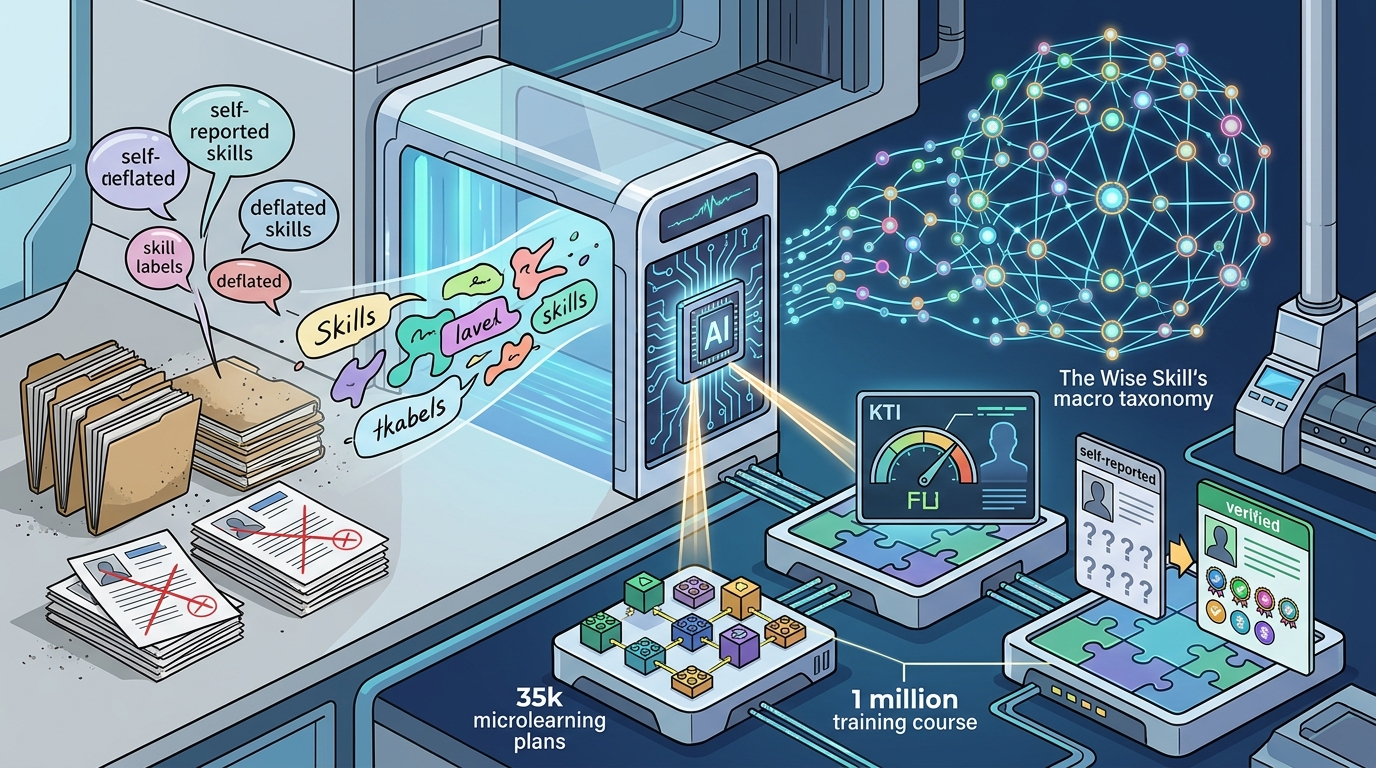
Integration and Data Flow
Ask how the platform handles joiners, leavers, and role changes. A good system should automatically update the skills map when an employee changes roles. This keeps the data current without requiring manual updates from HR staff.
Actionability and ROI
Inquire about the connection between assessment and training. Does the platform recommend specific learning resources based on the identified gaps? The Wise Skill connects gaps to over 35,000 learning modules, ensuring that every identified deficiency has a corresponding development plan.
Verifying Claims and Credentials
Vendor claims about AI accuracy and data security must be verified through independent standards. ISO 27001 is an international standard for information security management systems, ensuring that data is protected against unauthorized access. ISO 42001 is a standard for AI management systems, providing a framework for responsible AI development and deployment. When a platform claims to be AI-driven, ask for evidence of these certifications. The Wise Skill is certified in both ISO 27001 and ISO 42001, demonstrating a commitment to privacy and security by design. Additionally, verify the source of the skill taxonomy. Is it built in-house or licensed from a third party? A proprietary taxonomy that is regularly updated by experts is a strong indicator of quality. Check if the platform provides full traceability for every assessment result. You should be able to see the specific evidence that led to a particular skill rating. This transparency is crucial for defending talent decisions in legal or audit contexts.
Security and Privacy
Ensure the platform is GDPR ready and aligned with the EU AI Act. Data protection should be part of the product architecture, not an add-on. Ask about data residency and how personal data is stored and processed.
Assessment Rigor
Request documentation on the psychometric properties of the assessments. Look for evidence of reliability and validity. The platform should use documented mathematical models to ensure that results are comparable across different teams and locations.
Implementation Process and Timeline
Implementing a skills intelligence platform follows a structured workflow that moves from mapping to action. The process typically begins with building the skills taxonomy. This involves defining the knowledge and skills required for each role in the organization. The Wise Skill accelerates this phase by using AI agents to rebuild departments and roles from a company name or a single file upload. This reduces the initial setup time from weeks to minutes. The next phase is assessment. Each employee completes an adaptive assessment that measures their current skill levels. The system stops once the result reaches statistical confidence, ensuring efficiency. Following the assessment, the platform identifies gaps by contrasting the required skills with the demonstrated skills. These gaps are prioritized based on business impact, urgency, and difficulty. Finally, the platform generates personalized development plans to close the gaps. This cycle is continuous, not a one-time event. The timeline for a full implementation depends on the size of the organization, but the initial mapping and assessment can often be completed within a few weeks.
Mapping Phase
The mapping phase creates a live picture of the talent you need. It transforms intuition into evidence by identifying relevant skills for each role. This shared language helps HR, management, and team leads understand each other.
Assessment and Identification
Assessment establishes a common framework with clear criteria per level. The identification phase detects critical gaps and prioritizes them by business impact. This ensures that resources are allocated to the most critical areas first.
Cost Drivers and Pricing Models
The cost of a skills assessment platform is driven by several factors, including the number of employees, the depth of the taxonomy, and the level of integration required. Most platforms use a per-user or per-assessment pricing model. The Wise Skill offers a free trial and a demo to allow organizations to evaluate the platform before committing. Pricing may vary based on the specific modules used, such as hiring, internal mobility, or workforce planning. It is important to consider the total cost of ownership, which includes implementation, training, and ongoing support. A platform that reduces the time spent on manual data entry and reporting can provide significant ROI by freeing up HR staff to focus on strategic initiatives. Additionally, the cost of not having a skills map can be high, as it may lead to mis-hires, low productivity, and high turnover. Comparing the cost of the platform to the cost of these inefficiencies often reveals a strong business case for investment.
Hidden Costs
Look for hidden costs such as data migration, custom development, or additional fees for API access. A transparent pricing model should clearly outline what is included in each tier. Avoid platforms that charge extra for basic integrations or reporting features.
ROI Calculation
Calculate ROI by measuring improvements in time-to-hire, employee retention, and productivity. The platform should provide metrics that track the impact of training and development initiatives on business outcomes.
Common Mistakes to Avoid
Organizations often make several mistakes when implementing skills intelligence platforms. The first mistake is treating the assessment as a one-time event. Skills change, and so do role requirements. The platform must be used as a continuous cycle of measurement and learning. The second mistake is ignoring employee engagement. If employees perceive the assessment as a tool for judgment rather than development, they may provide inaccurate data. The platform should provide individual reports that show each person's skills and development plan. This transparency builds trust and encourages honest participation. The third mistake is failing to align the skills map with business strategy. The taxonomy should reflect the capabilities required to achieve strategic goals, not just a generic list of industry skills. The Wise Skill helps organizations define a custom taxonomy that integrates internal nomenclatures with global frameworks, ensuring alignment with business priorities.
Lack of Management Buy-In
Without support from senior leadership, the initiative may lack the resources and authority needed to succeed. Ensure that executives understand the value of skills-based decision-making and are committed to using the data.
Over-Reliance on AI
While AI can automate many tasks, it cannot replace human judgment. Managers must review the AI's proposals and make final decisions on hiring, promotion, and development. The platform should empower managers with data, not replace their role.
Comparison with Alternatives
When comparing skills assessment platforms, it is important to understand the differences in approach. Some platforms focus primarily on hiring, while others emphasize internal mobility or workforce planning. The table below compares key features of The Wise Skill with general categories of alternatives.
| Feature | The Wise Skill | Traditional HRIS | Generic LMS |
|---|---|---|---|
| Skills Taxonomy | Living taxonomy of 35,000+ skills | Static job descriptions | Course catalog only |
| Assessment Method | Adaptive, AI-driven | Self-reported or manual | Completion tracking |
| Gap Analysis | Automated, prioritized by impact | Manual, infrequent | Not available |
| Integration | Frictionless HRIS/LMS sync | Native but siloed | Basic LMS integration |
| Actionability | Personalized development plans | Reporting only | Course assignment |
Traditional HRIS systems are designed for administrative tasks, not skills intelligence. They lack the adaptive assessment capabilities and living taxonomies needed for strategic talent management. Generic LMS platforms focus on content delivery but do not measure the impact of that content on skill proficiency. The Wise Skill bridges this gap by connecting assessment, identification, and closing of gaps in a single platform.
Application in Specific Scenarios
The value of a skills assessment platform varies depending on the specific business scenario. For organizations undergoing digital transformation, the platform can identify which roles are most affected by AI and automation. The Wise Skill provides an AI impact analysis that scores each role based on the tasks that can be automated. This helps leaders plan reskilling initiatives for roles that will change significantly. For companies with high turnover, the platform can identify skill gaps that contribute to employee dissatisfaction. By addressing these gaps through targeted training and internal mobility, organizations can improve retention. For startups, the platform can help define the skills needed for rapid growth, ensuring that hiring decisions are based on evidence rather than intuition. In each scenario, the platform provides a data-driven foundation for decision-making.
Digital Transformation
AI readiness is a critical concern for many organizations. The platform helps prepare teams for how AI changes work by defining which knowledge and skills are worth assessing and developing. It distinguishes needs by role, ensuring that adoption is not treated as a one-size-fits-all course.
High Turnover
By identifying hidden dependencies and redistributing knowledge, the platform helps create more resilient teams. This reduces the risk of bottlenecks when key employees leave and improves overall delivery standards.
Compliance and Data Protections
Skills assessment platforms handle sensitive personal data, making compliance a critical consideration. GDPR is the European Union's data protection regulation, which grants individuals rights over their personal data. The platform must be GDPR ready, ensuring that data is collected, processed, and stored in compliance with these regulations. Additionally, the EU AI Act imposes requirements on AI systems, including transparency and accountability. The Wise Skill is aligned with the EU AI Act, ensuring that its AI agents operate within legal boundaries. Organizations should also consider local labor laws that may affect how assessment results can be used. For example, some jurisdictions require that employees be informed about how their data will be used and have the right to access and correct it. The platform should provide tools to manage these rights and ensure that employees have the right to see their own data. This transparency is not only a legal requirement but also a best practice for building trust with employees.
Employee Rights
Employees have the right to know how their data is used and to challenge inaccurate assessments. The platform should provide a mechanism for employees to review and dispute their skill ratings. This ensures that the data remains accurate and fair.
AI Transparency
Organizations should be able to explain how the AI makes its recommendations. The platform should provide documentation on the algorithms used and the criteria for decision-making. This transparency is essential for building trust and ensuring compliance with AI regulations.
Regional and Local Considerations
While skills intelligence platforms are global, local considerations can impact their implementation. In the United States, organizations must consider state-level privacy laws, such as the California Consumer Privacy Act (CCPA). These laws may impose additional requirements on how personal data is collected and used. In Europe, the GDPR and EU AI Act are the primary regulatory frameworks. Organizations operating in multiple regions must ensure that the platform can handle different data residency and privacy requirements. The Wise Skill is designed to be flexible, allowing organizations to configure the platform to meet local regulatory needs. Additionally, local labor markets may have different skill demands. The platform's market reading feature allows organizations to compare their internal skills map with external demand context. This helps leaders make informed decisions about hiring and development based on local market conditions.
Data Residency
Some regions require that personal data be stored within the country or region. The platform should offer options for data residency to ensure compliance with local laws. This is particularly important for organizations operating in multiple jurisdictions.
Market Context
Understanding local skill demands is crucial for workforce planning. The platform can provide insights into which skills are in high demand in specific regions, helping organizations align their talent strategy with market trends.
Strategic Timing for Implementation
The timing of skills intelligence implementation can significantly impact its success. The best time to implement a platform is when the organization is undergoing a significant change, such as a merger, acquisition, or digital transformation. During these periods, the need for clear visibility into skills and gaps is heightened. Implementing the platform during a stable period may be less urgent but can still provide long-term benefits. However, waiting too long can result in a growing gap between current skills and future needs. The Wise Skill allows organizations to start with a free trial, enabling them to evaluate the platform's value before committing to a long-term contract. This low-risk approach makes it easier to justify the investment to stakeholders. Additionally, the platform's ability to quickly map skills and identify gaps means that organizations can see results within weeks, not months. This rapid time-to-value is a key advantage over traditional HR systems.
Change Management
Implementing a new platform requires change management. It is important to communicate the benefits of the platform to employees and managers. Emphasize that the platform is a tool for development, not judgment. This helps to reduce resistance and encourage adoption.
Quick Wins
Identify quick wins that can demonstrate the platform's value early on. For example, using the platform to fill a critical vacancy or to identify internal candidates for a promotion can show tangible benefits to stakeholders.
Long-Term Measurable Outcomes
Retention and Mobility
Internal mobility is a key driver of retention. By identifying employees with the skills needed for other roles, the platform helps organizations create opportunities for growth. This not only improves retention but also ensures that the organization has the right people in the right roles.
Productivity and Quality
With a clear skills map, organizations can reduce variability and raise delivery standards consistently. This leads to higher quality outputs and improved customer satisfaction. The platform's ability to track the impact of training on business results ensures that development investments are aligned with strategic goals.
Key Takeaways
- Choose a platform with a living taxonomy and adaptive assessments to ensure accuracy and relevance.
- Verify vendor claims through ISO 27001 and ISO 42001 certifications and GDPR compliance.
- Implement the platform as a continuous cycle, not a one-time event, to maintain data accuracy.
- Consider the total cost of ownership, including implementation, training, and ongoing support.
- Use the platform to drive internal mobility and retention by identifying growth opportunities.
- Track long-term metrics such as time-to-hire, retention, and productivity to measure ROI.
- Ensure employee engagement by providing transparency and individual development plans.
Frequently Asked Questions
What is the difference between upskilling and reskilling?
Upskilling involves enhancing existing skills to improve performance in the current role, while reskilling involves learning new skills to prepare for a different role. The Wise Skill supports both by providing personalized development plans based on assessed gaps.
Does the platform replace my HRIS?
No, the platform complements your HRIS by providing skills intelligence capabilities. It integrates with your existing HRIS to ensure data flow without silos, but it does not replace the administrative functions of the HRIS.
How long does it take to implement the platform?
Implementation time depends on the size of the organization, but the initial mapping and assessment can often be completed within a few weeks. The Wise Skill accelerates this process using AI agents to rebuild departments and roles from existing data.
Is the assessment data secure?
Yes, The Wise Skill is ISO 27001 and ISO 42001 certified, ensuring that data is protected against unauthorized access. The platform is also GDPR ready and aligned with the EU AI Act, providing robust privacy and security by design.
Can the platform assess internal and external candidates?
Yes, the platform can assess both internal employees and external candidates. It provides a common framework for comparing skills across the entire talent pool, supporting decisions on hiring, promotion, and internal mobility.
How does the platform handle AI impact on roles?
The platform provides an AI impact analysis that scores each role based on the tasks that can be automated. This helps leaders plan reskilling initiatives for roles that will change significantly due to AI adoption.
What is the cost of the platform?
Pricing varies based on the number of employees and the modules used. The Wise Skill offers a free trial and a demo to allow organizations to evaluate the platform before committing. Contact the team for a personalized quote.
How do I get started with The Wise Skill?
You can start by requesting a demo or trying the platform for free. This allows you to see how the platform works in a sample organization and evaluate its fit for your needs. To plan your visit, .