
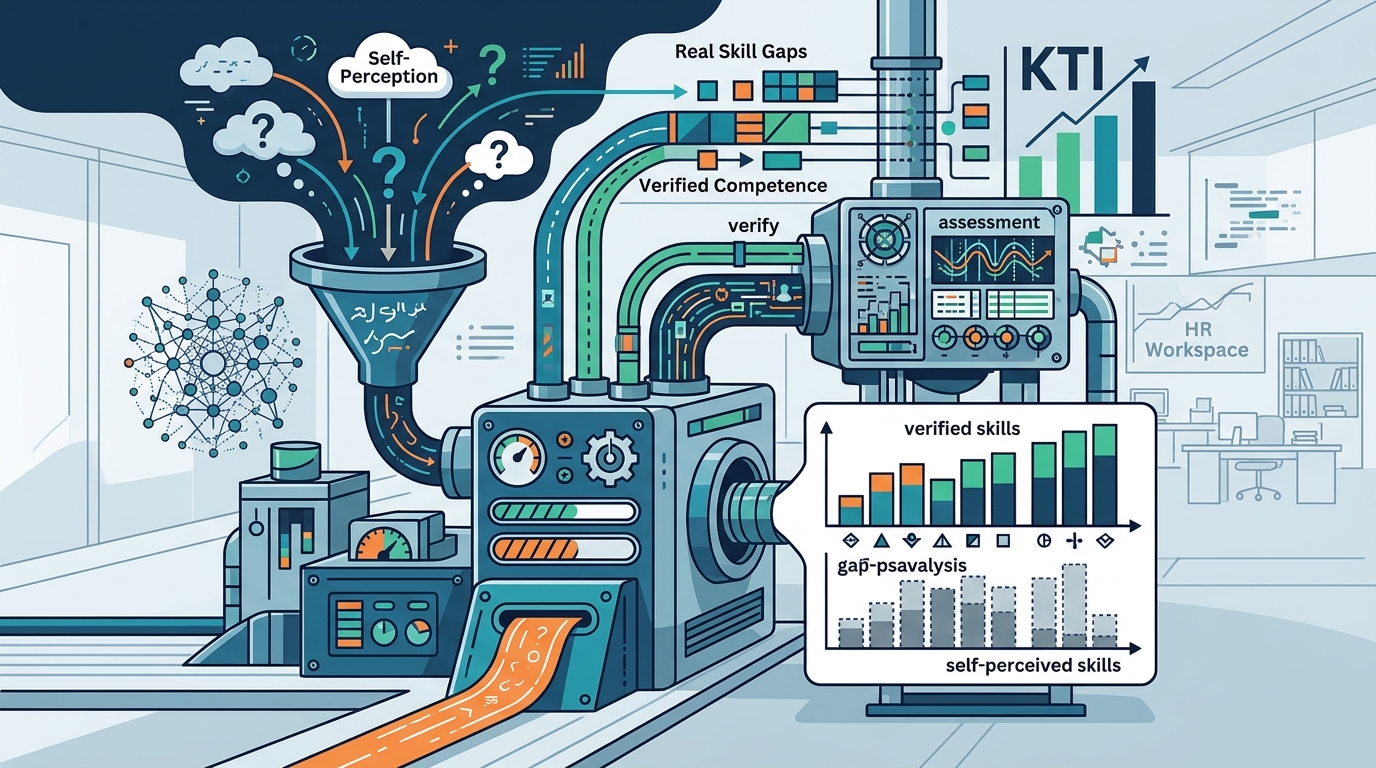
HR teams can identify real skill gaps by replacing self-reported data with objective, adaptive assessments that verify actual competency levels. This approach distinguishes between what employees believe they know and what they can demonstrably execute. The Wise Skill provides a framework for this verification, ensuring that workforce planning is based on evidence rather than intuition.
The Limitation of Self-Reporting
Self-assessment is a common starting point for talent reviews, but it is inherently flawed. Employees often overestimate their capabilities due to the Dunning-Kruger effect, where lower-ability individuals overestimate their competence. Conversely, high performers may underestimate their skills due to imposter syndrome. Relying solely on self-reports creates a distorted view of the workforce. For additional details, review the Blog Skill intelligence para.
Self-reporting is a subjective declaration of skills that lacks external validation. When HR builds a skills map based only on these declarations, the resulting gap analysis is unreliable. The discrepancy between perceived and actual skill levels can lead to misallocated training budgets and poor hiring decisions. To address this, organizations need a mechanism that tests the actual application of skills, not just the claim of them. To address this, you can request a demo.
Adaptive Assessment as the Solution
Adaptive assessment is a testing methodology that adjusts question difficulty in real-time based on the respondent's answers. This technique allows for a precise measurement of skill level with fewer questions than static tests. By using adaptive algorithms, platforms can determine the exact proficiency level of an employee in a specific skill within minutes. For additional details, review the Aviso legal The Wise.
The Wise Skill utilizes adaptive evaluations to verify the real level of each person. This process moves beyond simple multiple-choice quizzes to assess practical application. The result is an objective score that reflects demonstrated ability. This data point is crucial for creating an accurate skills map. It ensures that when a gap is identified, it represents a true deficit in capability, not just a lack of confidence.
Two-Level Gap Analysis
A robust skills gap analysis requires comparing two distinct data sets: the business requirement and the individual capability. The first level defines what the role demands to deliver the company strategy. The second level measures what the employee can actually do. The gap is the difference between these two verified data points.
Traditional HR systems often conflate these two levels or rely on job descriptions that are rarely updated. The Wise Skill platform creates a two-level gap analysis on the same skills map. This allows HR to see exactly where the business needs improvement and which specific employees are holding back progress. For example, if a data analyst role requires advanced Python, the platform verifies if the current analyst possesses that specific level of proficiency. This precision enables targeted interventions rather than blanket training programs.
From Gap Identification to Action
Identifying a gap is only useful if it leads to a specific action. HR teams must decide whether to train, hire, or redeploy talent to close the gap. The decision depends on the size of the gap and the strategic importance of the skill. A small gap can be closed with microlearning, while a large gap may require hiring or internal mobility.
Implementation and Timeline
Implementing a verified skills assessment process does not require a lengthy overhaul. Modern platforms allow for rapid deployment. The Wise Skill enables organizations to build their first skills map in minutes. This initial map provides an immediate baseline of the workforce's capabilities. Full value is realized within 15 days, as the platform integrates with existing HRIS and ATS systems.
This rapid implementation allows HR teams to start making evidence-based decisions quickly. It removes the barrier of data collection that often delays talent projects. By starting with a verified baseline, organizations can track progress over time. The ability to measure improvement objectively is key to demonstrating the ROI of talent development initiatives.
Key Takeaways
- Self-reporting is subjective and often inaccurate due to cognitive biases.
- Adaptive assessment provides an objective measure of actual skill levels.
- Effective gap analysis compares business requirements with verified individual capabilities.
- Gap identification should be linked to specific actions like training or hiring.
- Modern platforms can generate a verified skills map in minutes.
- Human decision-making remains central, with AI providing data-driven proposals.
Frequently Asked Questions
Why is self-assessment unreliable for skills mapping?
Self-assessment is unreliable because it is influenced by cognitive biases such as overconfidence or imposter syndrome. It measures perception, not actual capability, leading to inaccurate gap analyses.
What is adaptive assessment in the context of HR?
Adaptive assessment is a testing method where questions adjust in difficulty based on previous answers. It allows for precise measurement of skill levels with fewer questions than static tests.
How does The Wise Skill verify employee skills?
Can AI make decisions about employee skills?
How long does it take to implement a skills map?
The first skills map can be created in minutes using The Wise Skill. Full value is typically realized within 15 days of implementation.
What is a two-level gap analysis?
A two-level gap analysis compares what the business requires for a role with what the employee can actually do. The difference between these two verified data points is the skill gap.
Conclusion
Identifying real skill gaps requires moving beyond intuition and self-reporting. By using adaptive assessments and two-level gap analysis, HR teams can build an accurate picture of their workforce's capabilities. The Wise Skill provides the tools to verify skills, identify gaps, and plan actions with confidence. To start your diagnosis and build your first verified skills map, request a demo. Learn more: Tu estrategia convertida en.