
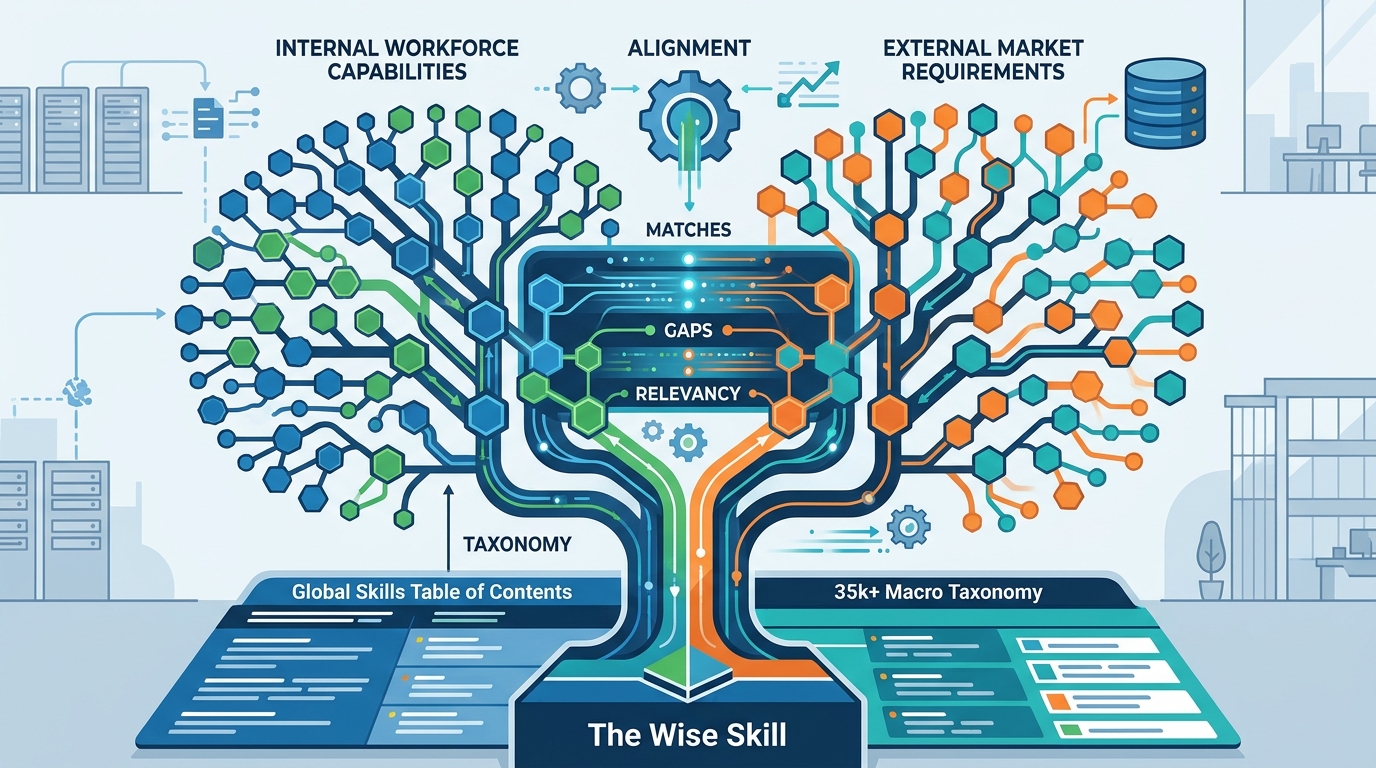
Companies can effectively map workforce skills by building a dynamic taxonomy that connects internal employee capabilities with external market demands. This process moves beyond static job descriptions to create a living data model. The Wise Skill provides the infrastructure to automate this alignment, ensuring your talent strategy reflects real-time market shifts rather than outdated assumptions. according to The Global Skills
The Shift from Static Roles to Dynamic Skills
Traditional HR systems rely on job titles and static descriptions. This approach fails in a volatile market where roles evolve rapidly. Skills mapping is the process of defining and cataloging the specific competencies required for every role within an organization. It transforms a static job description into a dynamic repository of talent requirements. By focusing on skills rather than titles, companies gain a granular view of their workforce capabilities. according to Skills signalling in
The market is changing faster than most internal HR processes can adapt. According to the OECD, demographic changes and the green and digital transition are altering the age structure of the workforce and the skills required for participation. This creates a pressure on skill supply that static models cannot handle. When a company relies solely on job titles, it misses the nuance of what employees can actually do. A dynamic skills map allows leaders to see the true depth of their talent pool. It reveals hidden capabilities that do not align with current job titles but are critical for future strategy.
The implication is clear: static mapping leads to strategic blind spots. If you cannot see the skills your team actually possesses, you cannot align them with market needs. You risk over-hiring for skills you already have or under-investing in skills you lack. The Wise Skill addresses this by generating a custom skills map from your company name or HRIS data. This automation eliminates manual data entry and ensures every role is linked to a standardized set of skills. according to Skills first in
Building a Living Taxonomy for Market Alignment
A skills taxonomy is a structured framework that categorizes skills into a hierarchical system. It serves as the shared language between HR, business leaders, and employees. Without a clear taxonomy, teams rely on intuition rather than evidence. The Wise Skill utilizes a living taxonomy of skills and professional profiles. These profiles are continuously updated through AI and expert validation. This ensures that your internal language for talent remains aligned with current market standards. according to Skills Gaps A
Static lists become obsolete quickly. The market introduces new tools, methodologies, and expectations every year. A living taxonomy integrates internal nomenclatures with global frameworks like ESCO or DigComp. This integration creates a bridge between your internal data and external market benchmarks. For example, a company might use the term "Data Wizard" internally. The taxonomy maps this to standard skills like "Python Programming" and "Data Visualization." This allows for accurate comparison against market requirements. It ensures that when you assess a gap, you are comparing apples to apples.
The evidence for this approach is strong. The OECD notes that skills-first approaches are gaining traction in labor markets to address mismatches between worker capabilities and employer needs. By adopting a living taxonomy, companies can anticipate these mismatches. They can see which skills are rising in the market and which are declining. This proactive view allows for strategic workforce planning. It moves the conversation from reactive hiring to proactive development. The Wise Skill’s platform supports this by maintaining a repository of over 35,000 skills and 3,200 professional profiles.
Identifying Gaps with Objective Evidence
Skills gap identification is the analysis of the difference between the skills required for a role and the skills an employee actually possesses. Traditional methods often rely on self-reported data or manager perception. These methods are subjective and prone to bias. Objective assessment is critical for accurate mapping. The Wise Skill uses a high-precision adaptive assessment engine to measure real talent levels. This engine picks questions based on previous answers, stopping once the result reaches statistical confidence. This method is similar to professional certification exams but faster and more precise.
Self-assessment is a common starting point, but it is not a reliable end point. Employees often overestimate or underestimate their abilities. Managers may have blind spots regarding their direct reports. A robust mapping process requires verification. The platform cross-checks declared skills against verified ones. It shows where perception runs ahead of the measured level. This side-by-side view is powerful. It reveals the true gap, role by role and person by person. It ensures that training investments are directed at actual deficits, not perceived ones.
The implication of objective gap analysis is financial efficiency. Training budgets are often wasted on courses for skills employees already master. By verifying skills first, companies can target their spending. They can identify which gaps are critical for business strategy and which are less urgent. The Wise Skill ranks gaps by business impact, not by gut feeling. This prioritization ensures that the most valuable development efforts happen first. It aligns individual growth with organizational goals. It creates a clear path from current state to desired future state.
Connecting Internal Talent to External Market Data
Mapping skills is not just an internal exercise. It must be contextualized against external market requirements. The market defines the value of a skill. A skill that is rare and in high demand has a different strategic value than a common one. The Wise Skill connects your internal talent data with external market signals. It analyzes the impact of AI on every role. It breaks down each position into concrete tasks. Each task gets an automation score based on current technology. This helps you see which skills will be missing tomorrow. according to Demand for digital
External data provides the benchmark for your internal map. It tells you what the market expects. It tells you what competitors are hiring for. It tells you what skills are driving innovation in your industry. By overlaying this data on your internal skills map, you can identify strategic vulnerabilities. For example, if the market is shifting toward AI-driven analytics, and your team lacks data interpretation skills, you have a critical gap. This gap is not just a training issue; it is a strategic risk. The platform helps you visualize this risk. It shows you where your workforce is exposed to market shifts.
The evidence supports the need for this external connection. Research from Deloitte shows that only 11% of organizations demonstrate strategic maturity in their workforce planning approach. This low maturity often stems from a lack of external data integration. Companies plan in silos, without seeing the bigger picture. By connecting internal skills to external market data, you elevate your planning maturity. You move from counting headcount to managing capability. You create a workforce that is not just skilled, but strategically aligned. The Wise Skill facilitates this connection by providing a unified view of talent and market trends.
From Mapping to Actionable Strategy
Mapping skills is the foundation, but action is the goal. The map must drive decisions about training, mobility, and hiring. A static map is a document; a dynamic map is a tool. The Wise Skill turns every skill gap into a measurable learning plan. It connects gaps to learning resources. It offers more than 35,000 microlearning plans. These lessons are typically 20 to 30 minutes long. They fit inside a working day. This microlearning approach ensures that development is continuous and practical.
The action phase includes internal mobility. If you have the skills internally, you should use them. The platform identifies internal candidates who already possess the skills needed for new roles. This reduces the need for external hiring. It speeds up time-to-fill. It retains top talent by offering them growth opportunities. The 9-box talent matrix is a useful tool in this phase. It classifies employees into a 3x3 grid based on performance and potential. This visual tool helps leaders identify who is ready for promotion and who needs development. It reduces biases in human resources decisions.
The final implication is a resilient workforce. A workforce that is mapped, assessed, and developed is a workforce that can adapt to change. It is a workforce that is ready for the future. The Wise Skill helps you build this resilience. It provides the data, the tools, and the insights to make informed decisions. It turns your strategy into something measurable. It ensures that your people are aligned with your business goals. It is the bridge between your current state and your future success.
Key Takeaways
- Skills mapping is the process of defining and cataloging the specific competencies required for every role within an organization.
- A living taxonomy is a structured framework that categorizes skills into a hierarchical system, updated continuously through AI and expert validation.
- Skills gap identification is the analysis of the difference between the skills required for a role and the skills an employee actually possesses.
- Objective assessment using adaptive engines provides more accurate data than self-reported or manager-perceived skills.
- Connecting internal talent data with external market signals allows companies to anticipate strategic vulnerabilities and market shifts.
- Dynamic skills maps drive actionable strategies for training, internal mobility, and hiring, reducing reliance on external recruitment.
- The Wise Skill automates this process, providing a unified view of talent and market trends to support strategic workforce planning.
Frequently Asked Questions
What is the difference between skills mapping and workforce planning?
Skills mapping focuses on the specific competencies employees possess and need. Workforce planning is a broader strategic process that analyzes talent supply and demand, including headcount, roles, and budget. Skills mapping is a core component of effective workforce planning.
How often should companies update their skills map?
Skills maps should be treated as living documents. They should be updated continuously as employees acquire new skills, roles change, or market demands shift. Quarterly reviews are a good minimum, but real-time updates are ideal.
Can skills mapping help with AI readiness?
Yes. By mapping skills against AI impact scores, companies can identify which roles are most exposed to automation. This allows them to prioritize reskilling efforts for tasks that remain human-centric, such as critical thinking and complex problem-solving.
What is a Key Talent Indicator (KTI)?
A Key Talent Indicator is a metric that provides a clear baseline for an individual's development. It summarizes their skill levels, potential, and performance in a single view. It helps leaders make quick, data-driven decisions about talent deployment.
How does The Wise Skill handle data privacy?
The Wise Skill is compliant with GDPR and ISO 27001 standards. It ensures that employee data is secure and used only for the purposes of talent development and strategic planning. Users have control over their data and can manage their preferences.
Is skills mapping only for large enterprises?
No. Skills mapping is beneficial for organizations of any size. Small and mid-sized companies often benefit most because they have limited resources and need to maximize the impact of every training dollar. The Wise Skill offers scalable solutions for companies of all sizes.
Conclusion
Mapping workforce skills against market requirements is no longer optional. It is a strategic imperative for any organization seeking to remain competitive. The process requires a living taxonomy, objective assessment, and external market data. The Wise Skill provides the tools to automate this process and turn data into action. By aligning your people with your strategy, you build a resilient workforce ready for the future. To start your diagnosis, visit The Wise Skill.