
Traditional hiring models are failing to meet modern workforce demands. According to recent industry analysis, organizations that adopt skills-based hiring practices report a 20% increase in hiring efficiency and a significant reduction in time-to-fill metrics. This shift is not merely a trend but a fundamental restructuring of how talent is acquired, evaluated, and retained. Companies are moving away from degree requirements and pedigree bias toward measurable competencies that directly correlate with job performance. This guide explores the structural advantages of this approach and how to implement it effectively.
Understanding Skills-Based Hiring
Skills-based hiring is a recruitment methodology that prioritizes the specific abilities and competencies required to perform a job over traditional credentials such as university degrees or years of experience. Skills-based hiring is a recruitment methodology that prioritizes the specific abilities and competencies required to perform a job over traditional credentials. This approach relies on work samples, practical assessments, and structured interviews to evaluate candidates objectively.
The framework dismantles the "paper ceiling" that often blocks qualified candidates from non-traditional backgrounds. By focusing on what a candidate can do rather than where they studied, organizations can identify high-potential individuals who might otherwise be filtered out by automated resume screening systems. This method aligns closely with the mission of platforms like The Wise Skill, which focuses on recruiting and training that finally work by emphasizing practical capability.
Expanding Talent Pools and Diversity
One of the most immediate benefits of adopting a skills-based framework is the dramatic expansion of the available talent pool. Traditional hiring criteria often exclude up to 75% of potential candidates due to arbitrary degree requirements. By removing these barriers, companies gain access to a more diverse and global workforce.
Diversity is not just a moral imperative but a business advantage. Research indicates that diverse teams are more innovative and better at problem-solving. When hiring is based on skills, candidates from underrepresented groups, career changers, and self-taught professionals can compete on equal footing. This inclusivity drives better organizational outcomes and fosters a culture of meritocracy.
Reducing Bias and Increasing Fairness
Unconscious bias in hiring is a persistent challenge that affects hiring decisions at every level. Unconscious bias in hiring is a persistent challenge that affects hiring decisions at every level. Skills-based hiring mitigates this by introducing objective criteria. When candidates are evaluated on standardized work samples or technical tests, the subjective preferences of hiring managers are minimized.
This objectivity ensures that the best candidate for the job is selected based on evidence rather than affinity or pedigree. It creates a fairer process for everyone involved. For more insights on creating fair recruitment processes, you can explore resources on recruitment best practices.
Improving Retention and Performance
Hiring for skills leads to better job-person fit. When employees are hired based on their proven abilities, they are more likely to feel confident and competent in their roles. This confidence translates to higher engagement and lower turnover rates. Employees who feel their skills are valued and utilized effectively are more likely to stay with the organization long-term.
Furthermore, skills-based hiring supports internal mobility. Organizations can identify employees with the potential to take on new roles by assessing their current skills against future requirements. This approach reduces the need for external hiring and promotes a culture of continuous learning and development.
Cost Efficiency and Speed
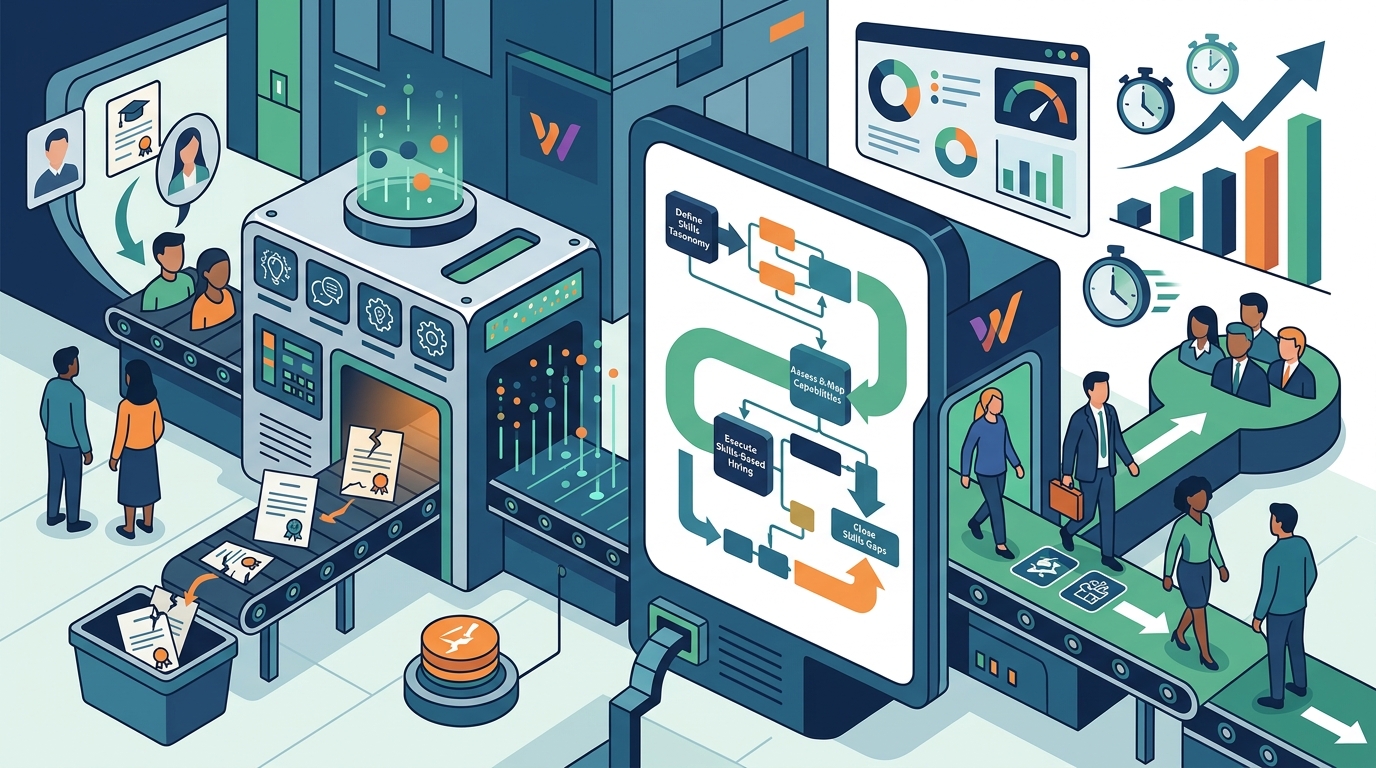
Traditional hiring processes are often slow and expensive. The average time-to-fill for a position can exceed 40 days, costing companies thousands of dollars in lost productivity. Skills-based hiring accelerates this process by streamlining the evaluation phase. Practical assessments can be administered quickly and scored objectively, reducing the time spent on multiple rounds of interviews.
Additionally, reducing time-to-fill lowers the cost-per-hire. Companies spend less on advertising and agency fees when they can efficiently identify and onboard qualified candidates. The efficiency gains are significant, allowing HR teams to focus on strategic initiatives rather than administrative tasks.
Comparison of Hiring Models
To understand the advantages of skills-based hiring, it is helpful to compare it with traditional credential-based hiring. The table below outlines the key differences in approach and outcome.
| Feature | Traditional Credential-Based Hiring | Skills-Based Hiring |
|---|---|---|
| Primary Criteria | Degrees, Certifications, Years of Experience | Work Samples, Practical Tests, Demonstrated Competencies |
| Talent Pool Size | Restricted by educational and pedigree filters | Expanded to include non-traditional and diverse candidates |
| Bias Mitigation | High risk of unconscious bias based on pedigree | Lower risk due to objective, standardized evaluation |
| Time-to-Fill | Often 40+ days due to complex screening | Reduced through streamlined, focused assessments |
| Job Performance | Correlation with degree is weak | Strong correlation with demonstrated skills |
Key Takeaways
- Skills-based hiring prioritizes demonstrable abilities over formal education, leading to more accurate candidate evaluation.
- Organizations can access a significantly larger and more diverse talent pool by removing degree requirements.
- Objective assessments reduce unconscious bias, promoting fairness and equity in the hiring process.
- Improved job-person fit results in higher employee retention and engagement levels.
- Streamlined evaluation processes reduce time-to-fill and overall cost-per-hire metrics.
- Internal mobility is enhanced as skills can be mapped to future roles within the organization.
- Platforms like The Wise Skill offer tools to facilitate this transition effectively.
Frequently Asked Questions
What is the definition of skills-based hiring?
Skills-based hiring is a recruitment methodology that prioritizes the specific abilities and competencies required to perform a job over traditional credentials. It focuses on what a candidate can do rather than where they studied.
How does skills-based hiring improve diversity?
By removing arbitrary degree requirements, skills-based hiring opens the door to candidates from non-traditional backgrounds, including self-taught professionals and career changers, thereby increasing demographic diversity.
Is skills-based hiring more cost-effective?
Yes, it reduces costs by shortening the time-to-fill and decreasing reliance on expensive external recruiting agencies. It also lowers turnover costs by ensuring better job-person fit.
Can skills-based hiring be used for senior roles?
Absolutely. While often associated with entry-level roles, skills-based hiring is increasingly used for executive positions to assess strategic thinking, leadership capabilities, and specific industry expertise through case studies and practical exercises.
What tools are needed to implement skills-based hiring?
Organizations need assessment platforms, structured interview guides, and clear competency frameworks. Tools like those provided by The Wise Skill can help standardize these processes.
How do you measure the success of skills-based hiring?
Success is measured by metrics such as time-to-fill, cost-per-hire, retention rates, and performance reviews of new hires. A significant improvement in these areas indicates a successful transition.
Does skills-based hiring eliminate the need for cultural fit?
No, cultural fit remains important. However, it is often reframed as "culture add," where candidates are evaluated on how their unique skills and perspectives can enhance the existing team dynamic.
What is the biggest challenge in adopting skills-based hiring?
The primary challenge is shifting organizational mindset and building the infrastructure to assess skills objectively. It requires training hiring managers and investing in reliable assessment tools.
Next Steps
Transitioning to a skills-based hiring framework is a strategic move that pays dividends in talent quality, diversity, and operational efficiency. To begin this transformation, you need a robust system for assessing and validating skills. Schedule a demo with The Wise Skill to see how our platform can help you recruit and train talent that finally works. Visit our about page to learn more about our mission and legal terms for more information.