
Companies can find internal candidates before posting an open role externally by using a skill intelligence platform that maps employee capabilities against role requirements. The Wise Skill enables this by connecting business needs with assessed talent evidence. This guide covers internal candidate identification, skills matching, and talent marketplace workflows to help you build a data-driven internal mobility strategy.
Internal Candidate Identification
Internal candidate identification is the process of locating employees within your organization who possess the capabilities required for a new or evolving role. Traditional methods rely on managers remembering who is good at what, which is slow and biased. A modern approach uses data to surface hidden talent before you spend money on external recruitment.
From Intuition to Evidence
Most organizations struggle because they do not have a clear picture of their current workforce capabilities. The Wise Skill transforms this by converting static job descriptions into dynamic skill maps. Instead of guessing, you see a live image of the talent you already have. This allows you to identify individuals who may not be in the obvious department but have the right skills.
The Role of Skill Mapping
Skill mapping is the foundational step in identifying internal candidates. It involves defining the specific knowledge and abilities required for a role and comparing them against the assessed levels of your employees. By using a shared taxonomy, you ensure that everyone in the company speaks the same language about talent. This clarity is essential for spotting potential internal movers.
When you map skills, you move from perception to objective fact. You can see exactly where the gaps are and who is ready to step up. This visibility is critical for planning internal mobility. It helps you decide whether to train someone, move them, or hire externally. The goal is to make the right decision with the right data.
Skills Matching
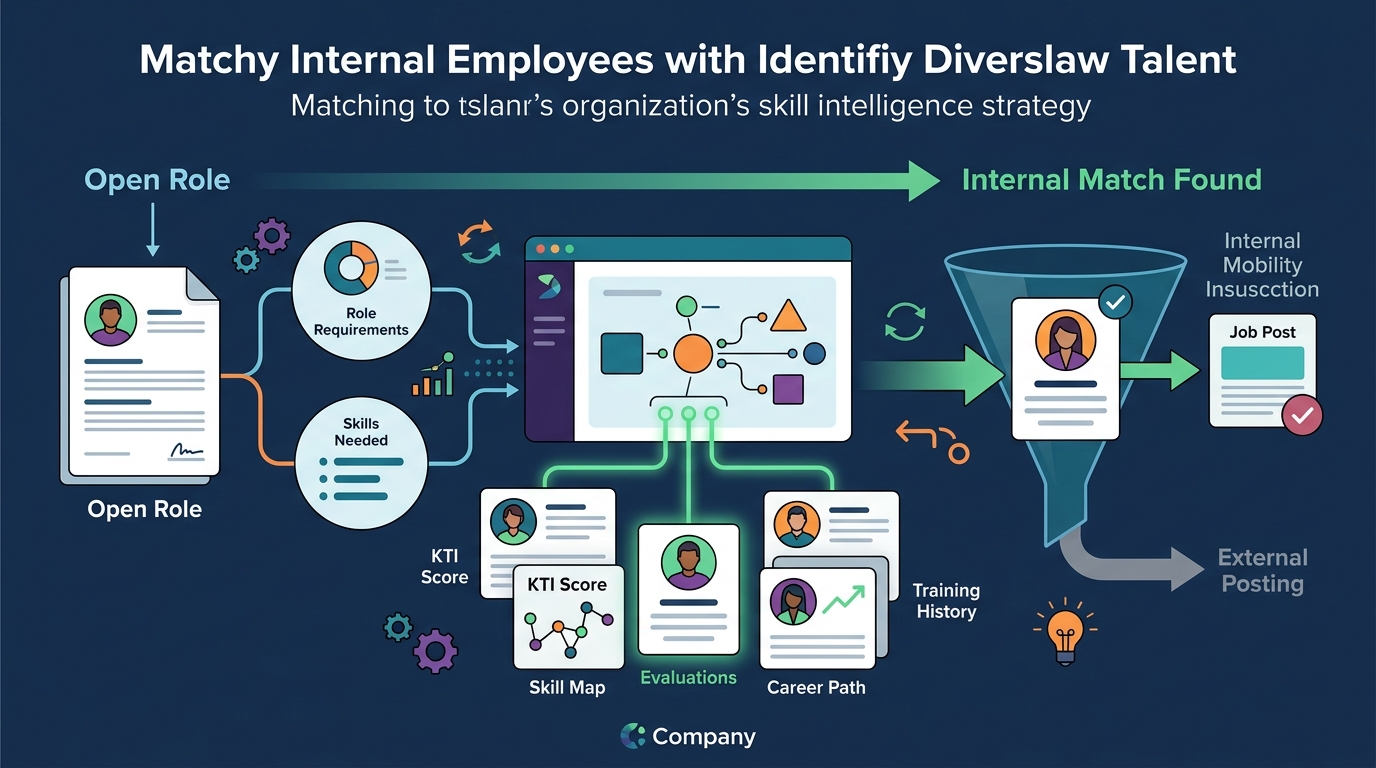
Skills matching is the technical process of comparing the requirements of a role with the verified capabilities of a candidate. It goes beyond keyword matching in a resume. It looks at the depth and proficiency of specific skills. This precision ensures that you are matching people to roles based on actual ability, not just job titles.
Why Keyword Matching Fails
Traditional Applicant Tracking Systems (ATS) often rely on keywords. This approach misses candidates who have the right skills but used different terminology in their profiles. It also fails to distinguish between someone who knows a skill and someone who has mastered it. Skills matching solves this by using a standardized framework to evaluate proficiency levels.
Assessment Evidence
At The Wise Skill, matching is supported by assessment evidence. We use adaptive assessments to measure the real level of each person. This means the match is based on verified data, not self-reported claims. The platform contrasts the role requirements with the available evidence to provide a clear picture of fit. This evidence-based approach reduces the risk of bad hires and misplacements.
Effective skills matching requires a robust taxonomy. The Wise Skill utilizes a living taxonomy with over 35,000 skills. This extensive library ensures that you can define roles with high granularity. It also allows for continuous updates as the market evolves. By keeping your taxonomy current, you ensure that your matching remains relevant and accurate.
Talent Marketplace
A talent marketplace is a digital platform that connects employees with opportunities within the organization. It functions as an internal job board but with a skills-based focus. Employees can browse roles that match their profiles, and managers can find candidates for open positions. This creates a two-way flow of talent and opportunity. according to Report A Nation
Building an Internal Marketplace
Benefits of Internal Mobility
However, a talent marketplace only works if the data is accurate. If your skill data is outdated or incomplete, the marketplace will show irrelevant matches. This is why assessment and mapping are so important. They provide the foundation for a functional marketplace. By investing in data quality, you ensure that your internal marketplace delivers real value.
| Feature | Traditional ATS | Skill Intelligence Platform |
|---|---|---|
| Matching Method | Keyword-based | Assessment-based proficiency |
| Data Source | Resume/CV text | Verified skill assessments | Internal Visibility | Low (manual search) | High (automated mapping) | Update Frequency | Static (upon application) | Dynamic (continuous learning) |
Key Takeaways
- Internal candidate identification relies on skill mapping to surface hidden talent.
- Skills matching uses assessment evidence to verify proficiency, not just keywords.
- A talent marketplace connects employees with internal opportunities based on skills.
- Internal mobility reduces hiring costs and improves retention.
- Accurate data is the foundation of a functional internal marketplace.
- Assessments provide a defensible basis for talent decisions.
- Continuous updates to skill data ensure the marketplace remains relevant.
Frequently Asked Questions
How does skill intelligence differ from a standard ATS?
Skill intelligence focuses on verified capabilities and proficiency levels, while a standard ATS relies on keyword matching from resumes. This allows for more accurate internal candidate identification.
Can I use skill intelligence to find candidates for roles I haven't posted yet?
Yes. By mapping your current workforce skills, you can identify employees who are ready for new roles before you even create a job posting. This proactive approach saves time and money.
What is a skills taxonomy?
How do I ensure my skill data is accurate?
Use adaptive assessments to verify employee skills. These assessments adjust to the candidate's level, providing a precise measurement of their capabilities. This evidence-based approach ensures data accuracy.
Is a talent marketplace just an internal job board?
No. A talent marketplace is a skills-based platform that connects employees with opportunities. It uses data to match people to roles, rather than just listing open positions.
How long does it take to implement a skill intelligence platform?
Does skill intelligence replace my HR team?
No. The platform provides data and recommendations, but your HR team makes the final decisions. The agents propose actions, and you approve them. This ensures human control over talent decisions.
Can I integrate skill intelligence with my existing HRIS?
Yes. The Wise Skill integrates with your LMS, HRIS, and content providers. This ensures that data flows smoothly between systems without manual work.
Conclusion
Finding internal candidates before posting externally is a strategic advantage. It saves money, improves retention, and accelerates growth. The key is to use a skill intelligence platform that provides accurate, evidence-based data. The Wise Skill offers the tools you need to map, evaluate, and match skills effectively. By leveraging our platform, you can build a robust internal talent marketplace. Start by exploring how we can help you transform your talent management. Request a demo to see how The Wise Skill can help you find the right people, inside and out.