
Aligning Employee Skills With Business Strategy Using Talent Intelligence Platforms
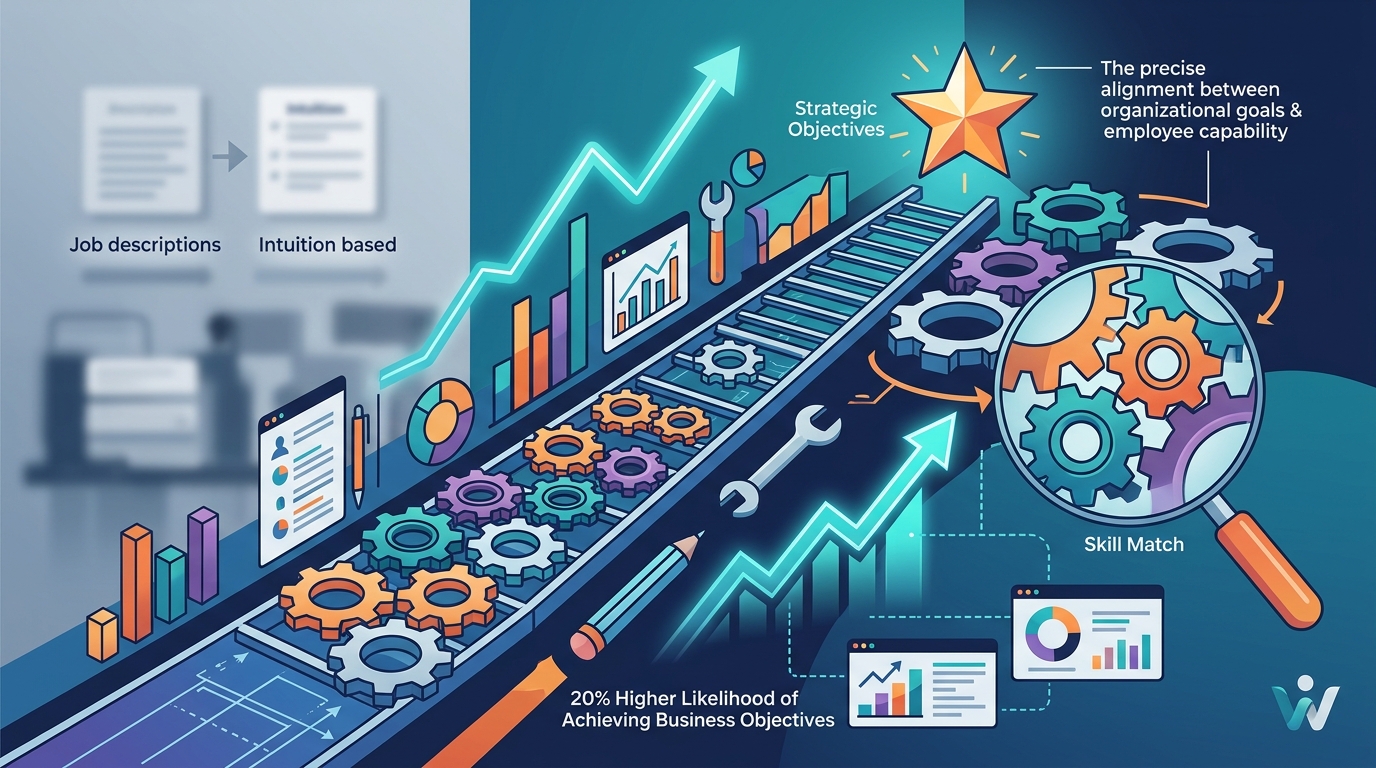
Organizations that fail to align their workforce capabilities with strategic goals face significant performance gaps. According to recent industry analysis, companies leveraging data-driven talent strategies see a 20% higher likelihood of achieving their business objectives compared to those relying on intuition. This shift marks the end of static job descriptions and the beginning of dynamic skill-based management. (Qui nes somos Skill)
Understanding Talent Intelligence
Talent intelligence is the systematic collection and analysis of data regarding employee skills, performance, and potential. It moves beyond traditional human resources metrics to provide a real-time view of organizational capability. This approach allows leaders to make decisions based on evidence rather than historical assumptions. (Skill Intelligence Blog Insights)
At its core, talent intelligence is the continuous measurement and application of workforce data to drive strategic business outcomes. It integrates internal data with external market trends to create a living map of organizational capacity. This enables companies to anticipate future needs rather than reacting to past failures. (Identificar Gaps de Skills)
The foundation of this system lies in the concept of skill taxonomy is a structured classification of skills and competencies used to define roles and measure proficiency. Without a standardized taxonomy, data remains siloed and unusable for strategic planning. A unified language between HR and business leaders ensures that skill definitions are consistent across the enterprise.
The Strategy-Skill Gap
Many organizations struggle to execute their strategies because their current workforce lacks the necessary skills. This disconnect is often referred to as the skills gap. It is not merely a hiring problem but a structural alignment issue. Leaders must identify which roles are critical to future success and which are at risk of obsolescence due to technological changes.
Data shows that the half-life of professional skills is shrinking rapidly. According to the World Economic Forum, 50% of all employees will need reskilling by 2025 due to the adoption of new technologies. This statistic highlights the urgency of proactive skill management. Waiting for a vacancy to arise before addressing a skill deficit is no longer a viable strategy.
The gap manifests in three primary areas:
- Strategic Alignment: The mismatch between business goals and workforce capabilities.
- Technological Disruption: The rapid automation of routine tasks requiring human reinvention.
- Agility: The inability to redeploy talent quickly to new opportunities.
Addressing this gap requires a shift from role-based management to skill-based management. This approach focuses on what people can do rather than what their job title says they should do. It creates a more flexible and resilient organization.
Mapping Skills to Strategy
The first step in alignment is mapping the skills required for current and future strategic objectives. This process involves deconstructing roles into their constituent tasks and identifying the skills needed to perform them effectively. It transforms abstract business goals into concrete talent requirements.
Effective mapping begins with context. Talent mapping is the process of identifying and documenting the skills and competencies required for each role within an organization. This is not a static exercise. It must evolve as the business strategy changes. The goal is to create a dynamic model that reflects the real needs of the enterprise.
Key steps in the mapping process include:
- Define Strategic Priorities: Identify the key business outcomes for the next 1-3 years.
- Deconstruct Roles: Break down critical roles into specific tasks and skills.
- Validate with Experts: Ensure the defined skills are relevant and accurate.
- Integrate with Data: Connect the map to existing HR systems for real-time updates.
This process reveals the "skills gaps" that prevent the organization from achieving its goals. It allows leaders to prioritize reskilling initiatives for the highest impact. By focusing on critical skills, companies can optimize their training budgets and improve ROI.
Evaluating Real Capability
Once the required skills are defined, the next step is to measure the current capability of the workforce. Traditional performance reviews are often subjective and biased. Talent intelligence platforms use adaptive assessments to provide objective, data-driven evaluations of employee skills.
Adaptive testing adjusts the difficulty of questions in real-time based on the candidate's responses. This method provides a more accurate measure of proficiency than static tests. It reduces test fatigue while maximizing precision. The result is a reliable baseline for each employee.
Key benefits of objective evaluation include:
- Reduced Bias: Data-driven assessments minimize human bias in skill measurement.
- Real-Time Insights: Immediate feedback on skill levels allows for faster decision-making.
- Personalized Development: Individual reports highlight specific gaps and recommend targeted learning paths.
This evaluation process is not about judging employees but about understanding their potential. It creates a culture of continuous improvement where development is tied to clear, measurable outcomes. Employees gain visibility into their own skill profiles and career paths.
Platform Capabilities Overview
Not all talent intelligence platforms offer the same capabilities. When selecting a solution, it is crucial to evaluate how well it aligns with your specific strategic needs. The following table compares key features of leading approaches in the market.
| Feature | Traditional HRIS | Learning Management System (LMS) | Talent Intelligence Platform |
|---|---|---|---|
| Skill Measurement | Self-reported | Course completion only | Adaptive assessment & evidence-based |
| Strategic Alignment | Low | Medium | High (Dynamic mapping) |
| Automation | Administrative tasks | Content delivery | Talent matching & gap closure |
| Data Integration | Siloed | Limited | Unified ecosystem |
Talent intelligence platforms like The Wise Skill offer a distinct advantage by focusing on skill intelligence rather than just administrative tracking. They connect business context with evaluated capabilities to drive action. This ensures that talent decisions are always aligned with strategic priorities.
Key Takeaways
- Data-Driven Decisions: Aligning skills with strategy requires objective data, not intuition.
- Dynamic Mapping: Skill taxonomies must evolve with business strategy to remain relevant.
- Adaptive Assessment: Real-time skill measurement provides accurate baselines for development.
- Strategic Gaps: Identifying gaps early allows for proactive reskilling and hiring.
- Unified Language: A common skill taxonomy bridges the gap between HR and business leaders.
- Continuous Improvement: Talent intelligence is an ongoing process, not a one-time project.
- ROI on Training: Targeted reskilling based on gap analysis maximizes training investment.
Frequently Asked Questions
What is the difference between talent management and talent intelligence?
Talent management focuses on administrative processes like hiring and retention. Talent intelligence uses data analytics to measure and predict workforce capabilities in alignment with business strategy.
How does adaptive assessment improve skill measurement?
Adaptive assessment adjusts question difficulty in real-time, providing a more accurate and efficient measure of proficiency compared to static tests.
Why is a skill taxonomy important for strategic alignment?
A skill taxonomy provides a standardized language for defining roles and measuring skills, ensuring consistency across the organization and enabling accurate gap analysis.
Can talent intelligence replace traditional performance reviews?
While it enhances performance management with objective data, it complements rather than replaces human judgment by providing evidence-based insights for development.
How quickly can an organization see ROI from talent intelligence?
Organizations often see initial ROI within months by reducing hiring errors and optimizing training spend through targeted gap closure.
What role does AI play in talent intelligence?
AI automates skill mapping, analyzes assessment data, and predicts future skill needs, enabling proactive talent strategy.
Is talent intelligence suitable for all company sizes?
Yes, scalable platforms can serve startups to enterprises by providing insights proportional to the organization's complexity.
Next Steps
Aligning your workforce with business strategy is no longer optional. It is a competitive imperative. Start by defining your critical skills and measuring your current capability. Schedule a demo to see how talent intelligence can transform your organization. Discover how to map skills, evaluate teams, and close gaps in minutes. Take control of your talent strategy today.