
Step-by-Step Guide to Running Workforce Skills Gap Analysis with AI-Powered Assessment
Organizations that fail to identify and close critical skill gaps face significant operational risks, with recent industry data showing that up to 30% of workforce productivity is lost due to misaligned talent capabilities. Traditional methods of talent management rely heavily on intuition and static job descriptions, which often lag behind the rapid evolution of business needs. This guide explains how to leverage AI-powered assessment to transform your workforce strategy from reactive guessing to proactive, data-driven precision. (Identificar Gaps de Skills)
Understanding the Skills Gap in the Modern Era
A skills gap analysis is the systematic process of comparing the skills your organization currently possesses against the skills it needs to achieve its strategic objectives. In the past, this was a manual, annual exercise often conducted through self-reported surveys. Today, the velocity of technological change, particularly with the rise of generative AI, has made static job descriptions obsolete. According to recent workforce studies, the half-life of professional skills is shrinking, meaning that what was relevant three years ago may be irrelevant today. This dynamic environment requires a continuous, evidence-based approach to talent management.
The core challenge for HR leaders is not just identifying that a gap exists, but understanding the specific nature of that gap. Is it a lack of technical proficiency? A deficit in soft skills like leadership or communication? Or perhaps a misalignment between employee potential and role requirements? AI-powered assessment tools address this by providing real-time, objective data on employee capabilities, allowing organizations to move beyond perception and into precision.
Step 1: Define Business Context and Strategic Goals
The foundation of any effective skills gap analysis is a clear understanding of your business context. You cannot map skills if you do not know what the business needs. This step involves aligning your talent strategy with your corporate purpose and strategic priorities. Instead of starting with a generic list of skills, you must start with the specific challenges and opportunities your organization faces.
Begin by documenting your current business strategy. Are you expanding into new markets? Adopting new technologies? Restructuring for efficiency? Each of these scenarios demands a different set of skills. For example, a company pivoting to AI-driven services will need a different skill profile than one focusing on operational excellence. This contextual definition ensures that the subsequent analysis is relevant and actionable. It transforms the skills gap analysis from an HR exercise into a business imperative.
Step 2: Map Skills Using Intelligent Taxonomies
Once the business context is defined, the next step is to create a dynamic map of the skills required for each role. Traditional job descriptions are often static and vague. In contrast, an intelligent skills map breaks down roles into specific, measurable tasks and competencies. This process involves defining a taxonomy that is both comprehensive and adaptable.
Using AI-driven tools, you can automate the creation of these skill maps. By inputting your company name or uploading organizational data, the system can reconstruct departments, profiles, and the specific skills each position demands. This eliminates the need for manual data entry and ensures consistency across the organization. The resulting taxonomy serves as a common language for HR, management, and employees, ensuring that everyone understands what is expected and what is valued.
This step is critical because it establishes the "target" state. Without a clear map of required skills, you cannot accurately measure the "current" state. The intelligent taxonomy also evolves with the market, ensuring that your skill definitions remain relevant over time. This dynamic approach allows you to detect emerging skill needs before they become critical bottlenecks.
Step 3: Conduct AI-Powered Talent Assessment
With the target skills defined, you must now measure the current capabilities of your workforce. This is where AI-powered assessment shines. Traditional tests often rely on static questions that do not adapt to the candidate's level, leading to inaccurate results and candidate fatigue. AI-driven assessments, however, use adaptive algorithms to adjust the difficulty of questions in real-time based on the respondent's answers.
This adaptive approach ensures that the assessment is both efficient and precise. The system stops asking questions once it has reached a statistically confident measure of the individual's skill level. This not only saves time but also provides a more accurate picture of true capability. The assessment covers a vast library of validated questions, ensuring that the evaluation is robust and reliable.
Furthermore, AI-powered assessments can evaluate both hard skills and soft skills. They can measure technical proficiency, cognitive abilities, and even behavioral traits. This holistic view allows you to identify not just what employees know, but how they apply that knowledge. The results are objective, defensible, and free from the biases that often plague traditional performance reviews.
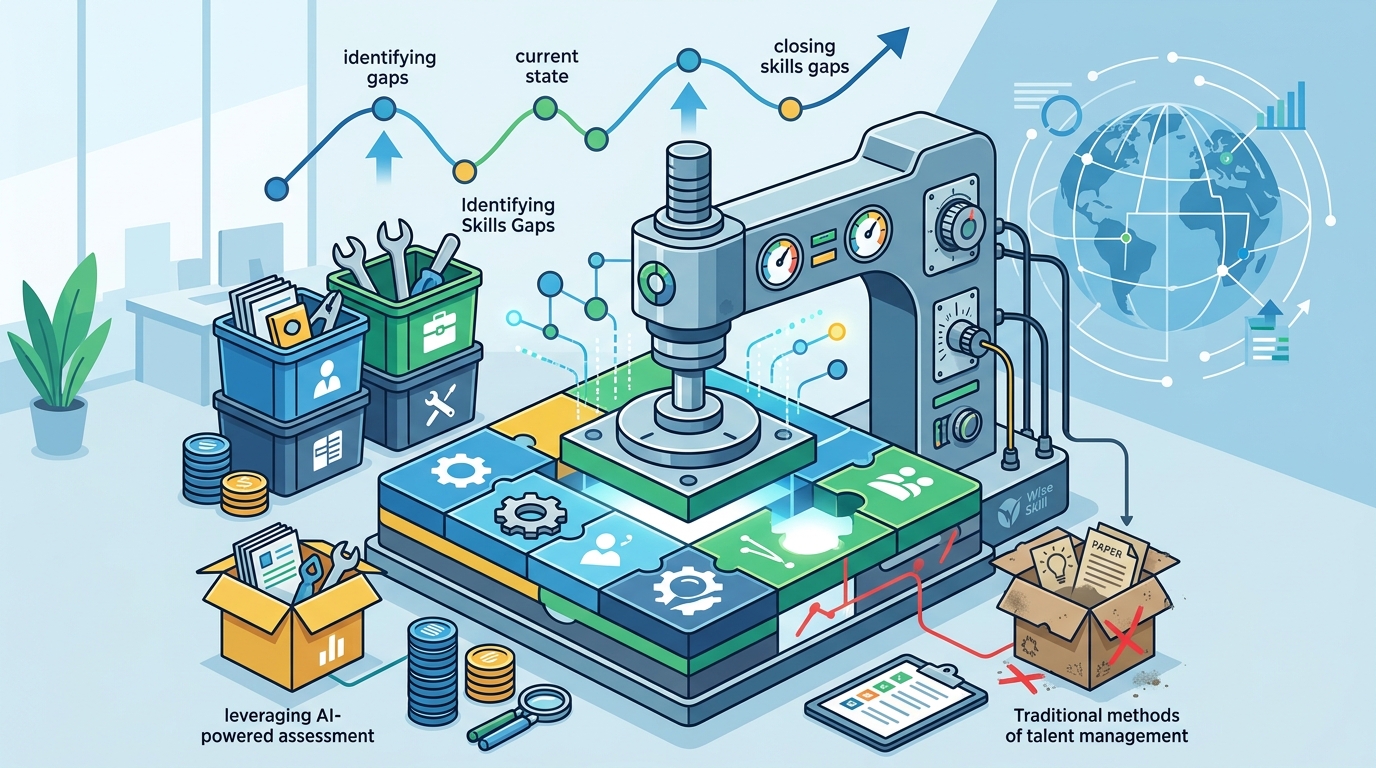
Step 4: Analyze Data and Identify Critical Gaps
Once the assessments are complete, the real work begins: analyzing the data to identify gaps. This step involves comparing the individual skill scores against the target skill map defined in Step 2. The goal is to pinpoint specific areas where the workforce is lacking and where it is strong.
AI analytics tools can process this data at scale, providing detailed insights into skill distribution across the organization. You can identify not just individual gaps, but also team-wide or department-wide trends. For example, you might discover that your entire engineering team lacks proficiency in a new programming language, or that your sales team is strong in technical skills but weak in communication.
This analysis also helps you prioritize actions. Not all gaps are created equal. Some gaps may be critical to business success, while others may be less urgent. By ranking gaps based on their impact on business objectives, you can focus your resources on the most important areas. This data-driven prioritization ensures that your talent development efforts are aligned with your strategic goals.
Step 5: Execute Targeted Reskilling and Upskilling
The final step is to close the identified gaps through targeted reskilling and upskilling initiatives. This is where the insights from the analysis are translated into action. Instead of offering generic training programs, you can create personalized learning paths for each employee based on their specific gaps and career aspirations.
AI-driven platforms can recommend specific learning resources, courses, and projects that address the identified gaps. This personalized approach increases engagement and ensures that the training is relevant to the employee's role. It also allows for continuous monitoring of progress, ensuring that the learning initiatives are effective.
Moreover, this step is not just about training. It also involves mobility and retention strategies. By identifying high-potential employees who have the skills for new roles, you can promote them internally, reducing turnover and building a stronger talent pipeline. This proactive approach to talent management creates a culture of continuous learning and growth.
Key Takeaways
- Context is King: Always start with business strategy, not just job descriptions, to ensure relevance.
- Dynamic Taxonomies: Use AI to create evolving skill maps that adapt to market changes.
- Adaptive Assessment: Leverage AI-powered assessments for precise, unbiased, and efficient talent measurement.
- Data-Driven Prioritization: Rank skill gaps by business impact to focus resources effectively.
- Personalized Development: Create individual learning paths to close gaps and boost engagement.
- Continuous Monitoring: Treat skills gap analysis as an ongoing process, not a one-time event.
- Internal Mobility: Use skill data to identify internal candidates for new roles, enhancing retention.
Frequently Asked Questions
What is a skills gap analysis?
A skills gap analysis is a systematic process of comparing the current skills of your workforce against the skills needed to achieve business goals, identifying areas where training or hiring is required.
How does AI improve skills gap analysis?
AI improves accuracy by using adaptive assessments that adjust to the user's level, provides real-time data on skill proficiency, and automates the mapping of skills to business objectives, reducing bias and manual effort.
How often should a skills gap analysis be conducted?
While traditional analyses were annual, AI-powered tools allow for continuous monitoring. It is recommended to conduct deep dives quarterly or bi-annually, with ongoing tracking of key metrics.
Can AI assess soft skills?
Yes, modern AI assessment tools can evaluate soft skills such as communication, leadership, and problem-solving through behavioral questions and scenario-based assessments.
What is the difference between reskilling and upskilling?
Upskilling involves teaching employees new skills to improve their performance in their current role, while reskilling involves training employees for a different role, often to adapt to technological changes.
How do I ensure data privacy during assessment?
Choose platforms that are compliant with GDPR and other relevant regulations, and ensure that data is encrypted and stored securely. Transparent communication with employees about how their data is used is also crucial.
What are the benefits of using a common skills taxonomy?
A common taxonomy creates a shared language across the organization, aligning HR, management, and employees on what skills are valued and how they are measured, leading to more consistent and fair decisions.
How long does it take to implement an AI-powered skills gap analysis?
Implementation can be rapid, often taking just minutes to map skills and hours to assess teams, thanks to automated data integration and AI-driven analysis, compared to months for traditional methods.
Start Your Skills Intelligence Journey
Transform your workforce strategy from intuition to evidence. The Wise Skill provides the tools to map, measure, and close your skills gaps with precision. Schedule a free demo today to see how our AI-powered platform can help you build a future-ready organization. Visit our homepage to learn more about our mission and discover our team. Explore our blog for more insights on talent management.