
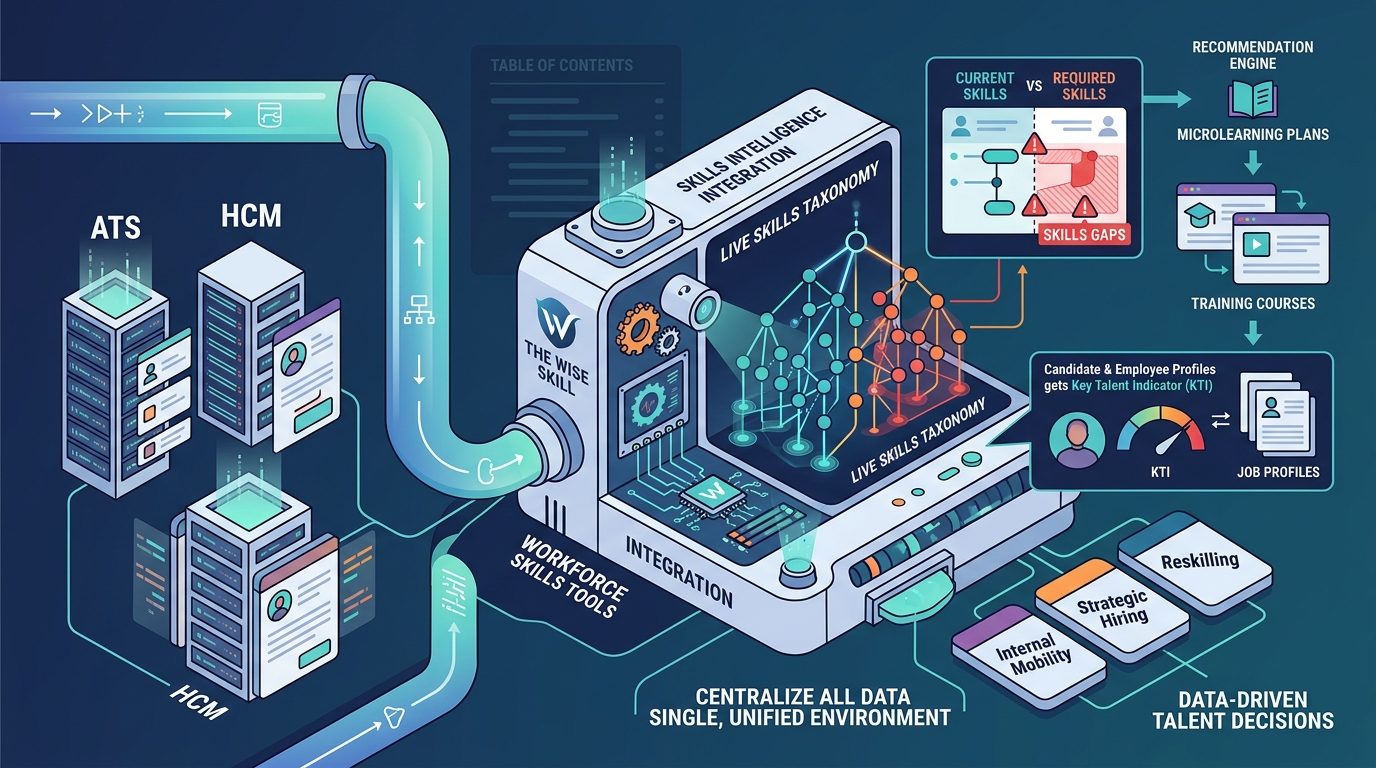
Workforce skills tools that integrate with ATS and HCM systems allow organizations to track employee competencies in a single, unified environment. The Wise Skill provides this capability by connecting your Applicant Tracking System and Human Capital Management data with a live skills taxonomy. This guide covers how to identify gaps, integrate systems, and centralize competency tracking for data-driven talent decisions.
Skills Gap Identification
From Intuition to Evidence
Traditional HR methods often treat gaps as static reports. In contrast, a skills intelligence approach treats a gap as a living record. It opens only when evidence shows a distance between a person's level and the role's requirement. This ensures that training investments are directed at critical operational needs rather than perceived weaknesses. For additional details, review the Conecta lo que tu.
ATS Integration
Applicant Tracking System (ATS) integration allows skills data to flow directly into your recruitment pipeline. When an ATS is connected to a skills platform, recruiters can filter candidates based on verified competencies rather than just keywords in a resume. The Wise Skill connects with your ATS to extract skills from CVs and match them against your internal taxonomy. This streamlines the hiring process by ensuring that only candidates with the right skill profile reach the interview stage. For additional details, review the Blog de Skill Intelligence.
Automated Skill Extraction
Manual screening of resumes is time-consuming and prone to bias. Integration with an ATS enables automated extraction and classification of skills from candidate profiles. This creates a consistent baseline for evaluation across all applicants, improving the speed and quality of hiring decisions. For additional details, review the Aviso Legal The Wise.
HCM Integration
Real-Time Synchronization
Manual data entry is a common source of errors in HR systems. Direct integration with your HCM allows for real-time updates of employee status and role assignments. This ensures that skills maps reflect the current organizational structure without requiring manual maintenance from HR teams.
Competency Tracking
Competency tracking is the continuous monitoring of an employee's proficiency in specific skills over time. It moves beyond one-time assessments to provide a longitudinal view of talent development. The Wise Skill tracks competencies using a standardized scale, allowing for comparable measurements across different teams and departments. This visibility helps managers identify trends in skill decay or growth and plan interventions accordingly.
Standardized Scales
Skills Assessment
Skills assessment is the objective measurement of an individual's ability to perform specific tasks. Unlike subjective performance reviews, skills assessments use validated questions to determine proficiency levels. The Wise Skill leverages a library of over 3 million validated questions to create assessments that are both rigorous and efficient. These assessments provide a defensible result that can be used for promotions, hiring, and development planning.
Adaptive Testing Logic
Modern assessment engines use adaptive logic to select questions based on previous answers. This approach stops the test once statistical confidence is reached, ensuring that employees are not over-tested. The result is a precise measurement of skill level that respects the employee's time while providing high-quality data for HR.
Microlearning Matching
Microlearning matching is the process of connecting identified skills gaps with short, focused learning resources. Instead of assigning long courses, the platform recommends lessons of 20 to 30 minutes that address specific deficits. The Wise Skill matches over 35,000 microlearning plans to the exact skills that need reinforcement. This approach increases completion rates and ensures that learning is directly applicable to the employee's current role.
ROI-Driven Learning
By linking training to specific gaps, organizations can measure the return on investment of their learning programs. The platform tracks progress against the initial assessment, allowing HR to verify that the training closed the gap. This data-driven approach ensures that learning budgets are spent on high-impact activities.
Skills Intelligence Platforms
Unified Talent Language
One of the primary benefits of a skills intelligence platform is the creation of a common language between HR and the business. By using a shared taxonomy, all stakeholders can discuss talent in terms of specific, measurable skills. This alignment reduces friction and accelerates decision-making across the organization.
ATS and HCM System Integration
Integrating both ATS and HCM systems creates a closed loop for talent management. Data from the ATS informs the skills map of new hires, while data from the HCM updates the map for existing employees. The Wise Skill facilitates this integration by acting as a central hub for skills data. This ensures that the skills profile of every employee is consistent, whether they were hired externally or promoted internally.
Eliminating Data Silos
Without integration, skills data often resides in separate systems, leading to inconsistencies. A unified integration strategy ensures that the skills map is always current and accurate. This reduces the administrative burden on HR and provides a reliable foundation for strategic planning.
Competency Tracking Centralization
Competency tracking centralization is the consolidation of all skills data into a single repository. This eliminates the need to switch between multiple systems to view an employee's profile. The Wise Skill centralizes competency data, providing a 360-degree view of each employee's capabilities. This centralization enables faster reporting and more accurate benchmarking across the organization.
Single Source of Truth
A centralized system ensures that all departments access the same skills data. This prevents discrepancies that can arise when different teams maintain their own records. By establishing a single source of truth, organizations can make more confident and consistent talent decisions.
ATS and HCM System Integrations
Technical Compatibility
When selecting a skills tool, it is essential to verify its integration capabilities with your current systems. The Wise Skill is designed to connect with your LMS, HRIS, and content providers, ensuring that data flows without silos or manual reconciliation. This technical robustness is a key factor in the long-term success of a skills intelligence implementation.
| Feature | Traditional HR Tools | The Wise Skill |
|---|---|---|
| Skills Taxonomy | Static, manual lists | Dynamic, 35,000+ skills with AI updates |
| Assessment Method | Subjective reviews | Adaptive, 3M+ validated questions |
| System Integration | Manual data entry | Automated ATS and HCM sync |
| Gap Resolution | Generic course catalogs | Targeted microlearning matching |
Key Takeaways
- Skills gap identification requires a dynamic taxonomy to accurately compare role requirements with employee capabilities.
- ATS integration enables automated skill extraction from resumes, streamlining the recruitment process.
- HCM integration ensures real-time synchronization of employee data, eliminating manual maintenance.
- Skills assessment relies on adaptive testing logic to balance precision with efficiency.
- Microlearning matching connects specific gaps with short, focused lessons to maximize ROI.
- Centralizing competency data creates a single source of truth for all talent decisions.
- Seamless integrations with existing ATS and HCM systems are critical for a successful implementation.
Frequently Asked Questions
What is a skills intelligence platform?
A skills intelligence platform is a software solution that uses data and AI to manage the full lifecycle of workforce skills, including mapping, assessment, and training.
How does ATS integration benefit recruitment?
ATS integration allows recruiters to filter candidates based on verified competencies rather than just keywords, improving the speed and quality of hiring decisions.
What is the role of HCM in skills tracking?
HCM integration ensures that skills data is synchronized with core HR records, providing an up-to-date view of the workforce's capabilities.
How are skills gaps identified?
Skills gaps are identified by comparing the competencies required for a role against the actual capabilities demonstrated by employees using a structured taxonomy.
What is microlearning matching?
Microlearning matching is the process of connecting identified skills gaps with short, focused learning resources to address specific deficits efficiently.
Why is competency tracking centralization important?
Centralization consolidates all skills data into a single repository, eliminating data silos and ensuring that all departments work from the same source of truth.
Conclusion
Selecting the right workforce skills tool is a strategic decision that impacts every aspect of talent management. By integrating with your ATS and HCM systems, you can create a unified view of employee competencies that drives better hiring, development, and retention decisions. The Wise Skill provides the infrastructure to make this transition seamless, offering a comprehensive platform for skills intelligence. To see how your organization can benefit from this approach, request a demo and explore how to map, evaluate, and close skills gaps with data-driven precision.