
What are the biggest skills gaps hiding in your workforce right now?
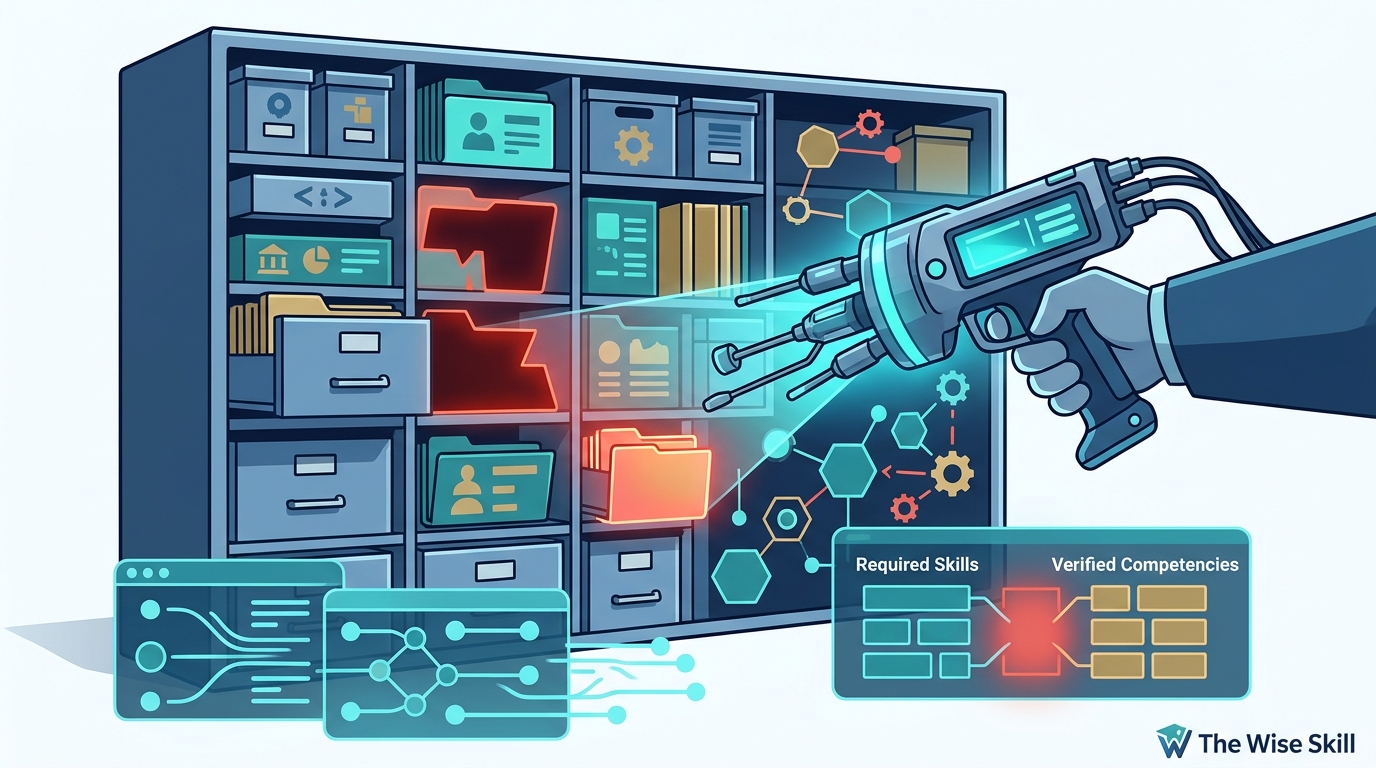
The biggest skills gaps hiding in your workforce right now are the invisible mismatches between the capabilities your strategy demands and the verified competencies your employees actually possess. These gaps often remain undetected because traditional HR metrics rely on job titles and self-reported data rather than objective, real-time skill assessments. The Wise Skill addresses this by replacing intuition with evidence, allowing organizations to measure the true level of each person against a dynamic taxonomy of skills.
The Illusion of Competence in Static Job Descriptions
Job titles are static labels that fail to capture the dynamic reality of modern work. A senior engineer title does not reveal whether the individual possesses the specific cloud architecture skills required for your current product roadmap. This disconnect creates a false sense of security where organizations believe they have the right people but lack the right capabilities. The Wise Skill defines a skill gap as the measurable difference between the skills required for a role and the skills verified in an employee's profile.
When you rely on resumes or annual performance reviews, you are looking at a snapshot of the past. The market changes faster than your HR cycle. By mapping roles to specific skills rather than generic titles, you expose the hidden voids in your team. This approach shifts the conversation from "who is in the role" to "what can this person actually do."
AI Readiness and the Automation Risk
Artificial intelligence is not just a new tool; it is a structural shift in how work is performed. The biggest gap in many organizations is not technical knowledge, but the lack of AI literacy across non-technical roles. Employees who do not understand how to leverage AI for their specific tasks are at a disadvantage. The Wise Skill measures the impact of AI on each position, providing a specific number that indicates how much of a role's tasks are exposed to automation or augmentation.
This metric allows you to identify which profiles are safe, which need immediate upskilling, and which require a strategic pivot. For example, a marketing manager might have strong campaign management skills but zero proficiency in AI-driven data analysis. Identifying this specific gap allows you to deploy targeted microlearning rather than generic training. The implication is clear: you cannot plan for the future if you do not know how the present is changing.
The Self-Perception Bias in Skill Assessment
When you build your talent map based on self-declared skills, you inherit this bias. You might think you have a team of experts in data visualization, but the objective tests reveal that only half of them can actually create a basic dashboard. This verification step is critical for making accurate decisions about internal mobility and promotion. It ensures that when you move talent, you are moving verified capability, not just confidence.
Strategic Misalignment and Business Goals
A skills gap is not just an HR issue; it is a business risk. If your strategy is to expand into a new market, but your sales team lacks the specific cultural and regulatory knowledge required for that region, you have a strategic gap. The Wise Skill translates your business strategy into a map of required skills, ensuring that your workforce is aligned with your goals. This process reveals where your current capabilities fall short of your strategic ambitions.
The Cost of Inaction and Hidden Attrition
Ignoring skills gaps leads to hidden attrition. Employees who feel stuck in roles that do not challenge their skills or align with their career goals are more likely to leave. This is not just a loss of headcount; it is a loss of institutional knowledge and momentum. The Wise Skill helps you identify these at-risk profiles by analyzing their skill trajectories and engagement with development plans.
By providing each employee with a clear view of their own skills and a personalized development plan, you increase retention and engagement. When people see a path to growth, they stay. The implication is that skills gap identification is not just about fixing current problems; it is about preventing future ones. It is a proactive strategy for building a resilient and motivated workforce.
Key Takeaways
- Job titles are insufficient: They do not reflect the specific skills required for modern, dynamic roles.
- AI impact is measurable: You can quantify how much of each role is exposed to automation or augmentation.
- Self-perception is biased: Objective evaluation is necessary to verify true competence levels.
- Strategy drives skills: Your workforce must be aligned with your business goals, not just your current operations.
- Retention is linked to growth: Clear development paths based on verified skills reduce hidden attrition.
- Data beats intuition: Replacing guesswork with evidence leads to better talent decisions.
Frequently Asked Questions
What is a skills gap in the context of workforce planning?
A skills gap is the measurable difference between the skills required for a role or business strategy and the skills verified in an employee's profile. It represents the specific capabilities that are missing and need to be addressed through training, hiring, or internal mobility.
How can I identify skills gaps in my current team?
You can identify skills gaps by mapping your roles to specific skills and then evaluating each employee against those skills using objective, adaptive tests. This process reveals the difference between what your strategy requires and what your team can actually do.
Why are self-reported skills unreliable for identifying gaps?
Self-reported skills are unreliable because of cognitive biases, such as the Dunning-Kruger effect, where individuals overestimate their abilities. Objective evaluation provides a verified level of competence, ensuring that your data is accurate and actionable.
How does AI impact the identification of skills gaps?
AI changes the nature of work, creating new skills requirements and automating existing tasks. Identifying skills gaps in the era of AI involves measuring how much of each role is exposed to automation and ensuring employees have the literacy to leverage AI tools effectively.
What is the difference between a skills gap and a performance gap?
A skills gap refers to a lack of specific capabilities or knowledge, while a performance gap refers to a failure to meet expected outcomes. A skills gap can cause a performance gap, but not all performance gaps are due to skills; some may be due to motivation, resources, or process issues.
How often should I reassess skills gaps in my workforce?
Skills gaps should be reassessed regularly, ideally on a quarterly or semi-annual basis, or whenever there is a significant change in business strategy or technology. Continuous monitoring allows you to stay ahead of market changes and ensure your workforce remains aligned with your goals.