
Modern companies map employee skills in one place by using a centralized skills intelligence platform that connects role requirements, individual assessments, and learning resources. This approach replaces scattered spreadsheets and HRIS data with a single, dynamic source of truth. The Wise Skill enables this by building a comprehensive skills map that reveals gaps and potential in real time.
The Shift from Static Profiles to Dynamic Maps
Traditional HR systems rely on static job descriptions and annual performance reviews. This model fails to capture the evolving nature of modern work. A skills map is a dynamic representation of the capabilities required for each role and the actual proficiency of each employee. It moves beyond job titles to focus on what people can actually do. For additional details, review the Eventos The Wise Skill.
For example, a software engineering role in 2026 requires different competencies than it did in 2020. A static profile cannot reflect this shift. A dynamic map updates as roles change and as employees acquire new abilities. This ensures that workforce planning is based on current reality, not historical data.
The implication is clear: organizations need a system that treats skills as living data. The Wise Skill platform automates this process by continuously syncing role requirements with employee assessments. This creates a living document that reflects the true state of the workforce.
Building the Foundation: Taxonomy and Data Integration
The first step in mapping skills is establishing a robust taxonomy. A skills taxonomy is a structured classification system that defines and categorizes all the skills an organization needs. Without a standardized taxonomy, data becomes fragmented and unusable. The Wise Skill utilizes a macro taxonomy of over 35,000 skills to ensure comprehensive coverage.
Companies often struggle with data silos. Employee data lives in the HRIS, learning data in the LMS, and performance data in separate tools. Integrating these sources is critical. The Wise Skill connects with existing HRIS, ATS, and LMS systems to pull data into a single view. This integration eliminates manual data entry and reduces errors.
Consider a mid-sized tech company with 500 employees. Manually updating a spreadsheet for each role and employee is impossible. By integrating with their HRIS, they can automatically populate the skills map with current role requirements. This foundation allows for accurate gap analysis and strategic planning.
Assessment: Measuring Real Proficiency
Self-assessment alone is insufficient for accurate skills mapping. Employees often overestimate their abilities or lack the context to evaluate themselves objectively. Adaptive assessment is a method where questions adjust in difficulty based on the respondent's answers. This provides a precise measurement of proficiency levels.
The Wise Skill employs adaptive assessments to verify the actual level of each person. This process distinguishes between what an employee claims to know and what they can demonstrate. For instance, a marketing manager might claim advanced proficiency in data analytics. An adaptive test can verify this by presenting scenario-based questions that adjust to their responses.
This verification step is crucial for trust. When employees see that their skills are measured objectively, they are more likely to engage with the platform. The resulting data provides a reliable baseline for identifying gaps. It transforms subjective opinions into objective evidence.
Identifying and Closing Gaps
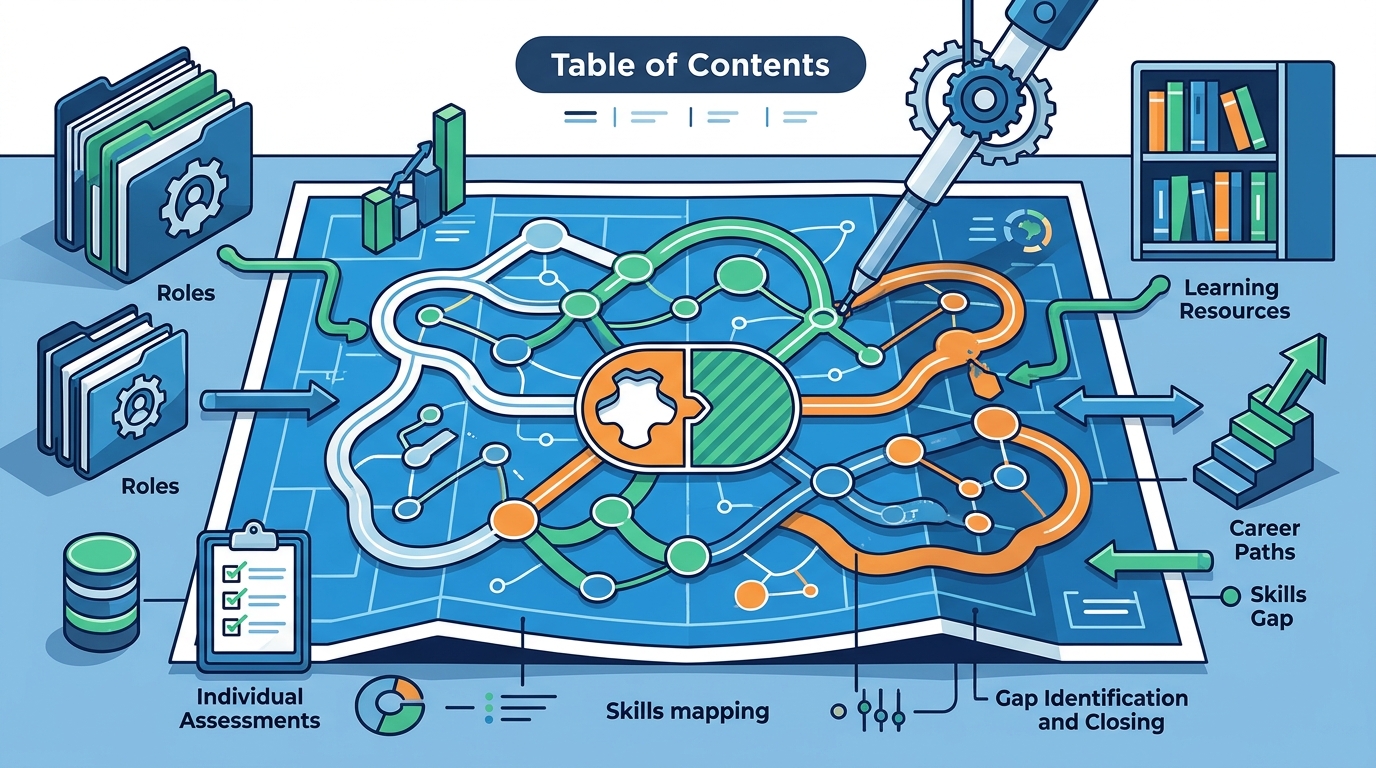
Once skills are mapped and assessed, the platform can identify gaps. A skills gap is the difference between the proficiency required for a role and the proficiency an employee currently possesses. Identifying these gaps is the core value of skills mapping. It highlights where training is needed and where hiring is necessary.
For example, a company planning to launch a new AI-driven product may find that 60% of its data science team lacks proficiency in machine learning. This specific insight allows for targeted intervention. The Wise Skill connects each gap with relevant learning resources, including microlearning plans and external courses.
The implication is a shift from reactive training to proactive development. Instead of sending employees to generic courses, companies can assign specific learning paths that address verified gaps. This ensures that training investments yield measurable returns. It aligns individual development with business strategy.
Strategic Workforce Planning
Skills mapping is not just about individual development; it is about organizational resilience. Workforce planning is the process of aligning the current workforce with future business needs. By analyzing the skills map, leaders can predict future capacity and identify risks. This is particularly important in the era of AI, where roles are evolving rapidly.
Key Takeaways
- A skills map is a dynamic, centralized view of role requirements and employee proficiency.
- Standardized taxonomies are essential for creating comparable and actionable skills data.
- Adaptive assessments provide objective verification of employee skills, reducing bias.
- Integrating with HRIS and LMS systems eliminates data silos and manual entry.
- Skills gap analysis enables targeted training that aligns with business strategy.
- Workforce planning using skills data helps organizations anticipate future needs and risks.
Frequently Asked Questions
What is the primary benefit of mapping employee skills in one place?
The primary benefit is visibility. It provides a single source of truth for all skills data, enabling accurate gap analysis, strategic workforce planning, and targeted development.
How does adaptive assessment differ from self-assessment?
Can skills mapping help with AI readiness?
Yes. By analyzing the skills required for each role and the current proficiency of employees, organizations can identify which roles are most exposed to automation. This allows for proactive reskilling and strategic redeployment.
How long does it take to implement a skills mapping platform?
What is a skills taxonomy?
A skills taxonomy is a structured classification system that defines and categorizes all the skills an organization needs. It provides a common language for discussing and measuring skills across the company.
Conclusion
Mapping employee skills in one place is no longer optional; it is a strategic imperative. By leveraging a centralized skills intelligence platform, organizations can gain the visibility needed to make data-driven decisions. The Wise Skill provides the tools to build, assess, and act on skills data, ensuring that your workforce is aligned with your business goals. To begin your journey, request a demo and see how your strategy can be converted into something measurable.