
Integrating Skills Intelligence Into HR Systems: A Strategic How-To
Organizations that fail to modernize their talent data infrastructure face significant operational risks. According to recent industry analysis, companies with mature skills-based talent strategies report a 20% higher agility in workforce planning compared to traditional hierarchical models. This shift is not merely a trend but a structural necessity for maintaining competitive advantage in a rapidly evolving labor market. The integration of skills intelligence into existing Human Resources (HR) systems allows organizations to map, measure, and manage human capital with unprecedented precision. By moving beyond job titles and focusing on granular capabilities, businesses can unlock hidden talent pools and reduce critical hiring gaps.
Understanding Skills Intelligence
Before diving into the technical mechanics, it is essential to define the core concept driving this transformation. Skills intelligence is the systematic collection, analysis, and application of data regarding the specific capabilities, competencies, and proficiencies of a workforce. Unlike traditional HR metrics that rely on static job descriptions, skills intelligence provides a dynamic, real-time view of what employees can actually do. This data-driven approach enables organizations to make informed decisions about internal mobility, upskilling, and strategic hiring.
The foundation of this system lies in the ability to translate unstructured employee data into structured, searchable skills taxonomies. When integrated correctly, this intelligence becomes the backbone of your HR technology stack, influencing everything from recruitment to performance management. For a deeper understanding of the recruiting methodologies that support this data, you can explore recruiting and training strategies that prioritize capability over credential.
Audit Your Existing Data
The first step in any successful integration is a comprehensive audit of your current data landscape. Most organizations suffer from data silos where employee information is scattered across Applicant Tracking Systems (ATS), Learning Management Systems (LMS), and human resources information systems (HRIS). This fragmentation creates blind spots that prevent accurate skills mapping.
Begin by identifying the primary source of truth for your employee profiles. Is it your HRIS, or is it a specialized talent management platform? You must determine which system holds the most accurate and up-to-date information regarding employee roles, certifications, and project histories. This audit should also include an assessment of data quality. Are job titles standardized? Are skills listed in a consistent format? Without clean, standardized data, any integration effort will result in garbage in, garbage out.
Consider the scope of your data. Are you looking to integrate only hard technical skills, or do you also need to capture soft skills and behavioral competencies? The latter often requires more sophisticated natural language processing (NLP) tools to extract meaning from unstructured text such as performance reviews or project descriptions. For insights into how training frameworks can help standardize these skills, review our approach to workforce development.
Selecting the Integration Method
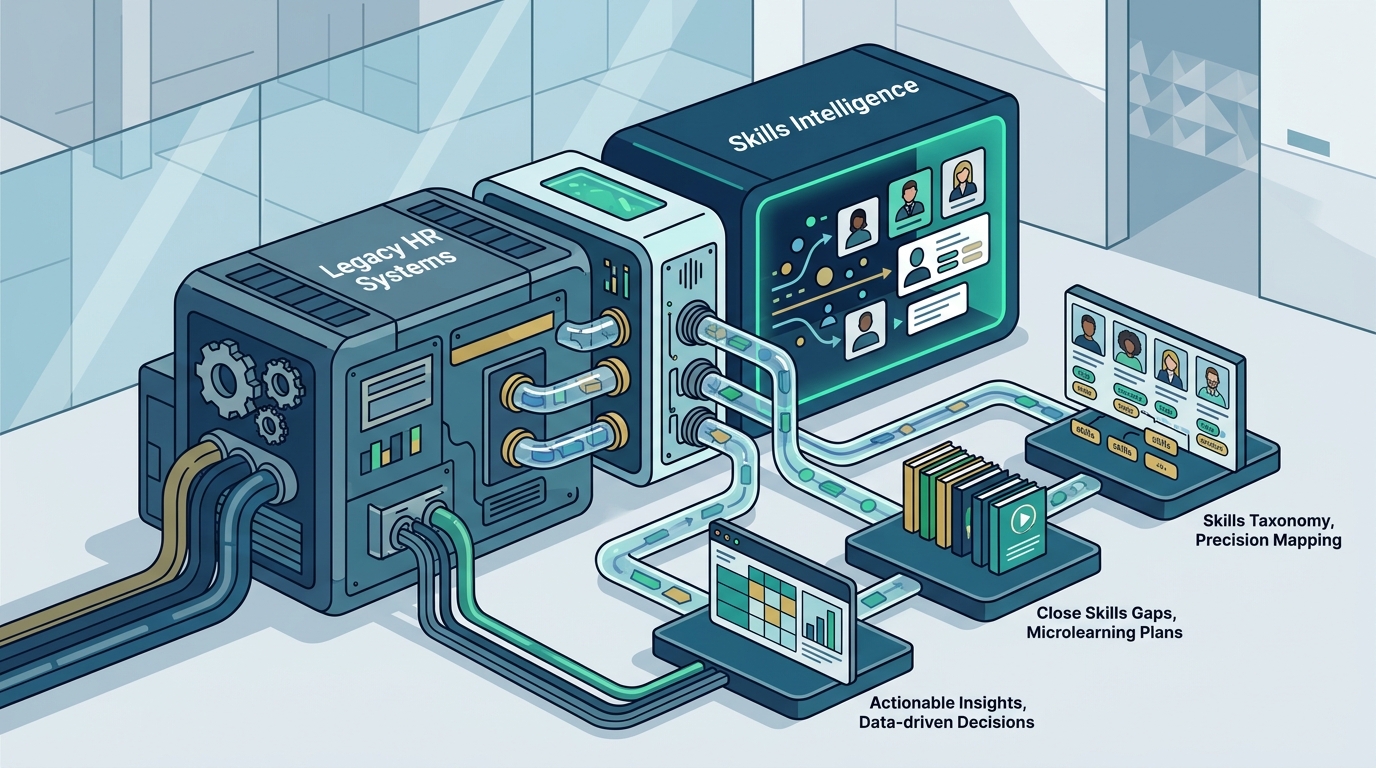
Once you have audited your data, you must choose the technical method for integration. There are three primary approaches to connecting skills intelligence with your existing HR ecosystem.
1. API-First Integration
This is the most robust method for large enterprises. APIs (Application Programming Interfaces) allow your skills intelligence platform to communicate directly with your HRIS, ATS, and LMS in real-time. This ensures that any update to an employee's skill profile is immediately reflected across all connected systems. It requires significant technical resources but offers the highest level of data accuracy and automation.
2. Middleware and iPaaS Solutions
For organizations with complex, legacy systems, an Integration Platform as a Service (iPaaS) can act as a bridge. Tools like MuleSoft or Zapier can map data fields between disparate systems without requiring custom code development. This method is faster to implement but may introduce latency in data synchronization.
3. Manual Data Import/Export
While less ideal for large-scale operations, CSV imports can be a viable starting point for smaller teams. This involves periodically exporting skills data from your intelligence platform and uploading it to your HR system. It is prone to human error and lacks real-time capabilities but is a low-cost entry point.
When evaluating these methods, consider the scalability of your solution. As your organization grows, the integration must handle increased data volume and complexity. For more information on how to scale your recruitment efforts, check out our demo resources.
Implementation Steps
Executing the integration requires a phased approach to minimize disruption and ensure data integrity. Follow these steps to guide your implementation.
Step 1: Define Your Skills Taxonomy
Before any technical work begins, you must establish a standardized skills taxonomy. This is a hierarchical framework that defines all skills relevant to your organization. It should include core technical skills, leadership competencies, and industry-specific certifications. A well-defined taxonomy ensures that data entered into your HR systems is consistent and searchable. Without this standard, your integration will fail to produce actionable insights.
Step 2: Map Data Fields
Next, map the fields in your skills intelligence platform to the corresponding fields in your HRIS and ATS. For example, map the "Python Programming" skill in your intelligence platform to the "Technical Skills" field in your ATS. This mapping must be bidirectional if you want updates in one system to reflect in the other. Pay close attention to data types, such as text, numbers, and dates, to prevent formatting errors.
Step 3: Pilot the Integration
Do not roll out the integration to the entire organization at once. Start with a pilot group, such as a single department or a specific business unit. This allows you to test the data flow, identify technical issues, and gather user feedback. Monitor the pilot closely for any discrepancies in data synchronization or user experience problems.
Step 4: Full Deployment and Training
Once the pilot is successful, proceed with full deployment. Provide comprehensive training to HR staff, managers, and employees on how to use the new integrated system. Emphasize the benefits of skills intelligence, such as improved internal mobility and personalized learning paths. Training is critical to ensuring adoption and maximizing the return on your investment.
Step 5: Continuous Monitoring and Optimization
Integration is not a one-time event. Continuously monitor the health of your data integrations. Set up alerts for failed syncs or data anomalies. Regularly review the skills taxonomy to ensure it remains relevant to your business strategy. As new technologies emerge, your skills framework must evolve to reflect these changes.
Challenges and Solutions
Integrating skills intelligence is not without its hurdles. Below is a table summarizing common challenges and their corresponding solutions.
| Challenge | Description | Solution |
|---|---|---|
| Data Silos | Information scattered across multiple disconnected systems. | Implement a centralized data lake or use an iPaaS to unify data sources. |
| Inconsistent Taxonomies | Different departments use different terms for the same skill. | Enforce a global skills ontology and use AI to map synonyms. |
| User Adoption | Employees resist updating their profiles or using new tools. | Incentivize participation and demonstrate clear personal benefits. |
| Technical Complexity | Legacy systems lack modern API capabilities. | Use middleware connectors or schedule regular batch updates. |
Addressing these challenges requires a cross-functional team including HR, IT, and data analytics experts. Collaboration is key to ensuring that the technical integration aligns with business goals. For more on how to align your team, visit our FAQ section.
Key Takeaways
- Skills Intelligence is Dynamic: It moves beyond static job titles to provide a real-time view of workforce capabilities.
- Data Audit is Critical: You must clean and standardize your existing data before attempting any integration.
- APIs Offer Real-Time Sync: For large organizations, API-first integration is the most effective method for data accuracy.
- Taxonomy Standardization: A unified skills framework is essential for consistent data mapping across systems.
- Pilot Before Scale: Always test your integration with a small group to identify issues before full deployment.
- Change Management Matters: User adoption depends on clear communication of benefits and comprehensive training.
- Continuous Evolution: Regularly update your skills taxonomy to reflect emerging technologies and business needs.
Frequently Asked Questions
What is the difference between skills intelligence and traditional HR data?
Traditional HR data focuses on static attributes like job titles, tenure, and department. Skills intelligence focuses on dynamic, granular capabilities that can change rapidly. It allows for more flexible workforce planning and internal mobility.
How long does it take to integrate skills intelligence?
The timeline varies based on complexity. A simple CSV-based integration might take a few weeks, while a full API-driven enterprise integration can take several months. Planning and data auditing often take longer than the technical implementation.
Can skills intelligence integrate with legacy HR systems?
Yes, but it may require additional middleware or batch processing solutions. Legacy systems often lack modern API support, so you may need to rely on scheduled data exports and imports rather than real-time sync.
What are the biggest risks of integrating skills intelligence?
The biggest risks include data privacy concerns, inaccurate data mapping, and low user adoption. Ensuring data security and providing clear training are essential to mitigating these risks.
How do I measure the ROI of skills intelligence integration?
Track metrics such as time-to-fill for internal roles, reduction in external hiring costs, employee retention rates, and speed of upskilling. These metrics demonstrate the tangible business value of your investment.
Is skills intelligence only for large enterprises?
No, small and medium-sized businesses can also benefit significantly. The principles of data standardization and integration apply regardless of company size, though the technical tools may differ.
What role does AI play in skills intelligence?
AI and machine learning are crucial for extracting skills from unstructured data, such as resumes and performance reviews. They also help in mapping skills to emerging roles and predicting future skill gaps.
Start Your Integration
Integrating skills intelligence into your HR systems is a transformative step toward building a more agile and resilient workforce. By following the steps outlined in this guide, you can unlock the full potential of your human capital. To see how The Wise Skill can support your journey, schedule a demo today and discover the power of data-driven talent management.