
Creating Audit-Ready Skills and Training Reports: A Step-by-Step Guide
Organizations that rely on intuitive talent management often face significant compliance risks during external audits. According to recent industry data, companies with structured skill intelligence frameworks reduce audit preparation time by over 40% compared to those using manual tracking methods. This guide details the precise operational steps to transform raw talent data into defensible, audit-ready reports. (Qui nes somos Skill)
Step 1: Establish a Unified Skills Taxonomy
The foundation of any defensible talent report is a standardized language. Without a unified taxonomy, different departments interpret "leadership" or "technical proficiency" differently, creating data silos that break down during an audit. A skills taxonomy is a structured framework that categorizes and defines the specific abilities required for various roles within an organization.
To begin, you must move beyond static job descriptions. The Wise Skill platform allows you to ingest your organizational structure directly. By uploading your HRIS data or simply entering your company name, the system reconstructs departments and profiles automatically. This eliminates the manual entry errors that frequently plague traditional HRIS systems.
Ensure your taxonomy is "living." Static lists become obsolete within months. The Wise Skill approach utilizes a database of over 35,000 skills that evolve with market trends. This ensures that your audit reports reflect current industry standards rather than outdated internal definitions. When auditors review your documentation, they see a dynamic, market-aligned framework rather than a stagnant spreadsheet.
Step 2: Deploy Adaptive Assessment Engines
Once the taxonomy is defined, you must measure the current state of your workforce. Traditional surveys are subjective and prone to bias. Instead, utilize adaptive assessment engines that adjust question difficulty in real-time based on the candidate's responses. An adaptive assessment engine is a software tool that dynamically modifies the difficulty of test questions to accurately measure a user's proficiency level.
This technology relies on a validated library of millions of questions. The engine stops administering questions only when it achieves statistical confidence in the result. This method mirrors professional certification exams, providing a level of precision that standard multiple-choice quizzes cannot match. The result is a defensible data point for every employee.
For audit purposes, the transparency of this process is critical. The Wise Skill platform ensures that every score is backed by item-level evidence. If an auditor questions a specific skill rating, you can trace that rating back to the specific tasks and questions that generated it. This traceability is the difference between a "best guess" and a "defensible metric." Furthermore, the platform is ISO 27001 and ISO 42001 certified, ensuring that the data collection process itself meets rigorous security and privacy standards.
Step 3: Map Skills Gaps to Strategic Objectives
Data without context is noise. The next step is to contrast the measured skills against the strategic needs of the business. This process identifies the "skills gap," which is the difference between the skills employees currently possess and the skills the organization requires to achieve its goals. A skills gap is the measurable disparity between the current capabilities of a workforce and the future capabilities needed for business success.
The Wise Skill Talent Engine automates this comparison. It does not just list missing skills; it prioritizes them based on business impact. For example, if your strategy involves adopting new AI technologies, the engine identifies which roles are most vulnerable to automation and which require immediate upskilling. This creates a clear narrative for your audit reports: "We identified risk X, and we are addressing it through training Y."
This step also involves calculating the impact of AI on specific roles. The platform decomposes each profile into daily tasks and scores them based on automation potential. This provides a concrete, data-driven justification for training investments. Auditors look for logical connections between business strategy and talent development. This mapping provides that logical bridge.
Step 4: Automate Training Itinerary Generation
Identifying gaps is only half the battle. The final operational step is closing those gaps through targeted training. Manual training planning is often reactive and disjointed. The Wise Skill platform generates personalized reskilling and upskilling itineraries automatically. These itineraries are directly linked to the specific gaps identified in the previous step.
The system integrates with your existing Learning Management System (LMS) and content providers. This ensures that the training recommendations are actionable and immediately accessible to employees. The key here is "evidence of action." For every identified gap, the report shows the assigned training path, the completion status, and the subsequent re-assessment results.
This automation reduces the administrative burden on HR teams significantly. More importantly, it creates a continuous loop of measurement and improvement. Instead of a one-time training event, you establish a habit of measurable growth. This continuous improvement model is highly favored by modern auditors and compliance frameworks.
Step 5: Generate and Archive Audit-Ready Reports
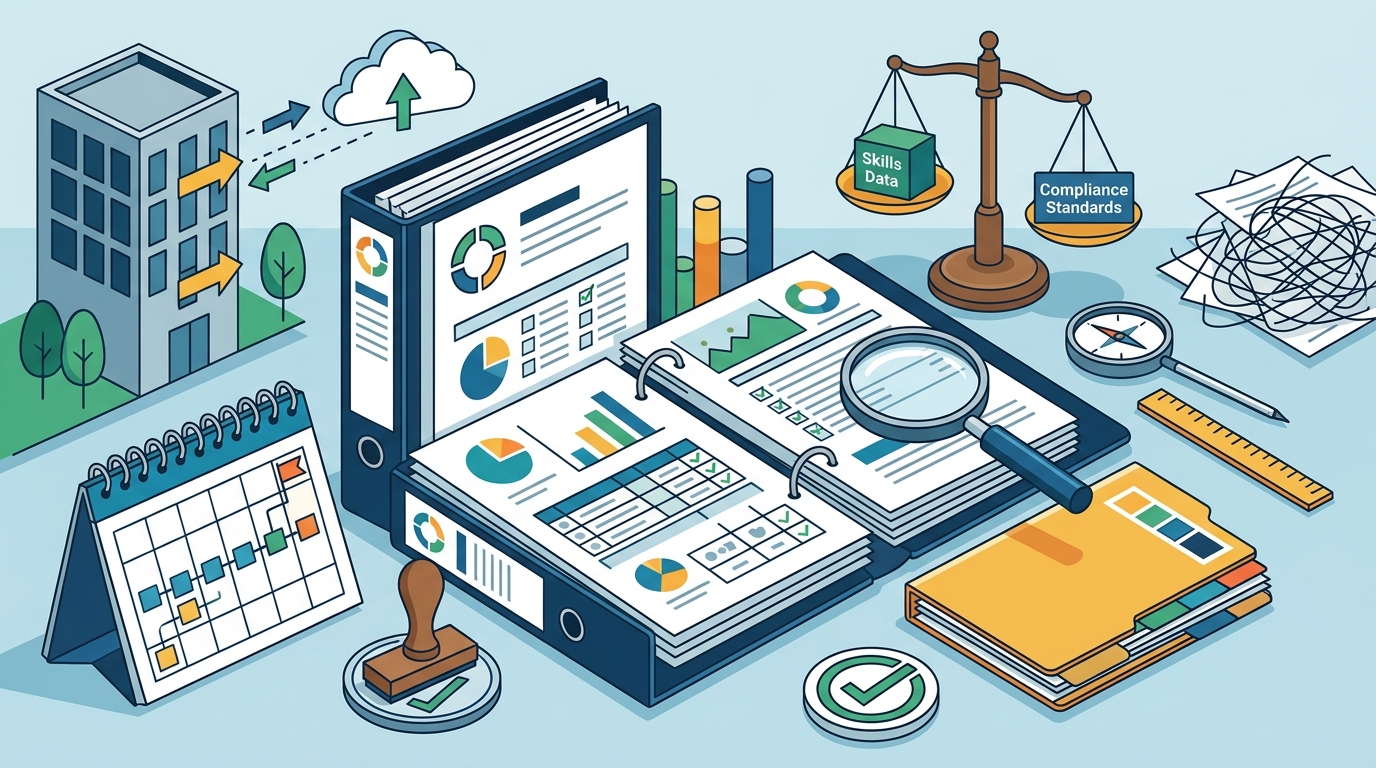
The final step is the compilation of all previous data into a coherent, audit-ready report. The Wise Skill platform provides individual reports that employees can also access, fostering a culture of transparency. For leadership and auditors, the platform generates aggregated views of organizational maturity.
These reports include:
- Individual Skill Profiles: Detailed breakdowns of each employee's competencies with item-level evidence.
- Team Comparability: Benchmarks that allow for fair comparison across teams using the same scales.
- Training ROI: Data showing the impact of training interventions on closing specific skills gaps.
- Compliance Status: Clear indicators of which roles meet regulatory or internal certification requirements.
The platform ensures that all data is stored securely and is easily retrievable. This eliminates the "scramble" for documents that often occurs during an audit. Having a centralized, digital source of truth for talent data streamlines the entire compliance process.
Key Takeaways
- Unified Taxonomy: Establish a living skills taxonomy with over 35,000 validated skills to ensure market alignment.
- Adaptive Precision: Use adaptive assessment engines to achieve statistical confidence in talent measurements.
- Traceable Evidence: Ensure every skill rating is backed by item-level data for full audit defensibility.
- Strategic Mapping: Connect skills gaps directly to business objectives and AI automation impacts.
- Automated Training: Generate personalized reskilling itineraries that integrate seamlessly with existing LMS platforms.
- Security Compliance: Leverage ISO 27001 and ISO 42001 certified platforms to protect sensitive talent data.
- Continuous Improvement: Move from sporadic training events to a continuous cycle of measurement and development.
Frequently Asked Questions
What makes a skills report "audit-ready"?
An audit-ready report provides traceable, item-level evidence for every skill rating, links training activities directly to identified business gaps, and maintains secure, compliant data storage standards.
How does adaptive assessment improve accuracy?
Adaptive assessment adjusts question difficulty in real-time, reducing test time while maximizing precision. It stops only when statistical confidence is achieved, eliminating the guesswork of static quizzes.
Can The Wise Skill integrate with my existing HRIS?
Yes, the platform is designed for frictionless integration. It connects with your HRIS, LMS, and content providers to ensure data flows without silos or manual reconciliation.
How is the impact of AI on roles calculated?
The platform decomposes each role into daily tasks and scores them based on current automation potential. This provides a concrete, data-driven view of which roles need reskilling.
Is the skills taxonomy static or dynamic?
The taxonomy is dynamic. It evolves with the market, utilizing over 35,000 skills that are continuously updated through AI and expert validation.
What security certifications does the platform hold?
The Wise Skill platform is certified ISO 27001 and ISO 42001, and is GDPR ready and aligned with the EU AI Act, ensuring robust data protection.
How long does it take to generate a skills map?
By ingesting your company name or HRIS data, the platform can reconstruct departments and profiles in minutes, allowing you to move from intuition to evidence rapidly.
Transform Your Talent Management Today
Stop relying on intuition for your most critical business decisions. The Wise Skill platform connects what your business needs with what your people know and can do. Experience the power of skill intelligence firsthand by scheduling a free demo and see how we can help you build a defensible, audit-ready talent strategy.