
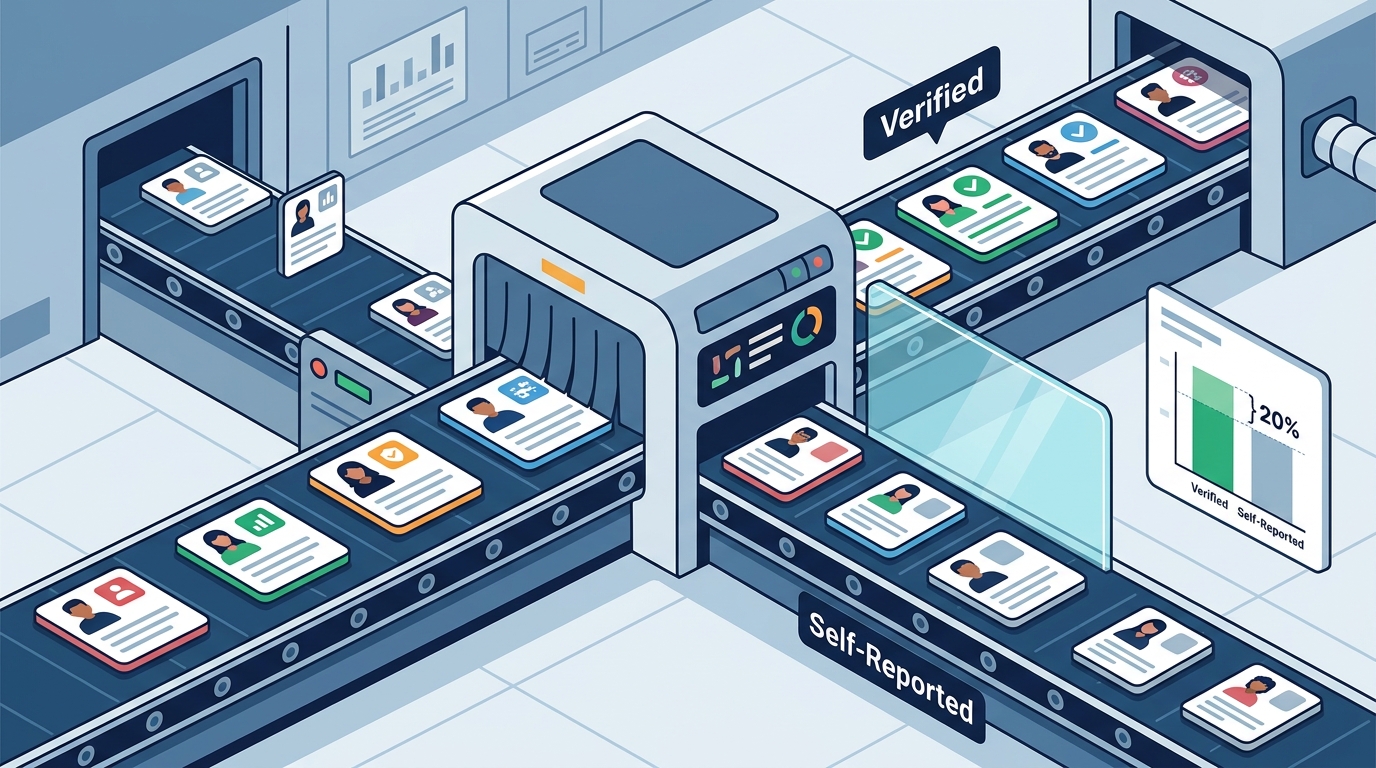
Organizations that rely on self-reported data for talent decisions face significant accuracy gaps. Research indicates that self-assessments often overestimate actual competency levels by a wide margin, leading to misaligned hiring and training strategies. According to a 2024 analysis of workplace performance metrics, companies using verified skill data see a 20% improvement in role-fit accuracy compared to those relying on resumes alone. This guide explains how to implement a dual-labeling system that distinguishes between claimed abilities and proven capabilities.
Understanding the Distinction
The foundation of effective talent management lies in recognizing the difference between what an employee claims they can do and what they have proven they can do. Self-reported skills are subjective. They reflect confidence, self-awareness, and sometimes, the Dunning-Kruger effect. Verified skills are objective. They reflect demonstrated competence through assessment, work samples, or peer validation.
At The Wise Skill, we operate on the principle that talent is measured, not intuited. This distinction is critical for modern HR teams. When you label a skill as "self-reported," you are acknowledging a gap that needs validation. When you label it as "verified," you are confirming a capability that can be leveraged for strategic projects.
Consider the concept of skill intelligence. This term is defined as the systematic mapping of employee capabilities against business needs using data-driven evidence. Without clear labeling, this intelligence becomes noise. You cannot build a strategy on ambiguous data. You must know the source of every skill claim in your database.
Implementing Verification
Verification is the process of transforming a claim into a fact. This requires a structured approach that minimizes bias and maximizes accuracy. The most effective verification methods include adaptive assessments, peer reviews, and work sample tests.
Adaptive assessments adjust in real-time to the candidate's level. This reduces testing time while increasing precision. According to industry standards for psychometric testing, adaptive algorithms provide a more accurate measure of true ability than static tests. This is because they eliminate the ceiling and floor effects that plague traditional exams.
At The Wise Skill, we utilize a fleet of specialized AI agents to assist in this process. These agents do not just suggest actions; they execute verification protocols based on your defined context. This ensures that the verification process is consistent across the organization. It also allows for rapid scaling. You can verify hundreds of skills across thousands of employees without manual intervention.
Another critical component is the integration of these verifications into your existing HRIS. Data silos kill skill intelligence. If your verified skills are trapped in a separate tool, they are useless for strategic planning. Ensure your verification platform connects seamlessly with your LMS and HRIS. This creates a single source of truth for all talent data.
Labeling Protocols
2Once you have collected both self-reported and verified data, you must apply clear labels. This labeling system serves as the metadata for your talent database. It tells every user, from HR to hiring managers, the confidence level of each skill entry.
We recommend a three-tier labeling system:
- Claimed: The employee has self-reported this skill. No verification has occurred. This label indicates a potential gap or a skill that requires validation.
- Validated: The skill has been verified through a standardized assessment or peer review. This label indicates a confirmed capability.
- Expert: The skill has been verified through multiple methods and/or recognized by external certification. This label indicates a high-confidence authority.
These labels must be dynamic. A skill labeled "Claimed" today might become "Validated" tomorrow after an assessment. Conversely, a skill labeled "Expert" might degrade if not used, though this is less common in skill databases than in knowledge bases. The key is that the label reflects the current state of evidence.
Transparency is also crucial. Employees have the right to see their own data. When an employee views their profile, they should see not just the skill, but the label and the date of verification. This builds trust and encourages continuous development. It shifts the conversation from "Do you have this skill?" to "How do we prove and improve this skill?"
Integration Workflow
Integrating this labeling system into your daily workflow requires a shift in process. Here is a step-by-step workflow for HR teams:
Step 1: Onboarding and Contextualization. During onboarding, ask new hires to self-report their skills. Label these as "Claimed." Simultaneously, use AI-driven agents to propose a verification plan based on the role's requirements. This aligns the employee's self-perception with the business's needs.
Step 2: Execution of Verification. Deploy adaptive assessments to verify the "Claimed" skills. According to data on assessment efficiency, adaptive testing can reduce verification time by up to 50% while maintaining accuracy. The AI agents execute these tests and update the labels in real-time.
Step 3: Continuous Monitoring. Skill decay is real. Implement periodic re-verification for critical skills. Label these as "Verified" with a validity period. When the period expires, the label reverts to "Claimed" until re-verified. This ensures your data remains current.
Step 4: Strategic Application. Use the labeled data for decision-making. When hiring, filter for "Validated" or "Expert" skills. When promoting, look for a mix of verified technical skills and validated soft skills. This reduces the risk of mis-hires and promotes high-potential employees.
For more details on how our agents work, visit our blog where we discuss the mechanics of skill intelligence in depth.
Comparing Approaches
Not all organizations approach skill labeling the same way. Below is a comparison of common methods:
| Method | Accuracy | Effort | Best For |
|---|---|---|---|
| Resume-Based | Low | Low | Initial screening only |
| Self-Reported Only | Medium | Low | Quick talent mapping |
| Static Assessment | High | Medium | Standardized roles |
| Adaptive Verification | Very High | Low (after setup) | Dynamic organizations |
As shown in the table, adaptive verification offers the best balance of accuracy and effort. It leverages AI to reduce the burden on both the employee and the HR team. This is the approach recommended by leading talent intelligence firms.
Key Takeaways
- Measurement over Intuition: Talent must be measured, not guessed. Self-reported data is a starting point, not an endpoint.
- Dynamic Labeling: Use labels like "Claimed," "Validated," and "Expert" to indicate the confidence level of each skill.
- Adaptive Testing: Use adaptive assessments to verify skills efficiently. This reduces time while increasing accuracy.
- AI Integration: Leverage AI agents to execute verification protocols. This ensures consistency and scalability.
- Transparency: Share verification data with employees. This builds trust and encourages development.
- Continuous Monitoring: Skills decay. Re-verify critical skills regularly to maintain data integrity.
- Strategic Alignment: Align skill verification with business strategy. Verify the skills that matter most to your goals.
Frequently Asked Questions
What is the difference between self-reported and verified skills?
Self-reported skills are claims made by employees about their own abilities. Verified skills are those confirmed through objective assessment or evidence. The key difference is the presence of data-driven proof.
Why is labeling skills important?
Labeling provides context. It tells users how much confidence to place in a skill entry. Without labels, all skills appear equal, which can lead to poor decision-making.
How often should skills be re-verified?
Frequency depends on the skill's criticality. Critical technical skills should be re-verified annually. Soft skills may be re-verified less frequently, perhaps every two years, or upon significant role changes.
Can AI replace human verification?
AI can automate the initial verification process through adaptive assessments. However, human oversight is still valuable for complex roles or nuanced skills. The best approach is a hybrid model.
What is skill intelligence?
Skill intelligence is defined as the systematic mapping of employee capabilities against business needs using data-driven evidence. It transforms raw skill data into actionable strategic insights.
How do I integrate skill verification into my HRIS?
Choose a platform with open APIs that connect to your existing HRIS. Ensure that skill data flows bidirectionally so that verification results update your central talent database automatically.
What are the benefits of using adaptive assessments?
Adaptive assessments adjust to the user's level in real-time. This reduces test fatigue and provides a more accurate measure of ability compared to static tests.
How does The Wise Skill handle data privacy?
We prioritize privacy and security by design. Our platform is ISO 27001 and ISO 42001 certified, and GDPR ready. Data protection is integral to our architecture, not an afterthought.
Next Steps
Stop guessing your talent landscape. Start measuring it. Implement a robust labeling system that distinguishes between claims and proof. This will transform your HR strategy from reactive to proactive.
Ready to see how skill intelligence can work for your organization? Book a demo with The Wise Skill today. Our team of experts will show you how to connect your business needs with your people's capabilities using our advanced AI agents.