
Step-by-Step Guide to Mapping Employee Skills and Closing Workforce Gaps on The Wise Skill
Organizations that fail to map their internal talent accurately face a significant risk of operational stagnation. According to recent industry analyses, companies with robust skills intelligence frameworks report a 30% faster time-to-productivity for new hires compared to those relying on traditional resume screening. This disparity highlights why modern HR leaders are shifting from intuition-based management to data-driven talent strategies. The Wise Skill provides the infrastructure to execute this shift, transforming vague job descriptions into precise, actionable talent maps. (Qui nes somos Skill)
Step 1: Establish Your Skills Taxonomy
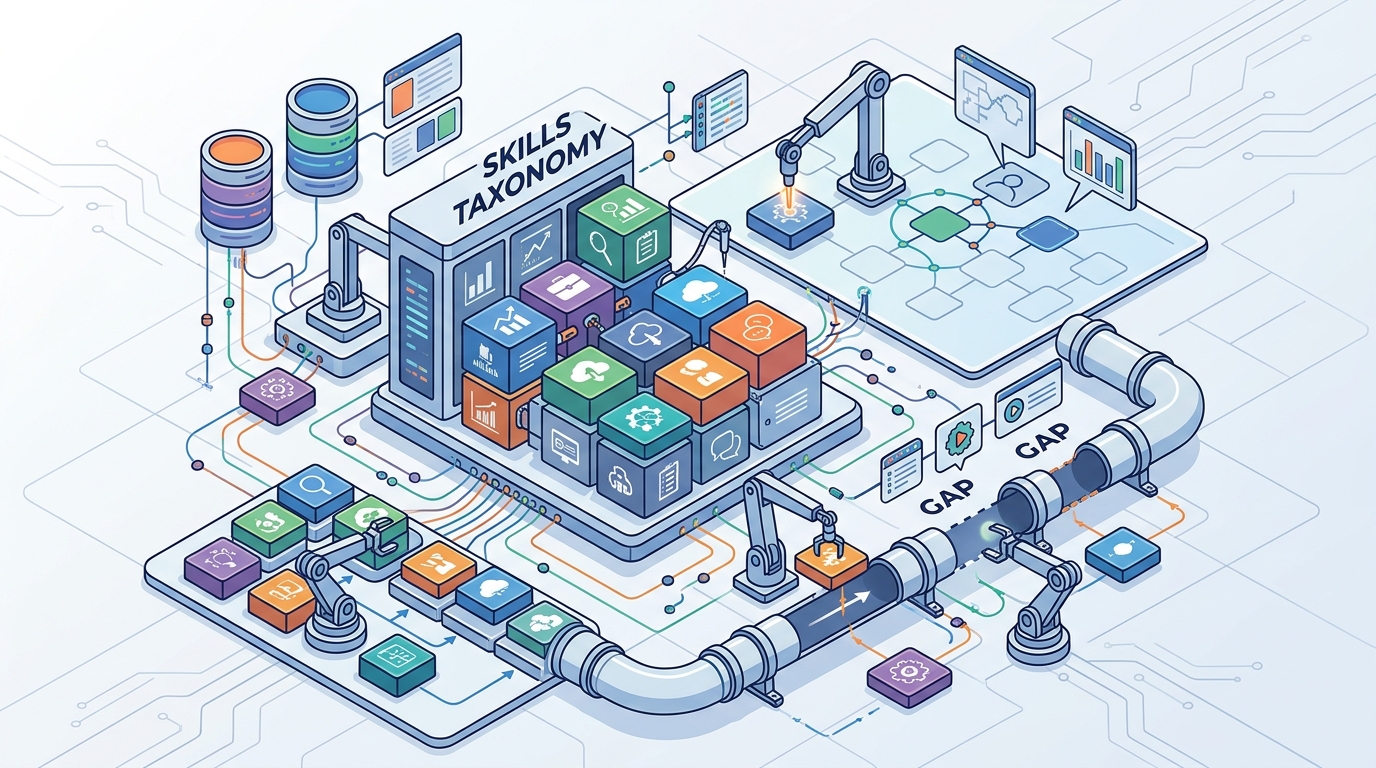
The foundation of any successful talent strategy is a unified language. Without a standardized taxonomy, HR departments and business leaders often speak different languages regarding what constitutes "expertise" or "competency." The Wise Skill addresses this by leveraging a macro taxonomy containing more than 35,000 validated skills. This extensive library ensures that whether you are defining a role in software engineering, marketing, or executive leadership, there is a precise, industry-standard definition available.
Building this taxonomy does not require manual data entry. The platform utilizes intelligent agents to reconstruct departmental structures and role requirements automatically. You simply input your company name or upload an organizational chart, and the system generates a draft taxonomy tailored to your specific business context. This process reduces the initial setup time from weeks to minutes, allowing you to focus on validation rather than creation.
Step 2: Map Roles to the Taxonomy
Once the taxonomy is established, the next phase involves mapping your current organizational roles to these skills. This step transforms static job descriptions into dynamic skill profiles. The Wise Skill platform integrates directly with your existing HRIS, ensuring that the data flows seamlessly without manual reconciliation. This integration is critical for maintaining accuracy, as it pulls real-time data on current employees, their tenure, and their historical performance metrics.
During this mapping process, the platform identifies the "Key Talent Indicators" (KTIs) for each profile. A KTI is a measurable metric that predicts success in a specific role. By defining these indicators, you create a clear benchmark against which every employee can be evaluated. This clarity eliminates ambiguity in performance reviews and promotes a culture of objective assessment rather than subjective opinion.
Step 3: Evaluate Current Employee Proficiency
With roles mapped, you must determine the actual proficiency levels of your workforce. Traditional self-assessments are notoriously unreliable due to the Dunning-Kruger effect, where individuals with low ability overestimate their competence. The Wise Skill replaces these flawed methods with adaptive, objective evaluations. The platform utilizes a database of over 3.5 million validated questions to assess skills with high precision.
The evaluation engine is adaptive, meaning it adjusts the difficulty of questions in real-time based on the candidate's previous answers. This approach ensures that the assessment stops exactly when statistical confidence is reached, saving time while maximizing accuracy. Employees receive individual reports that not only show their current level but also provide a personalized development plan. This transparency fosters trust and encourages continuous learning, as staff can see exactly where they stand relative to their peers and role requirements.
Step 4: Identify Critical Skills Gaps
After evaluation, the platform generates a comprehensive skills gap analysis. This analysis compares the skills required for each role against the actual skills possessed by the employees in those roles. The Wise Skill platform identifies not just individual gaps but also organizational-level deficits that could hinder strategic objectives. For example, if your company plans to expand into AI-driven services, the platform can highlight which teams lack the necessary machine learning competencies.
Understanding these gaps is crucial for prioritizing training investments. According to data from the World Economic Forum, nearly half of all employees will require reskilling by 2025 due to technological advancements. By pinpointing exactly which skills are missing, you can avoid generic training programs and focus resources on high-impact areas. This targeted approach ensures that every dollar spent on learning and development contributes directly to business growth.
Step 5: Deploy Targeted Reskilling Programs
Identifying gaps is only half the battle; closing them requires action. The Wise Skill platform connects directly to a network of over 1 million training courses, allowing you to match specific learning content to identified gaps. Whether your employees need microlearning modules for quick skill updates or comprehensive certification programs for deep expertise, the platform facilitates the connection.
The platform also supports both upskilling and reskilling initiatives. Upskilling involves enhancing the skills of employees in their current roles, while reskilling prepares them for entirely new positions. By leveraging the platform's intelligent matching algorithms, you can recommend the most relevant courses to each employee based on their career goals and the organization's needs. This personalized approach increases engagement and completion rates, as employees see a clear path to their professional development.
Step 6: Monitor Impact and Iterate
The final step in the cycle is monitoring the impact of your interventions. The Wise Skill platform provides continuous tracking of skill acquisition and application. Managers can view dashboards that show progress over time, allowing them to adjust training plans as needed. This iterative process ensures that your talent strategy remains aligned with evolving business goals and market demands.
Regularly revisiting your skills taxonomy and evaluation criteria is essential for maintaining relevance. As industries evolve, so do the skills required for success. The Wise Skill platform updates its taxonomy continuously, ensuring that your organization is always benchmarked against current industry standards. This proactive approach helps you stay ahead of the curve, identifying emerging skill needs before they become critical bottlenecks.
Key Takeaways
- The Wise Skill utilizes a macro taxonomy of over 35,000 skills to ensure precise role definition.
- Adaptive evaluations using 3.5 million questions provide accurate proficiency data without manual bias.
- The platform generates Key Talent Indicators (KTIs) to predict success in specific roles.
- Integration with HRIS systems allows for seamless data flow and real-time updates.
- Access to 1 million training courses enables targeted reskilling and upskilling initiatives.
- Skills gap analysis helps prioritize training investments for maximum business impact.
- Continuous monitoring ensures talent strategies remain aligned with evolving business goals.
Frequently Asked Questions
How does The Wise Skill ensure the accuracy of its skills taxonomy?
The Wise Skill maintains its taxonomy through continuous updates driven by AI and expert validation. The platform analyzes market trends and job postings to ensure that the 35,000+ skills listed remain relevant and aligned with current industry standards.
Can The Wise Skill integrate with my existing HR software?
Yes, the platform is designed for seamless integration with major HRIS and LMS providers. This ensures that employee data flows automatically, reducing administrative overhead and maintaining data consistency across systems.
What is the difference between upskilling and reskilling on the platform?
Upskilling focuses on enhancing the skills of employees for their current roles, while reskilling prepares them for new positions within the organization. The Wise Skill platform supports both by recommending relevant training paths based on individual career goals and business needs.
How does the adaptive evaluation process work?
The adaptive evaluation adjusts the difficulty of questions in real-time based on the candidate's responses. This ensures that the assessment stops when statistical confidence is reached, providing accurate proficiency data in less time than traditional tests.
Does The Wise Skill provide individual development plans?
Yes, each employee receives a personalized development plan based on their evaluation results. This plan outlines specific skills to improve and recommends relevant training courses to help them achieve their professional goals.
How does The Wise Skill help with recruiting?
The platform aids recruiting by providing a clear view of internal talent availability. By mapping skills internally, HR teams can identify internal candidates for open roles, reducing time-to-hire and improving retention rates.
Ready to Transform Your Talent Strategy?
Stop guessing and start knowing. The Wise Skill empowers you to map, evaluate, and close workforce gaps with precision. Book a demo today to see how our platform can drive your organization's success.
Request a Demo