
Verify Employee Skills vs. Self-Reported Abilities in Your HR Platform
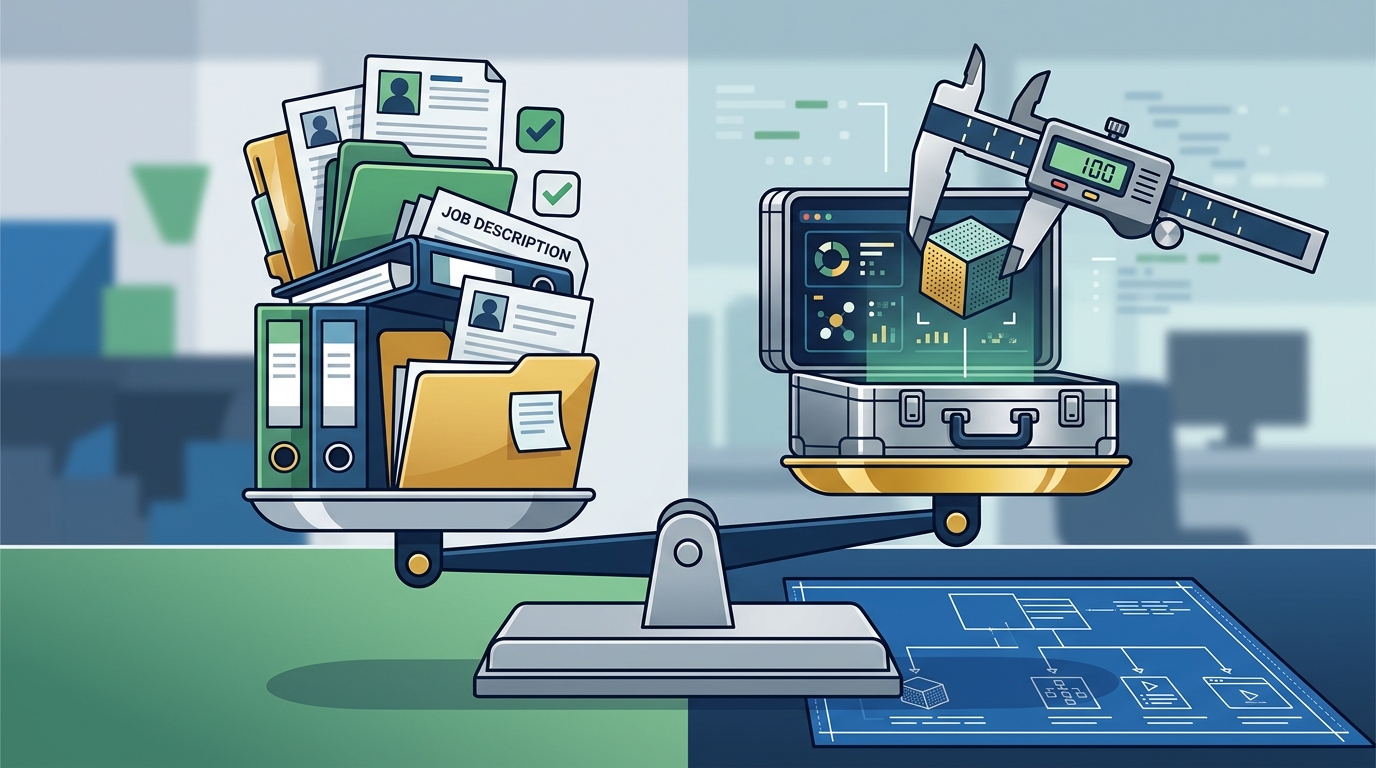
Traditional hiring and promotion processes rely heavily on self-reported data, which introduces significant bias and inaccuracy into talent management. According to recent industry analyses, self-reported skills often diverge from actual performance capabilities by a margin that impacts organizational agility. This discrepancy creates a critical need for objective verification methods that replace intuition with measurable evidence. By shifting from resume-based assessments to skill-first evaluations, organizations can ensure that talent decisions are grounded in reality rather than perception.
Why Self-Reporting Fails in Modern HR
The traditional model of talent management depends on candidates and employees describing their own capabilities. This approach is fundamentally flawed because it relies on subjective interpretation rather than objective measurement. When individuals assess themselves, they often overestimate their proficiency due to the Dunning-Kruger effect or underestimate it due to imposter syndrome. This leads to a misalignment between the skills an employee claims to have and the skills they actually possess.
Furthermore, self-reported data does not account for the dynamic nature of modern work. Skills that were relevant five years ago may now be obsolete, while new competencies emerge rapidly due to technological advancements. Relying on static resumes or self-assessments fails to capture this evolution. Organizations that continue to use these methods risk making hiring and promotion decisions based on outdated or inaccurate information.
The consequence is a talent pipeline that is filled with candidates who look good on paper but lack the practical abilities required for the role. This results in higher turnover, increased training costs, and reduced team productivity. To build a resilient workforce, companies must adopt a system that measures actual performance rather than relying on self-proclaimed expertise.
The Skill Intelligence Framework
Skill intelligence is the systematic measurement and analysis of employee capabilities to drive strategic talent decisions. Unlike traditional HR metrics that focus on tenure or job titles, skill intelligence provides a granular view of what individuals can actually do. This framework shifts the focus from who people say they are to what they can prove they can achieve.
At the core of this framework is the concept of a living taxonomy. A living taxonomy is a dynamic, continuously updated list of skills and competencies that reflects the current needs of the business and the evolving job market. This ensures that the skills being measured are relevant and aligned with organizational goals. By maintaining a shared vocabulary of skills, HR teams and business leaders can communicate more effectively about talent needs.
Implementing skill intelligence requires a shift in mindset. It is not just about collecting data; it is about using that data to inform action. This means using assessment results to identify gaps, create personalized development plans, and make informed hiring decisions. The goal is to create a culture where talent is measured, not just intimated, allowing for more accurate and fair evaluations.
Implementing Adaptive Assessment
Adaptive assessment is a method of evaluating skills where the difficulty of questions adjusts in real-time based on the candidate's previous answers. This approach provides a more accurate measurement of ability than traditional static tests. By tailoring the assessment to the individual, it reduces test fatigue and increases the precision of the results.
The process begins with a baseline evaluation that determines the starting point of the candidate's skill level. As the candidate answers questions, the algorithm analyzes their responses to determine the next question's difficulty. If the candidate answers correctly, the next question becomes more challenging. If they answer incorrectly, the next question becomes easier. This continues until the system reaches a high level of confidence in the candidate's proficiency.
This method offers several advantages over traditional testing. First, it is more efficient, as it requires fewer questions to achieve the same level of accuracy. Second, it is more engaging for the candidate, as the test adapts to their level. Third, it provides a more nuanced view of the candidate's abilities, identifying not just what they know, but where their limits lie. This level of detail is crucial for making informed talent decisions.
For HR platforms, integrating adaptive assessment means moving away from one-size-fits-all evaluations. It requires a robust engine that can generate and score questions dynamically. This engine must be backed by a large library of validated questions to ensure reliability and validity. The result is a more accurate and fair assessment of talent, leading to better hiring and development outcomes.
Mapping Skills to Business Needs
Once skills are measured, the next step is to map them to specific business needs. This process involves identifying the critical skills required for each role and comparing them against the current capabilities of the workforce. This gap analysis is essential for strategic workforce planning and identifying areas for improvement.
The mapping process starts with defining the skills required for each role. This is not just about job titles; it is about the specific tasks and competencies that drive success in that role. By breaking down roles into their component skills, organizations can create a more detailed and accurate picture of their talent landscape.
Next, the organization must assess the current skills of its employees. This can be done through a combination of assessments, interviews, and performance data. The goal is to create a comprehensive profile of each employee's capabilities. This profile is then compared against the required skills for each role to identify gaps.
These gaps represent opportunities for development and hiring. By prioritizing the most critical gaps, organizations can focus their resources on the areas that will have the greatest impact. This targeted approach ensures that training and hiring efforts are aligned with business objectives, leading to more effective talent management.
Closing the Skills Gap
Identifying skills gaps is only the first step. The real value lies in closing those gaps through targeted development and strategic hiring. This requires a proactive approach to talent management that focuses on continuous learning and adaptation.
For existing employees, closing the skills gap involves creating personalized learning paths. These paths should be tailored to the individual's current skill level and career goals. By providing relevant and timely training, organizations can help employees develop the skills they need to succeed. This not only improves individual performance but also enhances employee engagement and retention.
For new hires, closing the skills gap involves ensuring that the recruitment process focuses on potential and adaptability rather than just past experience. By assessing candidates on their ability to learn and apply new skills, organizations can build a more resilient and agile workforce. This approach is particularly important in rapidly changing industries where the half-life of skills is short.
Additionally, organizations can leverage technology to automate the matching of employees to learning resources. By using AI-driven recommendations, HR teams can ensure that employees are exposed to the most relevant training content. This reduces the administrative burden on HR and ensures that learning is continuous and personalized.
Key Takeaways
- Self-reported skills are often inaccurate and biased, leading to poor talent decisions.
- Skill intelligence provides a data-driven approach to measuring employee capabilities.
- Adaptive assessments offer a more precise and efficient way to evaluate skills.
- Mapping skills to business needs helps identify critical gaps and prioritize development.
- Closing skills gaps requires personalized learning paths and strategic hiring.
- Technology can automate the matching of employees to learning resources.
- A living taxonomy ensures that skill definitions remain relevant and up-to-date.
Frequently Asked Questions
How does adaptive assessment differ from traditional testing?
Adaptive assessment adjusts the difficulty of questions in real-time based on the candidate's responses, providing a more accurate measurement of skill level with fewer questions.
What is a living taxonomy in skill management?
A living taxonomy is a dynamic list of skills that is continuously updated to reflect changes in the job market and business needs, ensuring relevance and accuracy.
Why is skill mapping important for HR?
Skill mapping allows HR to compare current employee capabilities against business requirements, identifying gaps that need to be addressed through training or hiring.
Can skill verification reduce hiring bias?
Yes, by focusing on objective measurements of ability rather than subjective self-reports or resume keywords, skill verification helps create a more equitable hiring process.
How often should skills be reassessed?
Skills should be reassessed regularly, ideally as part of a continuous performance management cycle, to ensure that the data remains current and actionable.
What role does AI play in skill verification?
AI powers the adaptive algorithms that tailor assessments to individuals and analyzes large datasets to identify patterns and gaps in workforce capabilities.
Is skill verification suitable for all roles?
While most roles can benefit from skill verification, the specific skills and assessment methods must be tailored to the unique requirements of each position.
How does skill verification impact employee development?
It provides employees with clear, data-driven insights into their strengths and weaknesses, enabling more effective and personalized professional development plans.
Get Started with Skill Verification
Stop relying on intuition and start making talent decisions based on evidence. The Wise Skill provides the infrastructure to map, measure, and manage your organization's most valuable asset: its people. Schedule a demo today to see how our skill intelligence platform can transform your HR processes. Explore our evaluation tools to understand the depth of our assessment capabilities. Discover talent mapping solutions that align your workforce with your strategic goals. Learn about reskilling strategies that close critical skills gaps. Identify your skills gaps with precision and clarity. Read our latest insights on the future of work.