
Skills Management Platform Pricing and ROI for Integrated Talent Systems
Organizations that leverage data-driven talent strategies report a 20% increase in workforce agility compared to those relying on traditional intuition-based methods. This shift is not merely about adopting new software but about fundamentally rethinking how human capital is valued, measured, and developed. As the global talent management market continues to expand, the focus has moved from simple HR administration to sophisticated skill intelligence. Companies are now seeking platforms that connect business needs with employee capabilities in real time, ensuring that every dollar spent on talent yields measurable returns. (Skill Intelligence Blog Insights)
Understanding Skill Intelligence
Skill intelligence is the systematic measurement and application of employee capabilities to drive business outcomes. Unlike traditional performance reviews that look backward at past behavior, skill intelligence looks forward at potential and readiness. It maps the gap between what the business needs and what the workforce currently possesses.
The core of this approach lies in dynamic taxonomies. A static list of job titles is insufficient for modern enterprises. Instead, organizations require a living database of skills that evolves with market trends and technological advancements. This allows for precise matching of talent to projects, reducing time-to-hire and increasing internal mobility.
Platforms like The Wise Skill exemplify this by using AI agents to map profiles and measure real levels of proficiency. This moves the conversation from subjective opinions to objective evidence, allowing leaders to make decisions based on data rather than gut feeling.
Pricing Models Explained
Understanding the cost structure of a skills management platform is critical for budgeting and forecasting. Most enterprise-grade solutions utilize usage-based or tiered pricing models.
Subscription Tiers
Providers often segment their offerings into distinct levels based on the depth of analytics and automation features. For instance, entry-level tiers may focus on basic skill mapping, while advanced tiers include automated reskilling recommendations and deep HRIS integration.
Per-Employee vs. Flat Fees
Some platforms charge per active user, which scales directly with company growth. Others offer enterprise flat fees for unlimited access, which can be more cost-effective for large organizations with thousands of employees. It is essential to calculate the cost per employee to determine the true value.
Implementation and Onboarding
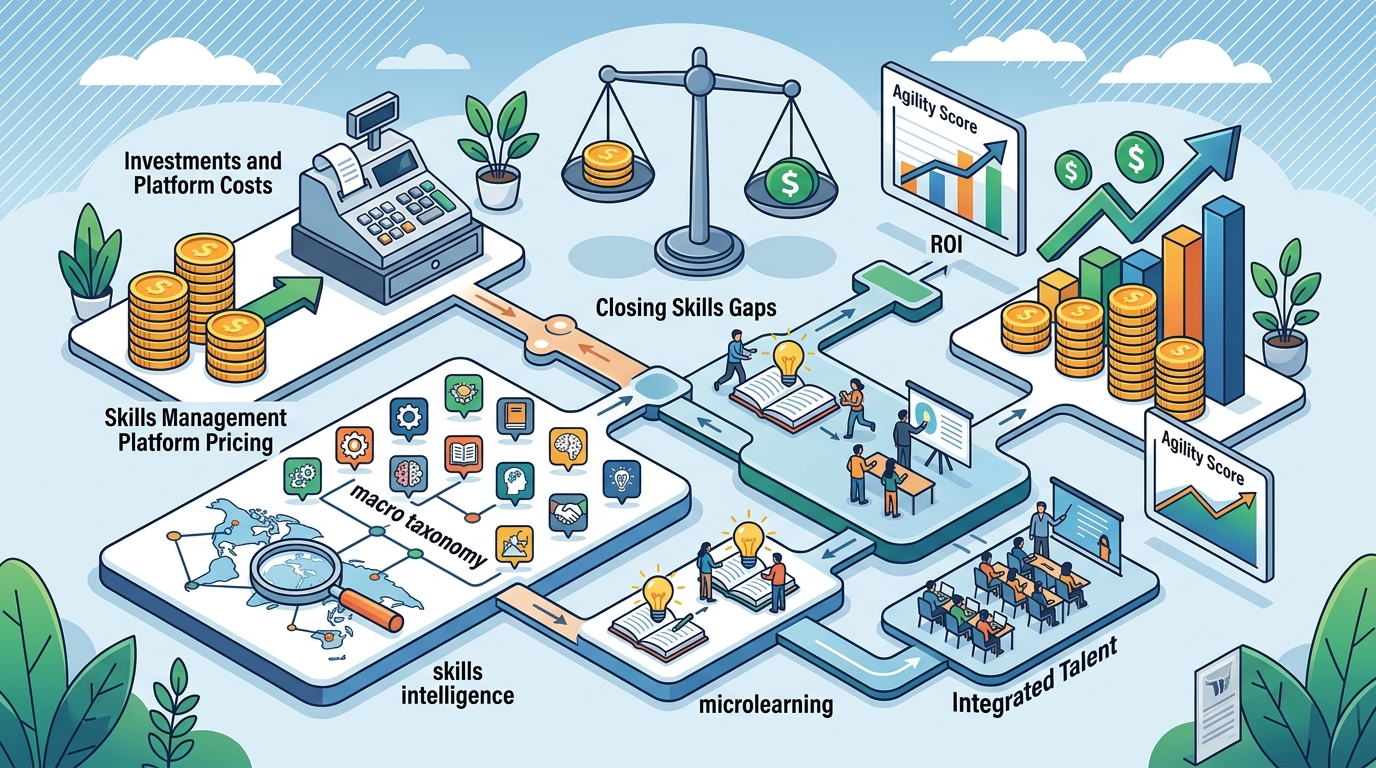
While the software license is the recurring cost, initial setup can involve significant investment. However, modern platforms emphasize zero-data-entry onboarding. By syncing with existing HRIS systems, they reduce the need for manual data entry, lowering the total cost of ownership.
ROI Calculation Framework
Calculating the return on investment for a skills management platform requires looking at both hard savings and soft efficiencies. The formula for ROI is generally: (Net Benefits / Cost of Investment) x 100.
Hard Savings
- Reduced Time-to-Hire: By identifying internal candidates for open roles, companies save on recruitment agency fees and advertising costs. Industry data suggests that internal mobility can reduce hiring costs by up to 30%.
- Lower Turnover: Employees who see a clear path for growth are less likely to leave. Retaining top talent saves the average replacement cost, which can range from 50% to 200% of an employee's annual salary.
Soft Efficiencies
- Improved Decision Making: Data-driven promotions reduce bias and improve leadership quality.
- Faster Reskilling: Identifying skill gaps early allows for targeted training, reducing the time employees spend in unproductive roles.
According to recent studies on talent management, organizations that effectively manage skills see a 24% increase in revenue growth compared to those that do not. This highlights the strategic importance of accurate skill measurement.
Integration Capabilities
A skills management platform does not exist in a vacuum. It must integrate seamlessly with the existing technology stack to be effective. Siloed data leads to inaccurate insights and user frustration.
HRIS and LMS Connectivity
The platform should connect with major Human Resource Information Systems (HRIS) and Learning Management Systems (LMS). This ensures that skill data flows automatically, keeping the taxonomy up to date without manual intervention.
API-First Architecture
For custom integrations, an API-first approach is essential. This allows developers to build custom workflows that trigger actions based on skill data, such as automatically enrolling an employee in a course when a gap is detected.
Platforms that prioritize integration, such as those offering skill mapping tools, ensure that the talent map is always current and actionable.
Security and Compliance
Given the sensitive nature of employee data, security is a non-negotiable aspect of platform selection. Organizations must ensure that their provider adheres to strict regulatory standards.
Data Privacy Standards
Compliance with GDPR and other regional data protection laws is mandatory. The platform must offer robust controls for data access, retention, and deletion.
Certifications
Look for providers with ISO 27001 and ISO 42001 certifications. These indicate that the company has rigorous information security and AI management practices in place. This is particularly important as the EU AI Act introduces new requirements for high-risk AI systems.
Security is not just a feature; it is the foundation of trust between the employer and the employee. When employees know their data is protected, they are more likely to engage honestly with skill assessments.
Key Takeaways
- Data-Driven Decisions: Skill intelligence replaces intuition with evidence, leading to more accurate talent assessments.
- Dynamic Taxonomies: Static job descriptions are obsolete; living skill maps are required for modern agility.
- ROI Potential: Effective skills management can reduce hiring costs by 30% and increase revenue growth by 24%.
- Integration is Key: Seamless HRIS and LMS connectivity ensures data accuracy and user adoption.
- Security First: ISO certifications and GDPR compliance are essential for protecting sensitive employee data.
- Scalable Pricing: Choose between per-user or enterprise models based on organizational size and growth trajectory.
- AI Automation: AI agents can automate the mapping and assessment process, saving hundreds of hours of HR time.
Frequently Asked Questions
How is the ROI of a skills management platform calculated?
ROI is calculated by comparing the cost of the platform against the savings from reduced turnover, lower hiring costs, and increased productivity. Hard savings include direct financial metrics, while soft savings include improved decision-making speed.
What is the difference between skill mapping and talent assessment?
Skill mapping is the process of defining and organizing the skills required for roles within an organization. Talent assessment is the measurement of an individual's current proficiency against those mapped skills. Together, they identify gaps and opportunities.
Is skill intelligence secure for employee data?
Yes, when provided by a reputable vendor. Look for platforms with ISO 27001 and ISO 42001 certifications, as well as GDPR compliance. These ensure that data is handled with the highest standards of security and privacy.
How long does it take to implement a skills management platform?
Implementation time varies, but platforms with zero-data-entry onboarding can be operational in days rather than months. By syncing with existing HRIS systems, the initial setup is significantly faster.
Can a skills management platform integrate with our existing HRIS?
Most modern platforms offer robust integration capabilities with major HRIS providers. This ensures that skill data is automatically updated and consistent across the organization.
What is the cost of a typical skills management platform?
Pricing varies based on the number of employees and the level of features required. Some platforms offer per-user pricing, while others provide enterprise flat fees. It is best to request a demo for a customized quote.
How does AI improve skills management?
AI automates the mapping of skills, analyzes assessment data to identify gaps, and recommends personalized learning paths. This reduces the manual workload for HR teams and increases the accuracy of insights.
Next Steps
Transforming your talent strategy requires more than just buying software; it requires a partnership that understands your unique business context. The Wise Skill offers a comprehensive approach to skill intelligence, connecting your business needs with your people's capabilities.
Ready to see the difference data-driven talent management can make? Schedule a free demo today to discover how we can help you map skills, evaluate your team, and detect gaps in minutes. Our team is ready to show you how to build a resilient, agile workforce for the future.