
Organizations that fail to map their internal talent capabilities are losing ground to competitors who leverage data-driven workforce planning. According to recent industry analysis, companies with mature skills intelligence frameworks report a 30 percent increase in internal mobility rates compared to those relying on traditional job descriptions. This shift is not merely a trend but a structural necessity for modern human resources. Integrating skills intelligence into your existing HR stack transforms static employee records into dynamic, actionable assets. The process requires careful alignment of data sources, middleware configuration, and user adoption strategies. This guide outlines the precise steps to achieve seamless integration without disrupting daily operations.
Understanding Skills Intelligence
Before technical implementation, it is vital to define the core concept. Skills intelligence is the systematic collection, analysis, and application of data regarding the capabilities, competencies, and potential of a workforce. Unlike traditional HR metrics that focus on tenure or title, skills intelligence focuses on what employees can actually do. This data-driven approach allows organizations to identify skill gaps, predict future hiring needs, and optimize internal talent deployment.
The foundation of this system lies in standardized taxonomies. Without a common language for skills, data silos persist. For instance, one department might label a capability as "Python Development" while another uses "Backend Engineering." Harmonizing these terms is the first step toward actionable insights. Organizations that successfully implement these frameworks see a significant reduction in time-to-hire for critical roles. The ability to match internal talent to open projects reduces reliance on external recruiting agencies, thereby lowering overall operational costs.
Audit Your Existing HR Stack
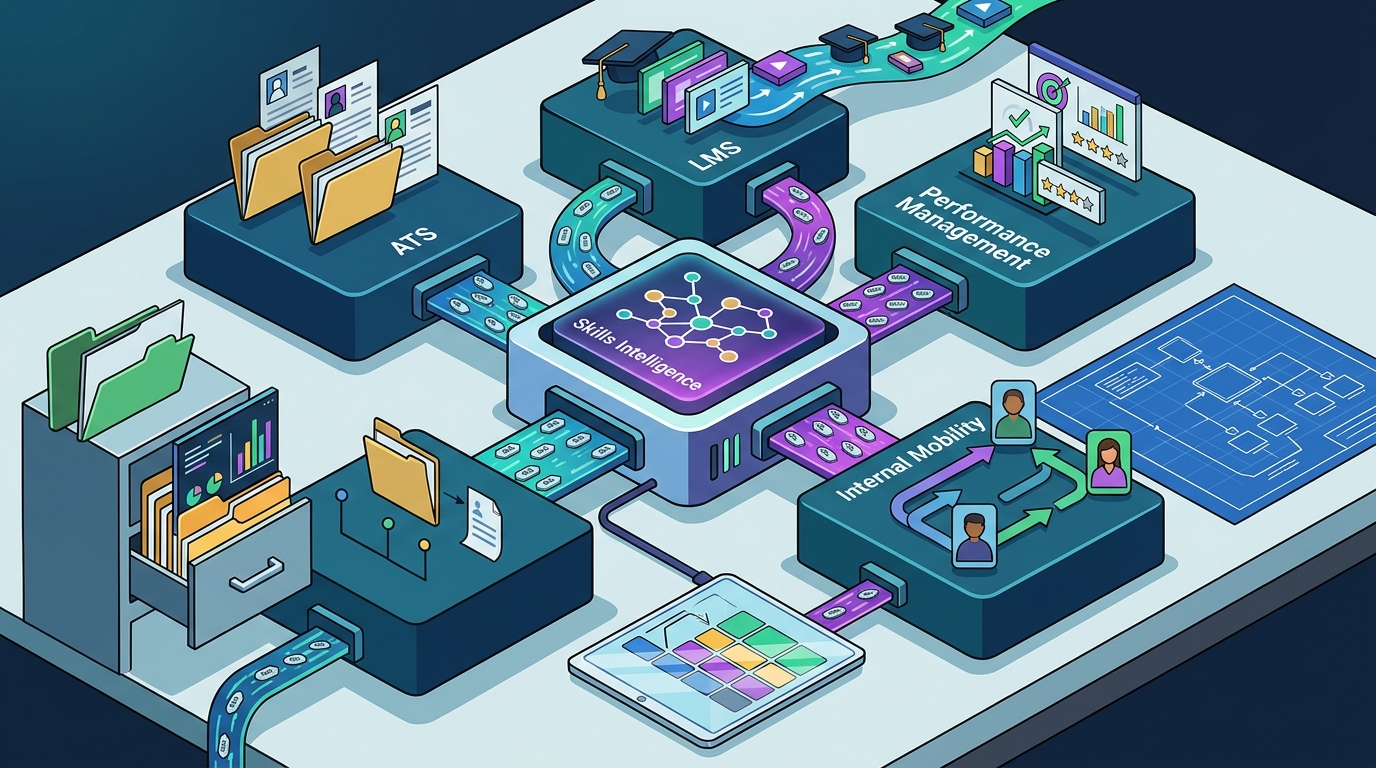
Integration begins with a comprehensive audit of your current technology ecosystem. Most enterprises use a combination of Applicant Tracking Systems (ATS), Human Resource Information Systems (HRIS), and Learning Management Systems (LMS). Each of these platforms holds fragments of skills data, but rarely in a unified format.
Start by identifying the primary source of truth for employee profiles. Is it your HRIS, such as Workday or SAP SuccessFactors, or is it a specialized talent management platform? Determine which systems currently capture skills data, whether through manual entry, resume parsing, or certification tracking. This audit reveals the gaps in your current infrastructure. You must also assess the API capabilities of these systems. Legacy systems with limited API access may require middleware solutions to facilitate real-time data exchange. Understanding these technical constraints early prevents costly rework during the integration phase.
Data Mapping and Standardization
Once you understand your current stack, the next step is data mapping. This process involves aligning the skills taxonomy of your chosen intelligence platform with the existing data structures in your HR systems. This is often the most complex phase of the integration. It requires collaboration between HR leaders, data engineers, and IT security teams.
Create a master skills ontology that serves as the bridge between your internal data and the external intelligence platform. This ontology should include core technical skills, soft skills, and emerging competencies. Use natural language processing (NLP) tools to map unstructured data from resumes and job descriptions to your standardized taxonomy. This automation reduces manual effort and ensures consistency across the organization. According to data from leading HR technology analysts, organizations that standardize their skills data see a 40 percent improvement in data accuracy within the first year of implementation.
Integration Methodologies
There are two primary approaches to integrating skills intelligence: API-driven real-time sync and batch processing. The choice depends on your organization's size, technical maturity, and real-time data needs.
API-Driven Real-Time Sync
API integration allows for continuous, bidirectional data flow. When an employee completes a course in your LMS, the skills intelligence platform updates their profile immediately. Conversely, when a new skill is identified in the market, it can be pushed to your ATS to update job descriptions. This method ensures that your talent data is always current. It requires robust API management and monitoring to handle data volume and latency issues. However, the benefits of real-time visibility often outweigh the technical complexity.
Batch Processing
Batch processing involves scheduled data transfers, typically nightly or weekly. This method is simpler to implement and less resource-intensive. It is suitable for organizations with stable workforce structures and less urgent data needs. However, batch processing can lead to data staleness, where the skills profile no longer reflects the employee's current capabilities. For dynamic industries like technology or consulting, real-time sync is generally preferred.
Vendor Selection Criteria
Selecting the right skills intelligence platform is critical to the success of your integration. The market is crowded with solutions, each offering different strengths. Evaluate vendors based on their ability to integrate with your specific HR stack. Look for pre-built connectors for your HRIS and ATS. This reduces development time and ensures compatibility.
Consider the depth of the vendor's skills taxonomy. Does it cover niche roles relevant to your industry? A generic taxonomy may miss critical competencies, leading to inaccurate insights. Additionally, evaluate the platform's AI capabilities. Advanced AI can automatically extract skills from unstructured data, such as project reports or performance reviews, enriching your database without manual input. The Wise Skill offers specialized frameworks for recruiting and training that align with these integration needs. Their approach focuses on making skills data actionable for both HR professionals and managers. You can explore their methodology further by visiting about the platform or reviewing their blog resources for detailed insights.
Implementation Roadmap
A phased rollout minimizes risk and allows for iterative improvement. Do not attempt to integrate all systems at once. Start with a pilot group, such as a single department or a specific hiring team.
| Phase | Key Activities | Success Metrics |
|---|---|---|
| Phase 1: Pilot | Integrate skills data for one department. Test API connectivity. | Data accuracy rate, user feedback score. |
| Phase 2: Expansion | Roll out to additional departments. Enable real-time sync. | Number of active users, skill gap identification rate. |
| Phase 3: Optimization | Refine taxonomy based on usage data. Integrate advanced AI features. | Internal mobility rate, time-to-fill reduction. |
During the pilot phase, gather feedback from HR partners and hiring managers. Are they finding the data useful? Is the interface intuitive? Use this feedback to refine the integration before full-scale deployment. Training is also crucial. Provide comprehensive training sessions for HR staff on how to interpret skills data and use it in decision-making. For more information on training methodologies, you can check the demo page to see the platform in action.
Key Takeaways
- Skills Intelligence Definition: Skills intelligence is the systematic collection and analysis of workforce capability data to drive strategic HR decisions.
- Audit First: Always audit your existing HR stack to identify data silos and API limitations before selecting a vendor.
- Standardization is Key: A unified skills taxonomy is essential for accurate data mapping and cross-departmental visibility.
- Real-Time vs. Batch: Choose real-time API integration for dynamic environments and batch processing for stable, less urgent data needs.
- Vendor Compatibility: Prioritize vendors with pre-built connectors for your specific HRIS and ATS to reduce implementation time.
- Phased Rollout: Start with a pilot group to test data accuracy and user adoption before full-scale deployment.
- Training Matters: Invest in training for HR staff to ensure they can effectively interpret and utilize skills data.
Frequently Asked Questions
What is the difference between skills intelligence and traditional HR metrics?
Traditional HR metrics focus on static attributes like tenure, title, and education. Skills intelligence focuses on dynamic capabilities and competencies, allowing for more agile workforce planning.
How long does it take to integrate skills intelligence into an HR system?
Integration timelines vary based on complexity. A pilot phase typically takes 4 to 8 weeks, while full enterprise deployment can take 3 to 6 months depending on the number of systems involved.
Can skills intelligence replace job descriptions?
Skills intelligence does not replace job descriptions but enhances them. It allows for dynamic job profiles that update in real-time based on market trends and internal capabilities.
What are the common challenges in skills data mapping?
Common challenges include inconsistent terminology across departments, lack of standardized taxonomies, and resistance to change from HR staff accustomed to traditional methods.
How does skills intelligence impact internal mobility?
By providing a clear view of internal capabilities, skills intelligence enables HR to match employees to internal opportunities more effectively, increasing retention and reducing hiring costs.
Is skills intelligence suitable for small businesses?
Yes, small businesses can benefit significantly from skills intelligence by optimizing limited resources and identifying growth opportunities within their existing team.
What role does AI play in skills intelligence?
AI automates the extraction of skills from unstructured data, such as resumes and performance reviews, and predicts future skill needs based on market trends.
How do I measure the ROI of skills intelligence?
ROI can be measured by tracking reductions in time-to-hire, increases in internal mobility rates, and decreases in external recruiting costs.
Start Your Integration
Integrating skills intelligence into your HR systems is a transformative step toward building a more agile and capable workforce. By following the steps outlined in this guide, you can ensure a smooth and effective implementation. To learn more about how The Wise Skill can support your journey, visit our FAQ page or schedule a demo today. For more insights on recruiting and training, explore our blog or review our legal and privacy policies.