
Internal Talent Mobility: The 2026 Guide to Finding Candidates Before External Hiring
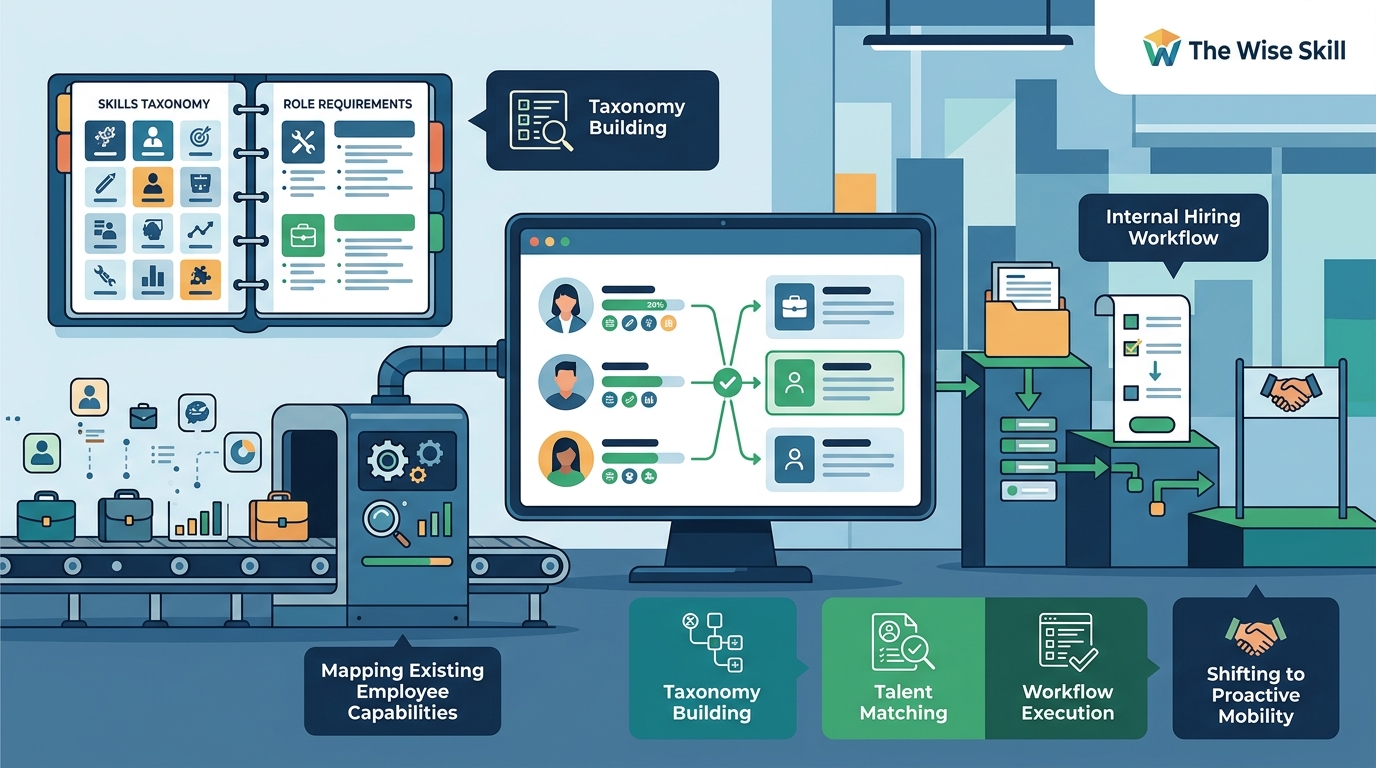
Companies can find internal candidates before posting an open role externally by using a skills intelligence platform that maps existing employee capabilities against role requirements. This guide explains how to build a skills taxonomy, match internal talent to new roles, and execute a structured internal hiring workflow. It covers the specific steps required to shift from reactive external recruiting to proactive internal mobility.
Internal Talent Mobility
Internal talent mobility is the process of moving existing employees into new roles within the same organization. It allows companies to fill vacancies faster and retain top performers by offering career growth. Traditional HR systems often rely on static job descriptions and manual searches, which miss hidden talent. A skills-based approach changes this by looking at what people can actually do, not just their current job title. For additional details, review the Request a Free Demo.
Why External Hiring Fails First
Posting a role externally is often the default reaction to a vacancy. This approach is expensive and slow. It also ignores the fact that the right candidate might already be on the payroll. When companies skip the internal search, they risk losing engaged employees who feel stuck in their current positions. Retention drops when people do not see a clear path for advancement.
The Role of Skills Intelligence
Skills intelligence provides the data needed to see who is ready for a move. It creates a living map of your workforce. This map shows which employees have the specific competencies required for open roles. By using this data, HR teams can identify candidates who are already 80% of the way there. They can then focus on closing the remaining 20% gap through targeted training.
The Wise Skill helps organizations build this map. It connects business needs with the actual capabilities of your people. This ensures that internal mobility is not a guess but a data-driven strategy. You can see exactly who is ready and who needs a little more development.
Skill Matching
Skill matching is the process of comparing an employee's assessed capabilities against the requirements of a target role. It moves beyond keyword searches in resumes to a precise analysis of competencies. This method ensures that candidates are evaluated on their actual ability to perform the job. It reduces bias and improves the quality of internal hires.
Building a Living Taxonomy
Effective matching requires a robust skills taxonomy. A taxonomy is a structured classification of skills and competencies. It must be detailed enough to distinguish between similar roles. It must also be broad enough to cover emerging technologies and soft skills. Static taxonomies become outdated quickly. A living taxonomy evolves with the market and your specific business needs.
The Wise Skill utilizes a macro taxonomy with over 35,000 skills. This extensive library allows for granular matching. It covers technical hard skills, behavioral soft skills, and AI-related competencies. By using a standardized framework, you ensure that comparisons are fair and consistent across different departments.
Assessing Real Capability
Knowing a skill name is not the same as possessing the skill. Assessment is the step that verifies capability. It involves asking objective questions that test practical knowledge. The Wise Skill uses adaptive assessments that adjust to the candidate's level. This cuts down assessment time while maximizing accuracy. The result is a verified skill profile for every employee.
Matching Logic and Gaps
Once skills are assessed, the platform matches them against role requirements. It calculates a fit score based on the overlap between the two. It also identifies specific gaps. For example, a candidate might have strong data analysis skills but lack experience in a specific software tool. The platform highlights these gaps clearly. This allows managers to make informed decisions about whether to hire, train, or pass on a candidate.
| Matching Component | Traditional Method | Skills Intelligence Method |
|---|---|---|
| Data Source | Static Job Descriptions | Assessed Skill Profiles |
| Search Method | Keyword Search | Competency Mapping |
| Gap Analysis | Manual Review | Automated Precision |
| Outcome | Subjective Guessing | Objective Evidence |
Internal Hiring Workflow
An internal hiring workflow is the structured process for moving an employee from their current role to a new one. It defines the steps for identification, assessment, approval, and transition. A clear workflow ensures that internal moves are as rigorous as external hires. It also provides transparency for both the employee and the hiring manager.
Step 1: Define the Role Requirements
Start by defining what the new role actually needs. This is not just a list of tasks. It is a breakdown of the specific skills and knowledge required for success. Use your skills taxonomy to define these requirements. Be clear about which skills are mandatory and which are desirable. This clarity is crucial for accurate matching.
Step 2: Identify and Assess Candidates
Run the skill matching process against your internal talent pool. The platform will generate a list of candidates based on their fit score. Review these candidates to see their verified skill levels. For those with minor gaps, initiate a development plan. For those with a strong fit, move them to the next stage. This step ensures you are only interviewing people who have the foundational capability.
Step 3: Manager and Employee Alignment
Internal mobility requires buy-in from three parties: the hiring manager, the current manager, and the employee. The hiring manager must agree that the candidate is a good fit. The current manager must be willing to release the employee. The employee must be interested in the move. The Wise Skill platform facilitates this by providing clear evidence of fit. It helps these conversations by removing ambiguity about the candidate's abilities.
Step 4: Transition and Onboarding
Key Takeaways
- Internal talent mobility reduces hiring costs and improves retention by offering growth opportunities.
- Skills intelligence replaces static job descriptions with dynamic, assessed capability profiles.
- A living taxonomy with thousands of skills is essential for accurate matching across diverse roles.
- Adaptive assessments verify real skill levels, ensuring that matches are based on evidence, not perception.
- Gap analysis identifies exactly what training is needed to prepare an internal candidate for a new role.
- A structured workflow ensures that internal hires are as rigorous and transparent as external hires.
- Aligning managers and employees on the move is critical for successful internal mobility.
- Automated matching saves HR teams significant time in identifying potential candidates.
Frequently Asked Questions
How does skill matching differ from keyword search?
Skill matching compares assessed competencies against role requirements. Keyword search looks for specific words in a resume. Matching is based on verified ability, while search is based on text presence. This makes matching far more accurate for identifying true capability.
Can I use skills intelligence for external hiring too?
Yes, the same principles apply to external hiring. You can assess external candidates using the same adaptive questions. This ensures that internal and external candidates are evaluated on the same standard. It creates a fair comparison between the two pools.
What happens if an internal candidate has skill gaps?
The platform identifies the specific gaps. You can then create a development plan to close them. This might involve short training modules or mentoring. The candidate can be hired conditionally, with the understanding that they will complete the training during onboarding.
How long does the internal hiring process take?
It is typically faster than external hiring. Since you already know the candidate's cultural fit and work ethic, you skip many screening steps. The main time is spent on assessment and manager alignment. This can reduce time-to-fill by weeks.
Do I need to replace my current HR system?
No, skills intelligence platforms integrate with existing HRIS and LMS systems. They layer on top of your current infrastructure. This means you do not need to migrate your entire data. You just add the skills layer to your existing data.
How do I get buy-in from managers for internal moves?
Use data to show the value of the candidate. Show them the verified skills and the gap analysis. Demonstrate that the candidate is ready or can be ready quickly. This removes the fear of losing a key employee to a role they are not qualified for.
Is this approach suitable for small companies?
Yes, even small companies benefit from internal mobility. It helps retain talent and fills roles faster. The platform scales to your size. You can start with a small number of roles and expand as you see the value.
Conclusion
Finding internal candidates before posting externally is a strategic advantage. It saves money, retains talent, and fills roles faster. The key is to move from intuition to evidence. By using a skills intelligence platform, you can see exactly who is ready and who needs development. The Wise Skill provides the tools to build this capability. It offers a comprehensive taxonomy, adaptive assessments, and a clear workflow for internal mobility. Start by mapping your current skills and identifying your first internal role. See what you find.