
Organizations are no longer guessing their workforce capabilities. According to recent industry analysis, companies utilizing skills-based talent strategies report a 30% faster time-to-productivity for new hires compared to traditional role-based models. This shift marks the end of intuition-driven HR and the beginning of evidence-based talent management. The core of this transformation is skills intelligence, a methodology that connects business strategy directly to individual employee capabilities. (Qui nes somos Skill)
What Is Skills Intelligence?
Skills intelligence is the systematic collection, analysis, and application of data regarding the specific abilities, knowledge, and competencies within an organization. Unlike traditional HR metrics that focus on job titles or tenure, this approach treats skills as the primary unit of organizational value. It allows leaders to see the actual capacity of their workforce rather than relying on static job descriptions. (Conecta lo que tu)
The foundation of this system is a living taxonomy. A living taxonomy is a dynamic, continuously updated framework of skills that evolves with market demands and technological advancements. This ensures that the language used by HR professionals matches the strategic needs of the business. When skills are treated as a common language, decision-making becomes transparent and auditible. (Eventos de Skill Intelligence)
At The Wise Skill, we believe that talent is measured, not intuited. Our platform connects what your business needs with what your people know and can do. This connection is not a one-time audit but a continuous process of alignment. By integrating your business context with evaluated capabilities, we provide a clear path from strategy to action. (Partners The Wise Skill)
The Skills-First Framework
Implementing a skills-first approach requires a fundamental shift in how organizations view their workforce. It moves away from the idea that a job title defines a person's potential. Instead, it focuses on the specific skills required to achieve business outcomes. This framework is critical for several key areas of talent management.
Strategic Talent Mapping
Talent mapping is the process of identifying the skills currently present in your organization and comparing them against future strategic needs. This is not about creating static organigrams. It is about building a living map of talent that reveals gaps and opportunities. By starting with the name of your company or uploading a single HRIS file, agents can reconstruct departments and profiles in minutes.
This process transforms intuition into evidence. You identify the relevant skills for each role within your organization and sector. You detect the skill gaps that would prevent you from reaching your next objectives. This clarity allows for proactive rather than reactive talent management.
Internal Mobility and Retention
One of the most significant benefits of skills intelligence is the enablement of internal mobility. When skills are clearly defined and measured, employees can see their own career paths. This transparency fosters a culture of improvement and growth. Employees are no longer limited by the visibility of their current manager.
Projects can find talent by demonstrated competencies rather than by who is available. This leads to fairer promotions and more efficient project staffing. The result is a workforce that is more engaged and better aligned with business goals. It also reduces the cost and risk associated with external hiring.
Mapping Technology and Agents
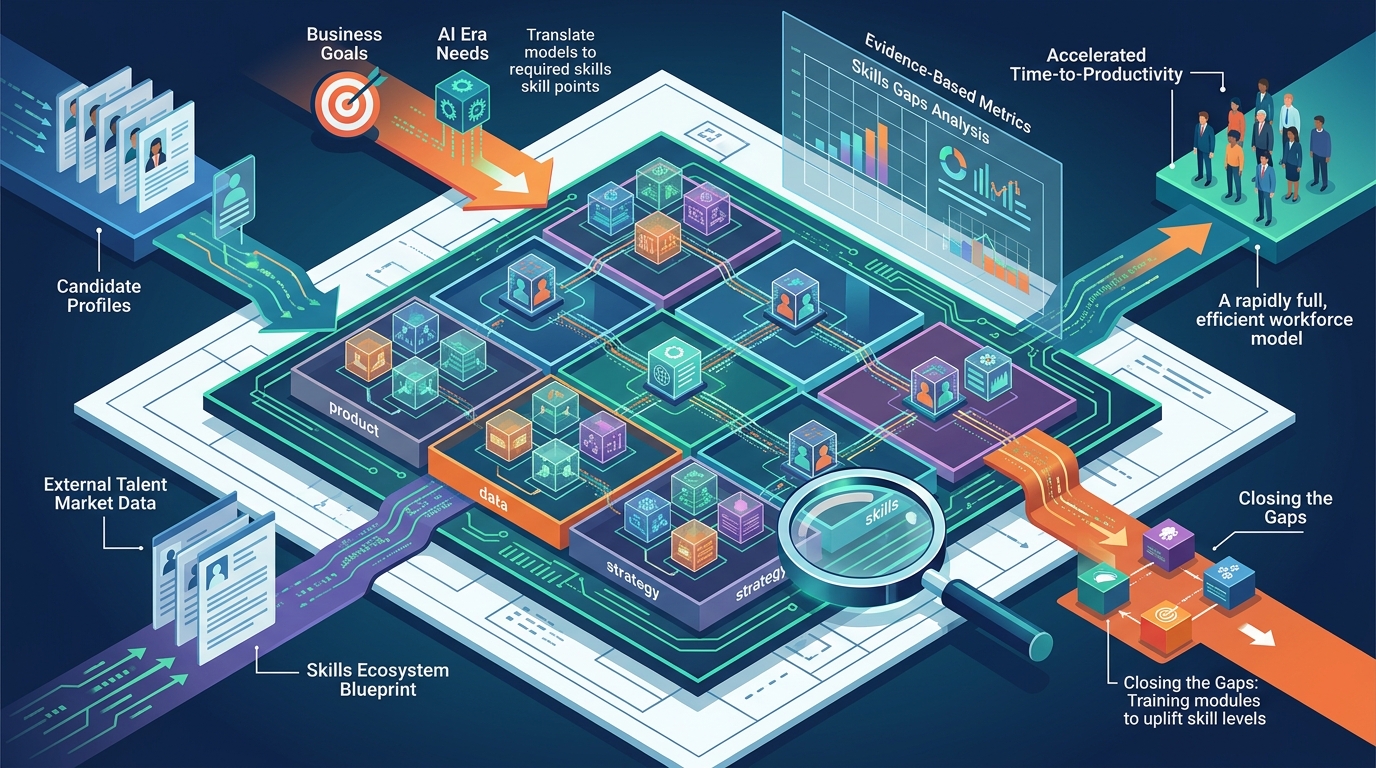
The complexity of managing thousands of skills across a large organization requires advanced technology. Manual mapping is impossible at scale. This is where intelligent agents come into play. These specialized agents work alongside HR teams to propose actions and execute approved initiatives.
The process begins with context. We understand your business by incorporating your purpose, strategy, and needs during the onboarding phase. We then define the knowledge and skills required for each role. Your team validates and adapts these requirements within the platform. This ensures that the taxonomy is relevant to your specific industry and culture.
Once the context is set, the fleet of specialized agents takes over. They map the profiles and their skills, measure the real level of each person, detect gaps, and launch the training that closes them. You assign an objective, not a task. The agents review everything and return with a proposal ready for your decision. This ensures that you maintain control while leveraging automation.
Integration is seamless. The Wise Skill connects with your existing LMS, HRIS, and content providers. Data flows without silos and without manual reconciliation work. This interoperability is crucial for maintaining data accuracy and reducing administrative burden.
Evaluation Methodology
Mapping skills is only half the equation. You must also measure them accurately. Traditional assessments often rely on long questionnaires that suffer from fatigue and low precision. The Wise Skill uses a different approach based on adaptive testing and statistical confidence.
Adaptive Assessments
Our engine chooses each question based on the previous one. It operates on a library of over 3 million validated questions. The assessment stops when the result reaches statistical confidence. This means fewer questions are needed to achieve a reliable result. It is the same logic used in professional certifications, but applied at scale.
This method reduces the time employed by the candidate while maximizing the precision of the measurement. The result is a defendable outcome that can be used for critical decisions such as promotions, hiring, and development planning. There are no passes or fails. Instead, individuals see the evidence supporting their level and their clear path for progress.
Homogeneous Scales by Role
Comparability is essential for fairness. We measure skills with homogeneous scales by role. This means that a person in a specific role is evaluated against the same criteria as their peers. AI assistants continuously optimize the quality of the tests to ensure consistency. The result is a common framework that allows for real comparability between teams and areas.
Managers receive individual reports that the person also receives. These reports include a development plan based on the detected gaps. This transparency builds trust and encourages a growth mindset. It also provides managers with specific, measurable objectives for improvement conversations.
AI Impact Assessment
The rise of artificial intelligence is changing the nature of work. Skills intelligence provides the data needed to navigate this transition. The question is not whether AI will change work, but which part of each job will change. The answer is a number per profile that you can trace back to the specific task that produces it.
We calculate this impact by decomposing each profile into the concrete tasks that occupy the day-to-day work of the person holding it. Each task is scored for automation potential based on what current technology can assume and what still requires human judgment. This calculation is fixed and documented, ensuring that comparable profiles obtain comparable results.
This analysis leads to three distinct decisions for each profile:
- Secure Profiles: The work still requires human judgment. There is no urgency here, but a need to continue developing.
- Profiles that Gain with Assistance: AI multiplies their output if they learn to use it. This is the training with the highest immediate return.
- Profiles to Reconvert: A significant part of their tasks is automatable. These profiles need reskilling as soon as possible.
This data-driven approach allows organizations to plan reskilling initiatives with precision. You can direct investment to gaps that hinder growth and activate training with a clear focus on results. It turns the impact of AI from a threat into a strategic opportunity.
Key Takeaways
- Skills Intelligence Definition: It is the systematic analysis of workforce capabilities to align talent with business strategy.
- Living Taxonomy: A dynamic framework of skills that evolves with market demands, ensuring relevance and accuracy.
- Adaptive Evaluation: Uses over 3 million validated questions to measure skills with statistical confidence in fewer steps.
- AI Impact Scoring: Decomposes jobs into tasks to score automation potential, identifying profiles for reskilling or development.
- Agent Automation: Specialized agents map profiles and propose actions, maintaining human control over final decisions.
- Internal Mobility: Clear skill definitions enable fairer promotions and more efficient internal project staffing.
- Integration: Seamless connection with existing HRIS and LMS systems ensures data flow without silos.
Frequently Asked Questions
How does skills intelligence differ from traditional HR metrics?
Traditional HR metrics focus on job titles, tenure, and static job descriptions. Skills intelligence focuses on the specific abilities and competencies of individuals, allowing for dynamic matching of talent to business needs regardless of role.
What is a living taxonomy?
A living taxonomy is a continuously updated framework of skills that evolves with market demands and technological advancements. It ensures that the language used by HR matches the strategic needs of the business.
How accurate are the adaptive assessments?
The assessments use a library of over 3 million validated questions and stop when statistical confidence is reached. This ensures high precision with fewer questions, providing defendable results for critical decisions.
Can skills intelligence help with AI integration?
Yes. It allows organizations to score each task for automation potential. This helps identify which profiles are secure, which will gain from AI assistance, and which need immediate reskilling.
Is the evaluation process fair and transparent?
Yes. Individuals receive their own reports with evidence of their level and a clear path for progress. Managers receive detailed insights by skill, enabling objective and fair decision-making.
How long does it take to map skills for an organization?
By starting with the company name or uploading an HRIS file, agents can reconstruct departments and profiles in minutes. The initial mapping is rapid, with continuous refinement as data flows in.
What is the role of AI agents in talent management?
AI agents map profiles, measure skill levels, detect gaps, and propose training actions. They work alongside HR teams, executing approved initiatives while maintaining human control over strategic decisions.
Next Steps
Transform your talent management from intuition to evidence. The Wise Skill provides the technology and expertise to map skills, evaluate talent, and detect gaps in minutes. Discover how to build a resilient, future-ready workforce.
Schedule your free demo today and see the platform in action. We will contact you within 24 hours with no commitment.