
Creating a comprehensive skills map is the foundational step for any organization seeking to align its human capital with its strategic goals. It transforms abstract workforce data into a clear, actionable view of capabilities. The Wise Skill provides the framework to build this map, ensuring that every role is defined by the specific skills required for success.
1. Define the Strategic Business Objectives
Start with the destination, not the current state. Before mapping a single employee, you must clarify what the business intends to achieve in the next 12 to 36 months. This involves translating high-level corporate strategy into specific operational requirements. If the strategy is to expand into a new market, the map must reflect the skills needed for that expansion, not just the skills currently in use.
2. Translate Strategy into Roles and Skills
Break down roles into measurable skill components. A skills map is a structured taxonomy that links business needs to individual capabilities. You must define the specific skills required for each role, distinguishing between core technical abilities and essential soft skills. This step ensures that the map is a living document that reflects the actual demands of the job, rather than a static list of job titles.
3. Establish a Standardized Skills Taxonomy
Use a consistent vocabulary to avoid data silos. A skills taxonomy is a standardized framework that categorizes and defines the skills used across the organization. Without a unified language, data from different departments becomes incomparable and difficult to analyze. The Wise Skill utilizes a taxonomy of over 35,000 skills to ensure that every capability is defined consistently, allowing for accurate cross-functional analysis.
4. Collect Current Skill Data via Assessment
Measure actual proficiency, not just self-perception. Gathering data on what employees currently know is among the most critical and often most difficult step. Relying solely on self-declarations can lead to inflated skill levels and inaccurate gap analysis. Objective assessments, such as those provided by adaptive testing engines, verify the true level of proficiency for each individual, providing a reliable baseline for the map.
5. Perform a Gap Analysis
Identify the difference between current and required skills. Once you have the required skills for each role and the verified skills of each employee, you can calculate the gap. This analysis highlights where the workforce is under-skilled relative to business needs. It also reveals hidden talent, where employees possess skills that are not currently utilized in their primary role but are valuable elsewhere in the organization.
6. Visualize the Workforce Landscape
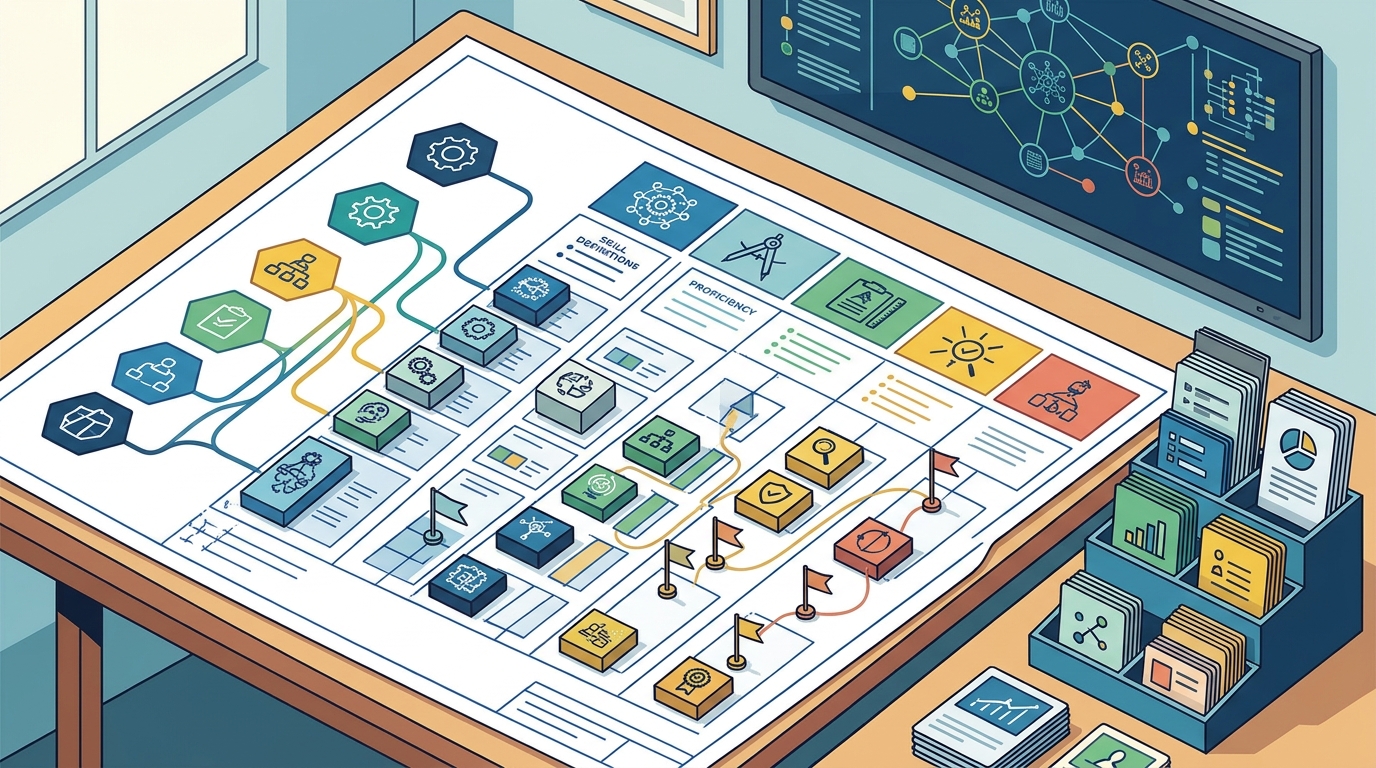
Turn data into a strategic view. A comprehensive skills map is a visual representation of the organization's capabilities. It should allow leaders to see skill density, critical gaps, and potential risks at a glance. This visualization helps in identifying single points of failure, where only one or two people possess a critical skill, and helps in planning for succession and continuity.
7. Integrate the Map into Talent Decisions
Use the map to drive action, not just observation. The final step is to connect the skills map to talent actions such as training, hiring, and internal mobility. The map should inform which employees need upskilling, which roles require external hiring, and who is ready for promotion. By integrating the map into the decision-making process, the organization ensures that talent development is aligned with strategic priorities.
Choosing the Right Approach
When selecting a method to build your skills map, prioritize accuracy and strategic alignment over speed. A map built quickly but inaccurately will lead to poor decisions. The Wise Skill’s approach ensures that the map is not just a snapshot, but a dynamic tool that evolves with your strategy and market conditions.
Frequently Asked Questions
How often should a skills map be updated?
A skills map should be reviewed at least annually, but ideally updated quarterly or whenever there are significant changes in business strategy or technology. Regular updates ensure that the map remains relevant and that gap analyses reflect the current state of the workforce.
What is the difference between a skills map and a skills matrix?
How can AI improve the creation of a skills map?
AI can automate the extraction of skills from job descriptions and resumes, suggest relevant skills for roles, and identify patterns in workforce data. It can also help in predicting future skill needs based on market trends, making the map more forward-looking.
Is it necessary to assess every employee for every skill?
No, it is not necessary to assess every employee for every skill. Focus on the critical skills that are essential for the business strategy. Assessing every skill for every employee is resource-intensive and often unnecessary. Prioritize based on strategic importance and potential impact. according to Workflow Management Online
How do you handle skills that are not in the standard taxonomy?
Standard taxonomies may not cover every niche or emerging skill. It is important to have a process for adding custom skills to the taxonomy when needed. This ensures that the map remains comprehensive and relevant to the specific needs of the organization.