
Organizations that tightly integrate their learning initiatives with core business objectives see a 24% higher return on investment compared to those that treat training as an isolated function. This statistic highlights a critical shift in modern corporate strategy. Learning and development can no longer be viewed as a soft perk. It must be a hard driver of revenue, efficiency, and competitive advantage. Companies that fail to make this connection often struggle with low engagement and wasted budgets. The Wise Skill provides the framework to ensure every training dollar contributes directly to your bottom line.
Understanding the Alignment Gap
Many companies suffer from a disconnect between what they teach and what they need. This gap often arises because training departments operate in silos. They design courses based on what is easy to build rather than what is critical for growth. This approach leads to content that is irrelevant to daily operations. Employees feel the training is a box-checking exercise. Managers see no improvement in team performance. The result is a cycle of disengagement and wasted resources.
Alignment requires a fundamental shift in perspective. Training must start with the business problem, not the learning solution. If a sales team is missing quotas, the issue might not be a lack of product knowledge. It could be a failure in negotiation skills or CRM usage. Identifying the root cause is the first step. The Wise Skill helps organizations diagnose these specific pain points before designing any curriculum. This ensures that every module addresses a tangible business need.
When training aligns with goals, it becomes a strategic asset. It accelerates onboarding for new hires. It upskills existing staff to handle complex tasks. It reduces errors and rework. Most importantly, it creates a workforce that is agile and responsive to market changes. This agility is essential in today's fast-paced economic environment. Companies that master this alignment outperform their peers in both revenue growth and employee retention.
The Strategic Audit Methodology
Before implementing any new training program, you must conduct a thorough strategic audit. This process involves mapping current business objectives to specific skill gaps. Start by reviewing your company's annual goals. Are you expanding into new markets? Are you launching a new product line? Are you trying to improve customer satisfaction scores? Each of these goals requires a specific set of competencies.
Next, assess the current capabilities of your workforce. Use performance data, manager feedback, and self-assessments to identify where the gaps lie. For example, if customer satisfaction is low, analyze support ticket data. Look for common complaints. Do customers mention slow response times? Do they complain about technical inaccuracies? These insights will tell you exactly what skills need to be developed.
Once you have identified the gaps, prioritize them based on business impact. Not all skills are created equal. Focus on the competencies that will have the highest return on investment. This prioritization ensures that your training budget is spent wisely. It also signals to employees that their development is tied to the company's success. This clarity boosts motivation and engagement. For more insights on effective recruiting and training strategies, visit The Wise Skill blog.
Designing Targeted Curricula
With the gaps identified, you can now design targeted curricula. Effective training is not one-size-fits-all. It must be tailored to the specific roles and responsibilities of the learners. A sales representative needs different training than a software engineer. Even within the same department, different levels of seniority require different content. Junior staff might need foundational skills, while senior staff need advanced strategic thinking.
Use a mix of learning modalities to keep engagement high. Microlearning modules are excellent for reinforcing specific concepts. Live workshops are ideal for complex problem-solving and collaboration. Self-paced online courses allow for flexibility. The key is to ensure that every modality supports the learning objective. Avoid adding content just for the sake of filling time. Every minute of training should have a clear purpose.
Integrate real-world scenarios into the training. Case studies from your own company are particularly powerful. They help employees see the direct application of what they are learning. This contextual learning improves retention and transfer to the job. It also makes the training more relevant and interesting. When employees see how their learning solves actual problems, they are more likely to apply it. This is the core philosophy behind The Wise Skill approach to organizational development.
Measuring Training ROI
Measuring the return on investment of training is often challenging but essential. You must move beyond simple completion rates and satisfaction surveys. These metrics tell you if people liked the training, not if it worked. To measure true impact, you need to track behavioral change and business results. This requires a structured evaluation framework.
Start with the Kirkpatrick Model, which evaluates training at four levels. Level one is reaction, which covers satisfaction. Level two is learning, which assesses knowledge acquisition. Level three is behavior, which looks at on-the-job application. Level four is results, which measures the impact on business goals. Focusing on levels three and four provides the most valuable insights. It connects training directly to performance.
Use key performance indicators to track progress. If the goal was to improve sales, track conversion rates before and after training. If the goal was to reduce errors, track defect rates. Compare these metrics against a control group if possible. This comparison helps isolate the impact of the training from other factors. It provides a clear picture of the training's effectiveness. For a deeper dive into these metrics, check out our FAQ section.
Technology Enablers for Scale
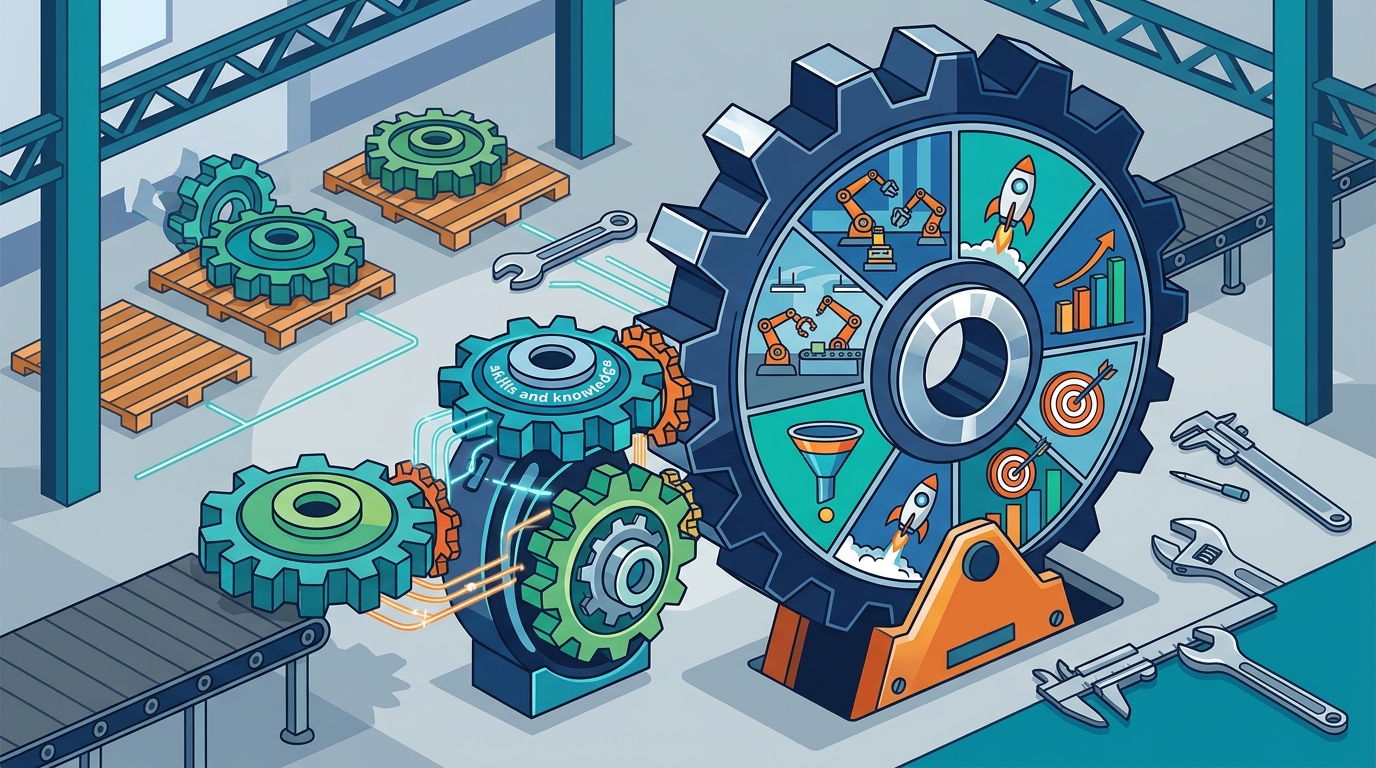
Technology plays a crucial role in aligning training with business goals at scale. Learning Management Systems (LMS) provide the infrastructure for delivering and tracking content. They allow you to automate assignments based on role or performance data. This ensures that the right people get the right training at the right time. It also provides a centralized repository for all learning assets.
Analytics dashboards are another powerful tool. They provide real-time visibility into training progress and outcomes. Managers can see which teams are lagging and intervene early. Leadership can see the aggregate impact of training initiatives on business metrics. This data-driven approach allows for continuous improvement. You can identify what works and what does not, and adjust accordingly.
Consider integrating your LMS with your HR and CRM systems. This integration allows for seamless data flow. For example, you can automatically trigger training when an employee is promoted. You can also link training completion to performance reviews. This creates a closed-loop system where learning and performance are tightly coupled. To see how this works in practice, schedule a demo of our integrated solutions.
Key Takeaways
- Training aligned with business goals yields a 24% higher ROI than isolated programs.
- Start with a strategic audit to identify specific skill gaps relative to company objectives.
- Prioritize training initiatives based on their potential impact on revenue and efficiency.
- Use the Kirkpatrick Model to measure training effectiveness beyond simple satisfaction.
- Integrate learning technologies with HR and CRM systems for seamless data flow.
- Tailor content to specific roles and use real-world scenarios for better retention.
- Continuous feedback loops are essential for adapting training to changing business needs.
Frequently Asked Questions
How do I prove the value of training to executive leadership?
Focus on business outcomes rather than learning activities. Present data on how specific training initiatives improved key metrics such as sales conversion, error reduction, or customer satisfaction. Use case studies from your own organization to demonstrate tangible results.
What is the best way to identify skill gaps in my team?
Conduct a skills audit by comparing current employee competencies against the requirements of their roles and future business goals. Use performance reviews, manager feedback, and self-assessments to gather comprehensive data.
How often should training programs be updated?
Training content should be reviewed and updated at least annually, or whenever there is a significant change in business strategy, technology, or regulatory requirements. Continuous updates ensure relevance and effectiveness.
Can small businesses afford to align training with business goals?
Yes, small businesses can and should align training with goals. Start with low-cost, high-impact initiatives such as peer-to-peer learning or targeted microlearning. The key is to focus on the most critical skills that drive immediate business value.
What role does leadership play in training alignment?
Leadership must champion the alignment effort by setting clear expectations and providing resources. They should also participate in training and model the desired behaviors. Their involvement signals the importance of learning to the rest of the organization.
How do I handle resistance to new training programs?
Address resistance by communicating the benefits of the training to employees. Show them how it will help them achieve their own career goals and make their jobs easier. Involve them in the design process to increase buy-in and ownership.
What metrics are most important for measuring training success?
The most important metrics are those that link training to business results. These include changes in performance indicators, revenue impact, cost savings, and employee retention rates. Avoid relying solely on completion rates or satisfaction scores.
Next Steps
Aligning employee training with business goals is not a one-time project. It is an ongoing process that requires commitment and continuous improvement. Start by conducting a strategic audit of your current training programs. Identify the gaps and prioritize the initiatives that will have the greatest impact. Then, design targeted curricula that address these gaps. Measure the results and adjust as needed.
Do not let your training efforts drift away from your business objectives. Take control of your learning strategy today. Visit thewiseskill.com to learn more about our comprehensive solutions. Book a demo to see how we can help you align your workforce with your goals.